
EZ Bar vs Straight Bar: Space Layouts & Frontal Raises Dumbbell Guide
Compare EZ curl bar vs straight bar footprints for small home gyms. Discover storage layouts, space ROI, and dumbbell frontal raises alternatives.

Designing a high-performance home gym in a constrained footprint—whether it is a 10x10 apartment bedroom, a low-clearance basement, or a narrow garage bay—requires ruthless prioritization of equipment. When outfitting a compact space for upper-body hypertrophy and strength, lifters inevitably face a critical spatial dilemma: should you invest in a standard 7-foot straight barbell or a compact EZ curl bar?
While most fitness guides compare these bars strictly through the lens of wrist biomechanics, space optimization demands a different framework. We must evaluate storage geometry, loadable sleeve limits, and how your barbell choice impacts the rest of your equipment layout. Furthermore, if you sacrifice a full dumbbell rack to save floor space, you must strategically address isolation movements like the anterior deltoid-focused dumbbell frontal raises. Here is the definitive 2026 guide to integrating the right barbell into your compact gym layout.
The Spatial Footprint: Straight Bar vs. EZ Curl Bar Dimensions
Before analyzing biomechanics, we must look at the raw geometry. A standard Olympic straight barbell dictates the minimum width of your power rack and the clearance required for horizontal wall storage. Conversely, an EZ curl bar offers a drastically reduced footprint but introduces severe limitations in plate loading and exercise versatility.
| Specification | Standard Olympic Straight Bar (e.g., Rogue Ohio) | Olympic EZ Curl Bar (e.g., Rogue Curl Bar) |
|---|---|---|
| Total Length | 84 inches (7 ft) | 47 to 52 inches |
| Bar Weight | 20 kg (44 lbs) | 15 kg (33 lbs) average |
| Loadable Sleeve | 16.4 inches per side | 10.5 inches per side |
| Max Bumper Plates (45lb) | 5+ per side | 2 per side (width restricted) |
| Min. Horizontal Storage | 86 inches wall clearance | 50 inches wall clearance |
| Avg. 2026 Price | $295 - $325 | $225 - $275 |
As highlighted in comprehensive equipment breakdowns by BarBend's barbell comparison guides, the EZ bar's shorter sleeves are a major bottleneck for heavy compound lifts. If your space optimization strategy involves doing heavy barbell rows or floor presses, the EZ bar's 10.5-inch sleeve will physically run out of room before you reach advanced loading thresholds.
Layout Design: Integrating Barbells into Compact Rooms
How you store the barbell when it is not in use will dictate the flow of your small gym. In a 100-square-foot room, leaving a barbell on the floor is a tripping hazard and ruins the functional layout.
The Drop-Ceiling Edge Case
Many home gyms are located in finished basements with drop ceilings or exposed HVAC ducting. While a standard US ceiling is 96 inches (8 feet), basement clearances frequently drop to 82 or 84 inches. A 7-foot straight barbell requires at least 86 inches of vertical clearance to be stored safely in a vertical barbell caddy or wall-mounted vertical holster. If your ceiling is under 85 inches, vertical storage of a straight bar is impossible. You are forced to use horizontal wall hooks (requiring 8 feet of unbroken wall space) or store it horizontally on the J-cups of your squat rack, which monopolizes your primary lifting station.
The EZ curl bar, measuring under 4 feet, completely bypasses this architectural limitation. It can be stored vertically in a corner caddy, hung on a single heavy-duty wall hook, or even slid under an adjustable weight bench, keeping your primary walking paths entirely clear.
Storage Hardware Recommendations
- For Straight Bars: Rogue Wall Mount Bar Holders ($45/pair). Requires stud-mounting into 2x4 framing to support the dynamic load of a barbell sliding in and out.
- For EZ Bars: Vertical A-Frame Barbell Racks. Because the EZ bar is shorter and lighter, a freestanding vertical rack can be tucked into a 2x2 foot corner dead-space without tipping risks.
The Versatility Gap: Curling, Pressing, and Dumbbell Frontal Raises
Space optimization often forces lifters to abandon a full tiered dumbbell rack (which can consume 20+ square feet of floor space) in favor of a barbell and a single pair of adjustable dumbbells. This creates a critical gap in shoulder isolation programming.
If you rely solely on a straight barbell for upper-body work, you can perform overhead presses and upright rows. However, for targeted anterior deltoid hypertrophy, the dumbbell frontal raises movement remains the biomechanical gold standard. Attempting to replicate this with a straight barbell (barbell front raises) forces your wrists into a fixed, fully pronated position at a width that often causes shoulder impingement for lifters with limited thoracic mobility.
According to biomechanics analyses featured on Rogue Fitness's equipment engineering pages, the angled grips of an EZ bar allow for semi-supinated wrist positions, which are excellent for biceps curls and triceps skull-crushers, but entirely useless for frontal raises. Therefore, if your space-saving layout eliminates a full dumbbell wall, you must allocate budget and a small 2x2 foot storage footprint for a high-quality adjustable dumbbell set (like the Nuobell 80lb or PowerBlock Pro) specifically to preserve your ability to perform frontal raises and lateral raises safely.
"When designing a micro-gym, never sacrifice joint health for square footage. If you lack the space for a full dumbbell set, a single pair of adjustable dumbbells is mandatory for isolation work like frontal raises, while your barbell selection should be dictated by your ceiling height and rack width."
— Home Gym Layout & Ergonomics Principles
Cost vs. Space ROI: Which Bar Wins the Small Gym?
If your budget and space only allow for one barbell, the straight bar is the undisputed king of ROI. A 7-foot Olympic barbell enables squats, deadlifts, bench presses, barbell rows, and overhead presses. The EZ curl bar is strictly an accessory implement. However, if you already own a straight bar and are looking to add a secondary barbell to your rack without cluttering your floor, the EZ curl bar is the ultimate space-efficient addition for arm-focused hypertrophy days.
Step-by-Step Small Gym Zoning Strategy
To maximize a 10x10 room, follow this spatial zoning protocol:
- Zone 1 (The Anchor): Place your power rack or squat stand against the longest unbroken wall. Ensure 24 inches of clearance behind the uprights for plate loading.
- Zone 2 (Vertical Storage): Mount horizontal barbell hooks on the adjacent wall, exactly 60 inches from the floor, allowing the straight bar to clear the floor without interfering with a bench.
- Zone 3 (The Accessory Corner): Dedicate a 2x2 foot corner for a vertical EZ bar caddy and a pair of adjustable dumbbells. This keeps your isolation tools (for curls, triceps extensions, and dumbbell frontal raises) out of the primary walking path.
- Zone 4 (Plate Management): Use a vertical plate tree rather than a horizontal plate post on the rack. This reclaims 12-18 inches of lateral space inside the rack, making bench press entries and exits safer in tight rooms.
Frequently Asked Questions
Can I use an EZ curl bar for bench pressing to save space?
While physically possible, it is highly discouraged. The cambered grips of an EZ bar force your wrists and elbows into unnatural angles during a pressing motion, drastically increasing the risk of elbow tendinopathy and shoulder impingement. Stick to a straight bar for pressing, and use the EZ bar strictly for arm isolation.
How much weight can an EZ curl bar hold compared to a straight bar?
Most high-quality Olympic EZ bars (like those from Rogue or CAP Barbell) have a tensile strength rating that supports 300 to 400 lbs. However, the physical limitation is the sleeve length. Because standard 45lb bumper plates are roughly 3 inches wide, you can only fit two per side on an EZ bar before running out of sleeve space, capping your practical load at around 225 lbs including the bar.
What is the best adjustable dumbbell for small spaces?
For tight layouts where you need to quickly transition between heavy presses and lighter dumbbell frontal raises, the PowerBlock Elite series offers the most compact, blocky footprint, easily sliding under a bench or into a tight corner rack without the protruding handles found on dial-style adjustable dumbbells.
More gear to consider
All reviews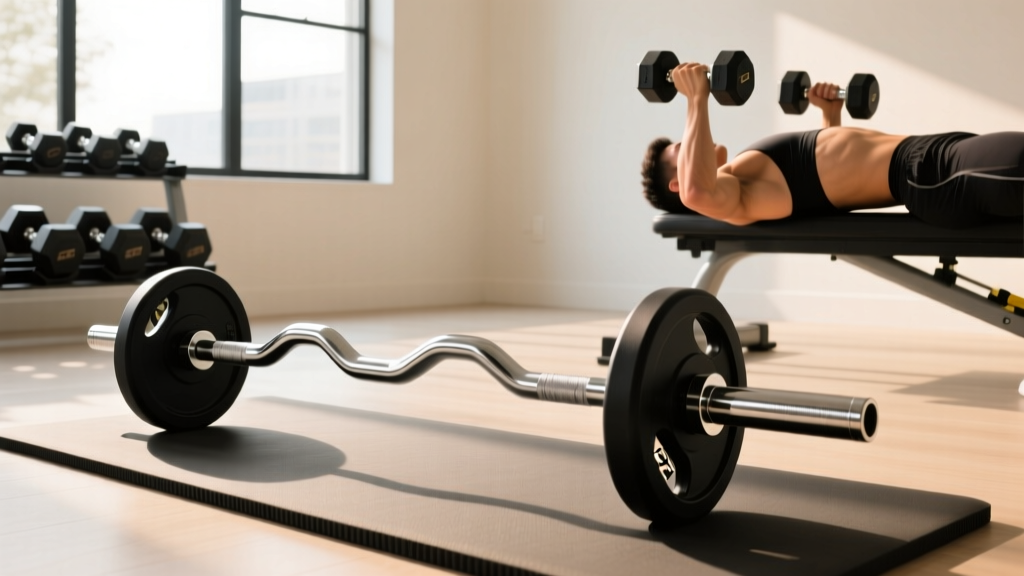
EZ vs Straight Bar Care & Correct Form for Dumbbell Bench Press

Olympic vs Standard: Back Exercises with Dumbbells and Barbells

Power Rack vs Squat Rack vs Stand: Alternating Dumbbell Shoulder Press

Home Gym Setup: Neoprene Dumbbells & Dumbbell Clips

Preacher Curls with Dumbbells: 2026 Adjustable Comparison
