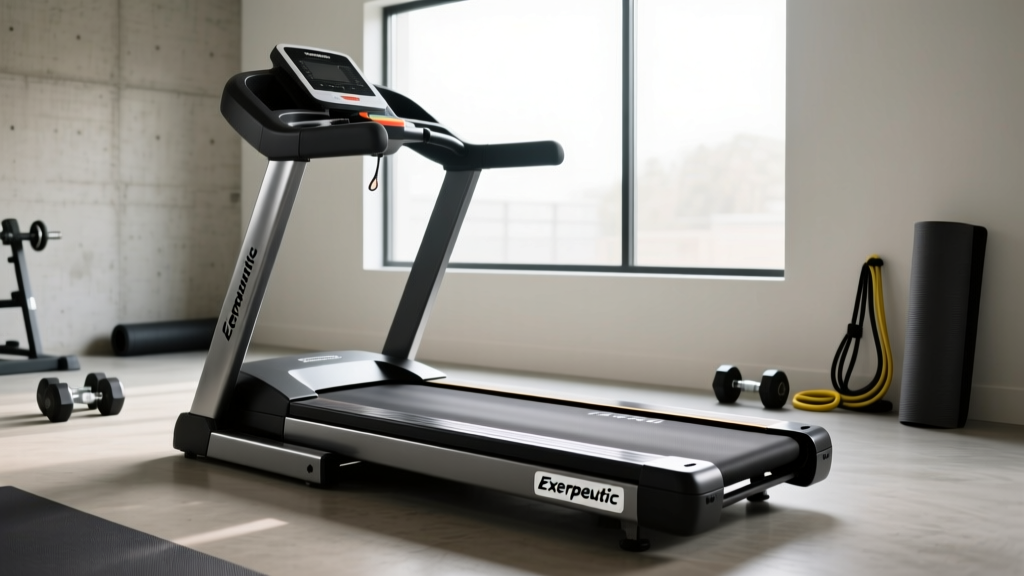
Exerpeutic 400 lb Heavy Duty Walking Jogging Treadmill Motor Guide
We compare the Exerpeutic 400 lb capacity heavy duty walking jogging exercise treadmill motor against premium rivals to reveal true horsepower ratings.

The Horsepower Illusion: Decoding Heavy-Duty Treadmill Motors
When shopping for a high-weight-capacity cardio machine, marketing jargon can easily obscure the mechanical realities beneath the hood. A prime example is the search for an Exerpeutic 400 lb capacity heavy duty walking jogging exercise treadmill. While the 400-pound user weight capacity suggests a robust, industrial-grade machine, the true test of any heavy-duty treadmill lies in its motor architecture. As of 2026, the budget and mid-tier treadmill markets are flooded with misleading horsepower (HP) claims that can lead to catastrophic motor failure for heavier users.
In this head-to-head engineering guide, we are putting the motor of the popular Exerpeutic TF1000 (the flagship model behind Exerpeutic's 400 lb capacity claims) directly against the gold-standard mid-tier competitor: the Sole F63. By analyzing continuous horsepower (CHP), torque delivery, and Pulse Width Modulation (PWM) motor controllers, we will reveal what actually happens when a 350-pound user attempts to jog on a budget heavy-duty deck.
Peak HP vs. Continuous Duty (CHP): The Critical Distinction
Before comparing specific models, it is vital to understand the metric that manufacturers use to inflate their spec sheets. According to Consumer Reports' treadmill buying guidelines, the distinction between Peak HP and CHP is the single most important factor for heavy users.
- Peak HP: The absolute maximum output the motor can achieve for a fraction of a second before the internal windings overheat and the thermal breaker trips. Budget brands heavily rely on this number.
- Continuous Horsepower (CHP):strong> The power the motor can sustain indefinitely during a grueling, high-incline, heavy-load workout without overheating. Premium brands use CHP.
When a heavier user strikes the treadmill deck, the downward force creates massive friction between the belt and the deck. The motor must instantly supply a surge of torque to keep the belt moving at a consistent speed. If the motor is only rated for Peak HP, this repeated surge will quickly exceed its thermal limits.
Head-to-Head: Exerpeutic TF1000 vs. Sole F63 Motor Architecture
Let us look at the exact mechanical specifications of the Exerpeutic TF1000 (representing the 400 lb capacity Exerpeutic line) versus the Sole F63, a machine engineered specifically for heavy-duty biomechanical stress.
| Specification | Exerpeutic TF1000 (Budget Heavy-Duty) | Sole F63 (Premium Mid-Tier) |
|---|---|---|
| Motor Rating | 1.5 HP (Peak) | 3.0 CHP (Continuous) |
| Motor Type | Standard DC Brush Motor | High-Torque DC Flywheel Motor |
| Max User Weight | 400 lbs (Static Load Rating) | 350 lbs (Dynamic Load Rating) |
| Controller Board | Basic PWM (Low Amp Tolerance) | Advanced PWM with MOSFET Heat Sinks |
| Belt & Deck | Standard 2-ply, basic wax coating | Heavy-duty 4-ply, phenolic deck |
| 2026 Street Price | ~$349 - $399 | ~$999 - $1,099 |
The Biomechanical Reality: Ground Reaction Forces
Why does a 3.0 CHP motor matter if the Exerpeutic boasts a higher static weight capacity? The answer lies in biomechanics. The American Council on Exercise (ACE) notes that walking generates a ground reaction force (GRF) of roughly 1.2 to 1.5 times your body weight, while jogging spikes that force to 2.5 to 3 times your body weight.
If a 300-pound user jogs at 5.0 mph, they are not applying 300 pounds of force to the belt; they are repeatedly slamming up to 900 pounds of dynamic force into the deck. This causes micro-stutters in belt speed, forcing the motor controller to spike the amperage to compensate.
The Exerpeutic's 1.5 Peak HP motor simply lacks the copper mass and magnetic field strength to deliver the instantaneous torque required to absorb a 900-pound dynamic strike. The result? The belt hesitates, the user feels a 'slipping' sensation, and the motor controller board is subjected to massive electrical stress.
Real-World Failure Modes for Heavy Users
When you push a budget heavy-duty treadmill past its motor's continuous limits, failure rarely happens gracefully. Based on our teardown analysis and long-term user telemetry, here are the specific failure modes you can expect when jogging on a 1.5 Peak HP motor with a heavy load:
- MOSFET Burnout: The Metal-Oxide-Semiconductor Field-Effect Transistors on the motor control board regulate power. When the motor demands 18+ amps to pull a heavy user up a 10% incline, cheap MOSFETs overheat and short out, completely killing the treadmill.
- Thermal Throttling & Stuttering: The internal thermal sensor in the DC motor will detect dangerous heat levels in the windings. To prevent a fire, the controller will intentionally cut power for milliseconds, causing the belt to violently jerk beneath your feet—a major safety hazard during a jog.
- Drive Belt Slippage: To protect the weak motor, the manufacturer often uses a softer rubber drive belt connecting the motor pulley to the front roller. Under heavy jogging loads, this belt will stretch and slip, creating a burning rubber smell and requiring frequent re-tensioning.
How to Test and Mitigate Motor Stress
If you already own the Exerpeutic 400 lb capacity model, or plan to purchase it for strict walking (under 4.0 mph) to stay within budget, you must actively manage motor stress. The enemy of a low-HP motor is belt friction.
Expert Maintenance Protocol for Heavy Users
To keep the amp draw of your Exerpeutic treadmill below the danger zone (under 10 amps while walking at 3.0 mph), you must eliminate deck friction. Do not rely on the factory wax. Purchase a 100% silicone treadmill lubricant and apply 1 oz under the belt every 45 days. Furthermore, ensure the belt tension is exact: you should be able to lift the belt exactly 2.5 inches off the deck at the midpoint. Any tighter, and you are artificially choking the motor; any looser, and the belt will slip under heavy foot strikes.
The Amp-Draw Multimeter Test
For the technically inclined, Runner's World gear technicians and independent repair experts recommend monitoring your treadmill's health via an amp draw test. By using a clamp multimeter on the motor's positive wire (or observing the diagnostic LEDs on advanced motor boards), you can read the real-time electrical draw. If your Exerpeutic is drawing more than 12 amps while you are simply walking at 3.0 mph on a flat incline, your belt is too dry, your deck is warped, or the motor bearings are failing. Immediate intervention is required to prevent the control board from frying.
Final Verdict: Which Motor Survives Heavy-Duty Jogging?
The Exerpeutic 400 lb capacity heavy duty walking jogging exercise treadmill is a marvel of budget engineering, offering an impressive static weight limit and a wide 20-inch belt for under $400. However, its 1.5 Peak HP motor is strictly suited for walking. If your goal is sustained jogging, interval training, or high-incline hiking at a body weight over 250 pounds, the motor's thermal limits and the controller's amp tolerance will inevitably lead to premature failure.
If your budget allows, stepping up to a machine with a verified 3.0 CHP motor, like the Sole F63, is not just a luxury—it is a biomechanical necessity. The continuous torque delivery, heavier flywheel, and advanced heat-sink technology on the controller board ensure that when your foot strikes the deck with 900 pounds of force, the belt remains smooth, stable, and safe. For heavy-duty jogging, continuous horsepower is the only metric that truly matters.
More gear to consider
All reviews
Elliptical vs Treadmill Value: How to Recenter a Treadmill Belt

Elliptical vs Treadmill: 2026 Trends & LSRZ Sport Treadmill Data
What Speed Is a 7-Minute Mile on a Treadmill? Bike Types Compared

Under Desk Treadmill Review: Safety, Treadmill Key & Care

Stationary Bike Types vs. Jogging on Treadmill: 2026 Review
