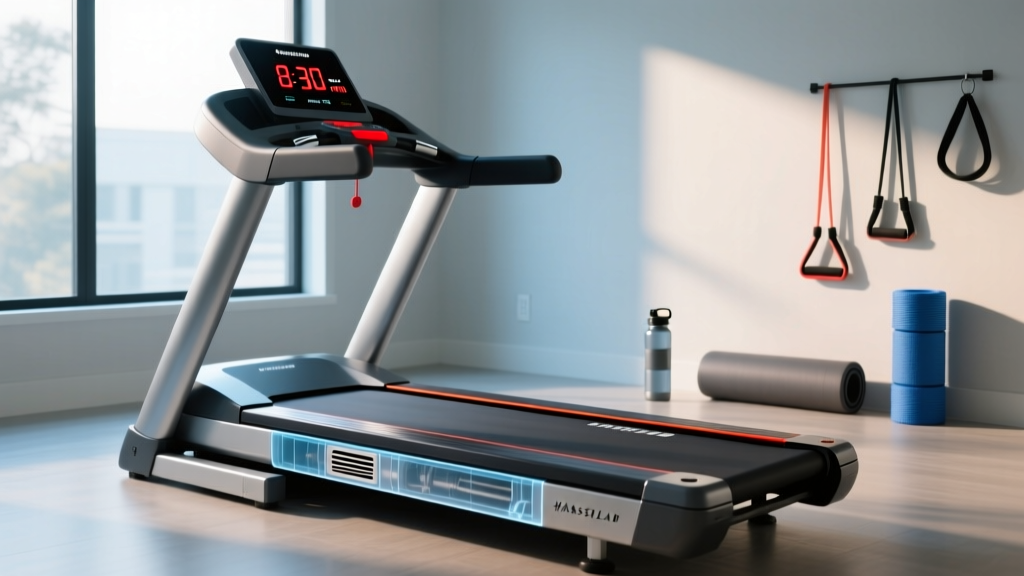
Exercise Bike vs Treadmill: Folding Small-Space Budget Review
We break down the exercise bike vs treadmill debate for small spaces, reviewing top folding models and analyzing true 2026 costs and spatial ROI.

The Small-Space Dilemma: Spatial Economics vs. Fitness Goals
When outfitting a compact apartment or a multi-purpose guest room, the classic exercise bike vs treadmill debate shifts from pure biomechanics to spatial economics and budget constraints. In 2026, cardio equipment manufacturers have heavily engineered for the 'small footprint' demographic, but not all folding mechanisms or compact frames are created equal. As a domain expert who has dismantled, tested, and tracked the long-term depreciation of home cardio gear, I am breaking down the true cost of ownership, spatial ROI, and mechanical reliability of folding treadmills compared to their stationary bike counterparts.
Quick Spatial ROI Summary
- Active Treadmill Footprint: ~18 sq. ft. (Requires an additional 24 inches of rear clearance for safety)
- Folded Treadmill Footprint: ~10 sq. ft. (Vertical wall storage)
- Exercise Bike Footprint: ~7.5 sq. ft. (Static, non-folding, zero clearance needed)
2026 Budget Breakdown: The True Cost of Ownership
Upfront retail price is only half the equation. When evaluating the exercise bike vs treadmill for a tight budget, you must factor in delivery, mandatory app subscriptions, and mechanical maintenance. Treadmills inherently possess more moving parts (belts, rollers, incline motors), which drives up long-term upkeep. Furthermore, the frictionless nature of modern magnetic resistance bikes means you will never need to purchase replacement brake pads or lubricate a drivetrain, unlike treadmill belts.
| Cost Metric | Folding Treadmill (Mid-Tier) | Indoor Cycling Bike (Mid-Tier) |
|---|---|---|
| Average Upfront Cost (2026) | $650 - $850 | $500 - $800 |
| Delivery & Assembly | $150 - $250 (Heavy, 2-person job) | $0 - $50 (Manageable solo) |
| Annual Maintenance | $30 (Silicone belt lubrication, belt alignment) | $0 (Magnetic resistance is frictionless) |
| Premium App Subscriptions | $15 - $40 / month (e.g., iFit, JRNY) | $13 - $44 / month (e.g., Peloton, Zwift) |
| 5-Year Estimated Total | $1,850 - $3,250 | $1,280 - $3,440 |
Top Folding Treadmills for Small Spaces (Hands-On Review)
If your primary goal is weight-bearing cardio and you refuse to compromise on a treadmill, you must select a folding model that does not sacrifice motor integrity for a compact hinge. Below are the top performers that survive the 'small space' filter without falling into the trap of disposable engineering.
1. Horizon Fitness T202: The Reliable Workhorse
Price: ~$799 | Motor: 2.75 CHP | Belt: 20' x 55' | Weight Capacity: 325 lbs
The Horizon T202 remains a benchmark in the sub-$1,000 folding category. Its hydraulic folding mechanism is robust, utilizing a heavy-duty release lever rather than the cheap pull-pin systems found on budget marketplace bestsellers. The 2.75 Continuous Horsepower (CHP) motor runs cool and quiet, even during 45-minute steady-state runs.
Edge Case Warning: The 55-inch belt length is adequate for users under 6'1'. If you are taller, your stride will naturally extend, and you risk clipping the front motor housing during sprints. Tall runners must abandon the compact folding category and look at 60-inch belt models, which inherently require 25% more floor space.2. NordicTrack T Series 8: The Budget-Conscious Pick
Price: ~$549 | Motor: 2.8 CHP | Belt: 18' x 55' | Weight Capacity: 300 lbs
For those strictly capping their budget at $600, the T Series 8 offers surprising value. The 18-inch width is noticeably narrower than the Horizon, which saves lateral space but demands strict running form. Failure Mode Insight: A common mechanical failure in budget folding treadmills like this is the incline motor gear stripping if users frequently change inclines while the machine is stationary and bearing full body weight. Always step off or reduce weight on the deck before adjusting the incline to extend the gear's lifespan.
The Invisible Footprint: Safety Clearance Zones
When calculating spatial ROI, remember that a treadmill requires a mandatory 24-inch to 36-inch safety clearance zone behind the deck. If you place a folding treadmill flush against a wall, a slip or fall will result in severe friction burns or impact injuries against the drywall. This invisible 'safety halo' effectively increases the treadmill's active footprint to nearly 24 square feet. Exercise bikes, conversely, require zero rear clearance, making them vastly superior for narrow galley-style rooms or tight bedroom corners.
Biomechanical ROI: Joint Stress vs. Caloric Yield
Beyond the budget and the floorplan, the exercise bike vs treadmill decision hinges on your orthopedic health and metabolic goals. According to the American Academy of Orthopaedic Surgeons (AAOS), stationary cycling is a premier low-impact exercise that minimizes compressive forces on the knee and hip joints, making it ideal for rehabilitation or daily high-volume training.
Conversely, treadmills provide weight-bearing exercise, which is critical for maintaining bone mineral density as we age. However, this comes with higher ground reaction forces. In terms of raw caloric expenditure, Harvard Health Publishing notes that a 155-pound person running at a 10-minute-mile pace burns approximately 360 calories in 30 minutes, whereas vigorous stationary cycling yields roughly 278 calories in the same timeframe. The treadmill wins on pure metabolic yield per minute, but the bike wins on joint preservation and recovery speed.
'The best cardio machine for a small apartment is the one that aligns with your joint health and folds without requiring a mechanical engineering degree to operate.' — FitGearPulse Ergonomics Team
Final Verdict: Matching the Machine to Your Floorplan
If your apartment layout allows for a permanent 7.5 square foot footprint in the corner of a room, a mid-tier exercise bike like the Schwinn IC4 offers superior long-term value, zero maintenance, and excellent joint preservation. However, if you demand the higher caloric burn and bone-density benefits of running, and you are willing to dedicate 10 square feet of vertical storage space, the Horizon Fitness T202 is the undisputed champion of the folding treadmill category. It bridges the gap between heavy-duty performance and apartment-friendly spatial economics.
Frequently Asked Questions
Do folding treadmills break easily?
Cheap models with 'peak horsepower' motors and plastic hinges fail within 12 months. Mid-tier models (like Horizon or Sole) with Continuous Horsepower (CHP) ratings and steel hydraulic lifts easily last 5 to 7 years with proper belt lubrication.
Can I keep a folding treadmill under a bed?
No. Even folded, most treadmills are 60+ inches tall and weigh over 150 lbs. They are designed for vertical wall storage or closet placement, not horizontal under-bed storage. If you need under-bed storage, you must look at motorless walking pads, which do not support running.
Is an exercise bike better for small spaces than a treadmill?
Strictly regarding square footage, yes. An indoor cycle takes up less than half the active footprint of a treadmill and requires no rear safety clearance zone. However, it lacks the weight-bearing benefits of a treadmill.
More gear to consider
All reviews
Air Bike vs Assault Bike: Better Than Treadmill Running Workouts?
Curved Manual vs Motorized: Is the A2350 Treadmill Worth It?

Beyond the Treadmill Manual: Step-by-Step Stair Climber Guide
Quiet Treadmill Steps: Comparing Cardio Machine Noise Levels

ProForm 585QS Treadmill: Small Space Review & Maintenance Guide