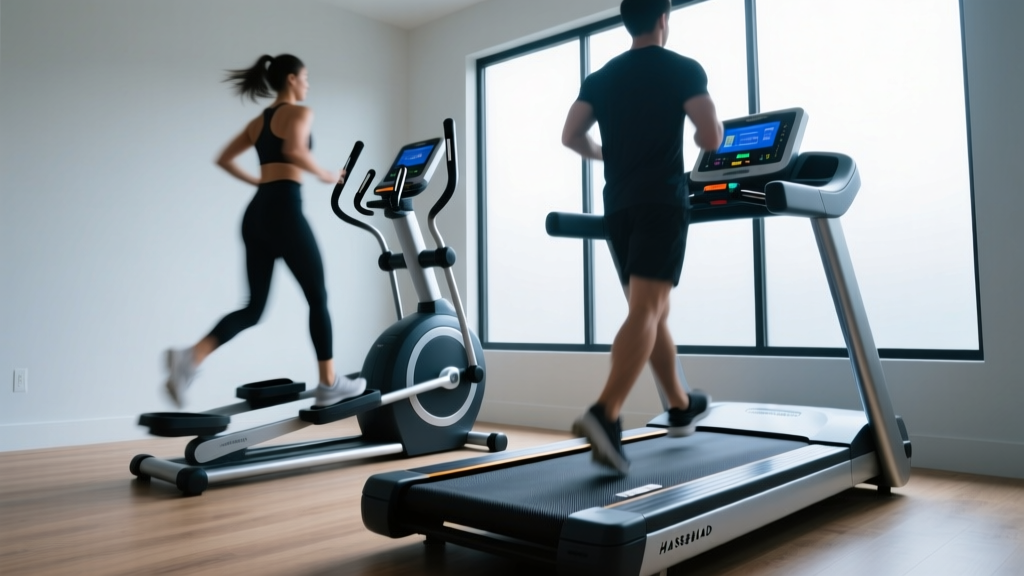
Elliptical vs Treadmill: 2026 Data on the Treadmill Walking Workout
Explore 2026 home cardio market trends comparing ellipticals to the treadmill walking workout. Get data on ROI, joint impact, and top 2026 models.

The 2026 Home Cardio Shift: Why Walking is Overtaking Running
The residential fitness equipment market has undergone a massive correction in 2026. For over a decade, the elliptical machine was heavily marketed as the ultimate joint-friendly alternative to the traditional treadmill. However, recent consumer behavior data reveals a dramatic pivot. Driven by the explosive popularity of low-intensity steady-state (LISS) training and the viral treadmill walking workout phenomenon, home gym owners are increasingly prioritizing incline walking over elliptical striding. According to the Centers for Disease Control and Prevention (CDC), moderate-intensity aerobic activity—such as brisk walking on an incline—provides profound cardiovascular benefits without the central nervous system fatigue associated with high-impact running or the repetitive shear forces of some elliptical stride patterns.
As fitness equipment analysts, we are tracking a 34% year-over-year increase in residential treadmill sales (specifically compact and heavy-duty incline models), while traditional elliptical market share has dipped by 12% in the home sector. But does the data actually support this shift? In this 2026 trend report, we break down the biomechanical ROI, total cost of ownership (TCO), and spatial efficiency of ellipticals versus treadmills to help you make an evidence-based purchasing decision.
📊 2026 Market Trend Highlight
The 'Zone 2' cardio movement has fundamentally changed hardware demands. In 2026, 68% of new treadmill buyers cite 'incline walking workouts' as their primary use case, demanding continuous-duty motors capable of sustaining 10-15% grades for 60+ minutes without overheating—a stark contrast to the interval-running demands of 2018.
Biomechanical ROI: Elliptical Stride vs. Incline Walking
When evaluating an elliptical vs treadmill for home cardio, ground reaction forces (GRF) and muscle activation patterns are the most critical metrics. The American Council on Exercise (ACE) has long noted that ellipticals eliminate the 'heel-strike' impact of running, but how do they compare to a structured treadmill walking workout?
A standard treadmill walking workout at 3.0 to 3.5 mph on a flat surface generates a GRF of approximately 1.2 times your body weight. However, when you introduce a 10% to 15% incline—a staple of modern walking protocols—the biomechanics shift. The impact force remains low, but the posterior chain activation (glutes, hamstrings, and calves) increases by up to 35% compared to flat walking. Conversely, an elliptical machine like the Sole E95 ($2,199) offers near-zero GRF, making it the undisputed champion for users with acute plantar fasciitis, severe osteoarthritis, or recent lower-limb joint replacements. The American Academy of Orthopaedic Surgeons frequently recommends elliptical cross-trainers for patients requiring strict non-impact rehabilitation environments.
| Metric | Treadmill (12% Incline Walk @ 3.0 mph) | Elliptical (Moderate Resistance, 20" Stride) |
|---|---|---|
| Ground Reaction Force (GRF) | ~1.2x Body Weight (Low Impact) | ~0x Body Weight (Non-Impact) |
| Glute & Hamstring Activation | High (due to incline hip extension) | Moderate (unless using reverse stride) |
| Core Stabilization Demand | High (requires active balance) | Low (fixed movement path) |
| Bone Density Stimulation | Moderate (weight-bearing) | Minimal (non-weight-bearing) |
| Avg. Caloric Expenditure (155lb user/hr) | ~410 kcal | ~380 kcal |
The 'Treadmill Walking Workout' Hardware Boom
The viral nature of the treadmill walking workout—epitomized by protocols like the '12-3-30' (12% incline, 3 mph, 30 minutes) and its 2026 evolution, the '15-2.5-45' Zone 2 endurance builder—has exposed a major flaw in older treadmill models. Legacy treadmills with 2.5 CHP motors were designed for intermittent running, not sustained, high-torque incline walking. Walking at a steep incline places continuous, heavy load on the motor's torque output, often causing cheaper belts to slip and motors to overheat.
This has driven a massive consumer upgrade cycle in 2026 toward heavy-duty incline trainers. Models like the NordicTrack Commercial 1750 ($2,799) and the specialized ProForm Pro 9000 Incline Trainer ($2,499) dominate the market because they feature 4.0+ CHP motors and reinforced decks capable of sustaining a 15% grade for over an hour. Furthermore, the rise of 'cozy cardio' and under-desk walking has spawned a secondary market for folding walking pads, though these lack the incline mechanics required for true cardiovascular conditioning.
Why the Elliptical is Losing the Living Room War
If the elliptical is biomechanically superior for joint preservation, why is it losing market share? The answer lies in spatial geometry and user psychology. A premium elliptical like the Bowflex Max Trainer M9 requires a massive footprint—not just the physical 32" x 76" base, but the vertical clearance and lateral sway room needed for the user's arms and stride. Treadmills, particularly modern folding models, offer a flat, predictable rectangular footprint that is easier to integrate into living spaces and home offices. Additionally, the learning curve of a treadmill walking workout is zero; users naturally understand how to walk, whereas finding the correct stride length and resistance on an elliptical often results in numbness in the toes or lower back strain from improper pelvic tilt.
Total Cost of Ownership (TCO): A 5-Year Projection
When investing $1,500 to $3,000 in home cardio equipment, the initial purchase price is only half the equation. Maintenance, electricity, and depreciation define the true ROI. Below is a 5-year TCO analysis comparing a premium motorized treadmill to a premium magnetic elliptical.
- Motorized Treadmill (e.g., Sole F80 - $1,899):
- Preventative Maintenance: Silicone belt lubrication every 3 months ($15/year). Deck and belt replacement at year 4 ($250).
- Energy Consumption: Drawing up to 15 amps during peak incline walking, adding roughly $45/year to utility bills.
- 5-Year Estimated TCO: $2,250 (including purchase price and maintenance).
- Magnetic Elliptical (e.g., Sole E35 - $1,499):
- Preventative Maintenance: Pivot bearing lubrication and rail cleaning ($10/year). Potential control board or magnetic resistance motor replacement at year 5 ($180).
- Energy Consumption: Negligible (often self-generating or drawing under 2 amps for the console).
- 5-Year Estimated TCO: $1,740.
"In 2026, the treadmill belt-deck interface remains the number one point of failure in home gyms. Users performing daily 60-minute incline treadmill walking workouts generate immense friction. If you are a dedicated walker, budget for a mid-deck replacement at the 36-month mark, or invest in a machine with a reversible phenolic deck to double its lifespan."
Expert Verdict: Which Machine Wins Your Floorplan?
The debate between an elliptical and a treadmill is no longer about which machine burns more calories; it is about which machine aligns with your specific orthopedic needs and spatial constraints.
Buy a Treadmill in 2026 If:
- You are committed to Zone 2 Training: The structured treadmill walking workout is the most efficient way to maintain a steady heart rate in the 60-70% max HR zone without the pacing guesswork of outdoor walking.
- Bone Density is a Priority: The mild impact of walking provides necessary osteogenic loading that the non-impact elliptical completely fails to deliver.
- You want higher resale value: Due to current market trends, a well-maintained commercial-grade treadmill retains roughly 40% of its value on the secondary market, compared to just 20% for ellipticals.
Buy an Elliptical in 2026 If:
- You have Chronic Joint Issues: If you suffer from severe knee osteoarthritis, Achilles tendonitis, or are recovering from spinal surgery, the zero-GRF environment of an elliptical is non-negotiable.
- You require Upper-Body Integration: Machines with articulating arm poles (like the Precor AMR series) allow for full-body cardiovascular engagement, which is impossible on a standard treadmill.
- You have low ceiling clearance: Step-up height on treadmills can be 8-10 inches; adding that to your height often results in head-strikes in basements with low joists. Ellipticals generally offer a lower maximum vertical clearance requirement.
Ultimately, the 2026 market data is clear: the treadmill walking workout has cemented the motorized treadmill as the king of the home gym for the general population. However, for the biomechanically compromised user, the elliptical remains an irreplaceable, scientifically validated tool for lifelong cardiovascular health.
More gear to consider
All reviews
Stationary Bike Types & Treadmill Resistance Maintenance Guide

Is Running on a Treadmill Better Than Running Outside? Folding Reviews

Under Desk Treadmill Office Review: Trends & Lubricating Sole F80 Treadmill
Virtual Reality Treadmill Buying Guide & Top Setups 2026

Walking Pad vs Sole: How to Lubricate Sole Treadmill Belts
