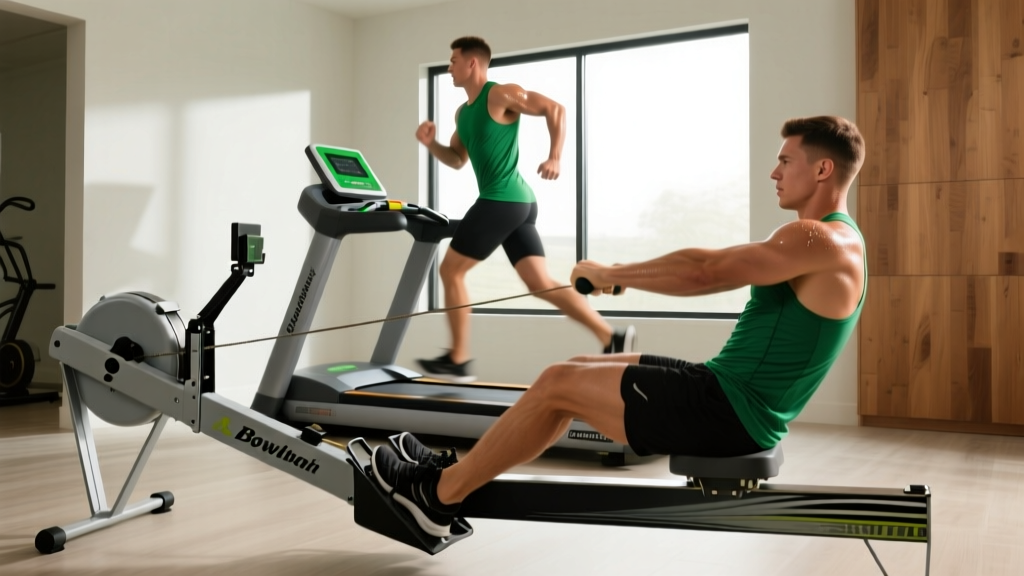
Bowflex Treadmill 7 vs Rowers: Buying Guide & Technique Mistakes
Transitioning from a Bowflex Treadmill 7 to a rowing machine? Explore our buying guide, fix common technique mistakes, and troubleshoot maintenance issues.

The Cardio Shift: Bowflex Treadmill 7 vs. Rowing Ergometers
The Bowflex Treadmill 7 has long been a staple in home gyms, offering a reliable 3.0 CHP motor, a 20-inch by 55-inch running belt, and a straightforward 0-12% incline range. Priced historically around the $1,299 mark, it is an excellent piece of equipment for dedicated walkers and moderate joggers. However, as fitness enthusiasts seek more comprehensive, low-impact cardiovascular conditioning, many are pivoting toward indoor rowing machines. While the Bowflex Treadmill 7 primarily targets the lower body and relies on gravitational impact, rowing ergometers engage up to 86% of the body's musculature per stroke, including the lats, rhomboids, core, and posterior chain.
According to the American Heart Association, adults should aim for at least 150 minutes of moderate-intensity aerobic activity per week. Rowing fulfills this requirement while simultaneously providing the resistance training benefits that a standard treadmill cannot. But making the switch from a treadmill to a rower introduces a steep learning curve. This guide serves as your definitive buying resource and troubleshooting manual for the most common technique and hardware mistakes made by former treadmill users.
Rowing Machine Buying Guide: Market Breakdown
When upgrading from a motorized treadmill to a rowing machine, the resistance mechanism is the most critical purchasing factor. Unlike the Bowflex Treadmill 7, where the motor dictates your pace, rowing machines rely on your physical output. Here is how the top 2026 models compare across resistance types, pricing, and footprint.
| Model | Resistance Type | Approx. Price | Footprint (L x W) | Best For |
|---|---|---|---|---|
| Concept2 Model D | Air | $990 | 95" x 24" | Data nerds, CrossFit, competitive rowers |
| Hydrow | Electromagnetic | $2,495 | 86" x 25" | Immersive coaching, silent operation |
| NordicTrack RW200 | Air / Magnetic Blend | $1,199 | 87" x 22" | Interactive classes with adjustable quiet resistance |
| Sunny Health SF-RW5613 | Water | $450 | 84" x 22" | Aesthetic appeal, soothing water audio feedback |
Understanding the Damper Setting Myth
The most pervasive buying mistake is assuming a higher damper setting equals a better workout. On air rowers like the Concept2, the damper (numbered 1 to 10) simply controls how much air enters the flywheel housing. According to Concept2's official training resources, a setting of 10 is akin to rowing a heavy, slow wooden boat, while a setting of 3 to 5 mimics the sleek, fast hull of an Olympic racing shell. For optimal cardiovascular transfer and lower back safety, aim for a Drag Factor between 100 and 130, which usually corresponds to a damper setting of 4 or 5.
Troubleshooting the 4 Most Common Rowing Technique Mistakes
Walking or jogging on a Bowflex Treadmill 7 is a natural, innate human movement. Rowing is a highly technical, sequenced skill. When treadmill users first sit on an ergometer, they inevitably default to flawed movement patterns. Here is how to troubleshoot the four most common errors.
Mistake 1: "Shooting the Slide"
The Error: You push with your legs, but your hips shoot backward while the handle remains stationary. Your knees extend before your arms and torso engage, placing massive shear force on the lumbar spine.
The Troubleshooting Fix: Perform the Pause-at-the-Catch Drill. Sit at the front of the slide (the catch position) and pause for two full seconds. Ensure your shins are vertical and your arms are straight. Initiate the drive by pressing your feet into the footplates, visualizing a steel rod connecting your hips to your hands. The handle and your shoulders must move backward at the exact same millisecond your knees begin to extend.
Mistake 2: The "Chicken Wing" Catch
The Error: As you reach forward to grab the handle, your elbows flare outward and upward, resembling chicken wings. This disengages the latissimus dorsi and shifts the load entirely to the vulnerable biceps tendons and anterior deltoids.
The Troubleshooting Fix: Focus on internal rotation and lat engagement. As you reach for the catch, actively depress your shoulder blades (pull them down toward your back pockets). Wrap your fingers loosely over the handle and pull your elbows down toward your ribs, not out to the sides.
Mistake 3: Over-Gripping and Blistering
The Error: Treadmill users are used to holding onto handrails or pumping their arms freely. On a rower, beginners tend to death-grip the handle, leading to severe forearm pump, callous tearing, and blisters within the first 10 minutes.
The Troubleshooting Fix: Adopt the Hook Grip. You do not need your thumb wrapped tightly around the handle. Simply hook your four fingers over the rubber grip, allowing your thumb to rest loosely alongside or slightly underneath. The handle should rest near the base of your fingers, not high up in the palm.
Mistake 4: Rushing the Recovery
The Error: The drive (the power phase) and the recovery (the return phase) are done at a 1:1 ratio. This leaves no time for the muscles to recover and ruins the rhythmic momentum of the flywheel.
The Troubleshooting Fix: The correct timing ratio is 1:2. The drive should be explosive and powerful (one beat), while the recovery should be slow, controlled, and deliberate (two beats). Use the mental cue: "Explode back, creep forward."
Expert Biomechanics Tip: The rowing stroke sequence is strictly Legs → Core → Arms on the drive, and Arms → Core → Legs on the recovery. If your sequence is broken, your power output will drop by up to 30%, regardless of your cardiovascular fitness on a treadmill.
Hardware Troubleshooting: Fixing Rower Maintenance Issues
Unlike the Bowflex Treadmill 7, which requires occasional belt lubrication and motor dusting, rowing machines have unique mechanical failure points. Here is how to troubleshoot common hardware anomalies.
Issue: Carriage Stuttering on the Rail
Diagnosis: If the seat roller wheels feel "bumpy" or stick slightly as you glide along the monorail, dust and skin cells have embedded themselves into the polyurethane wheels or the aluminum track.
The Fix: Never use WD-40 or abrasive scrubbers, which will destroy the track's anodized finish. Instead, spray a microfiber cloth with isopropyl alcohol (70% or higher) and wipe down the entire length of the monorail. Follow up by wiping the polyurethane seat wheels with a damp paper towel. Perform this weekly to maintain a frictionless glide.
Issue: Handle Retraction is Sluggish (Chain Sag)
Diagnosis: When you release the handle at the catch, it slowly droops or fails to snap back into the flywheel housing. This indicates the internal elastic bungee cord has lost tension or the chain needs lubrication.
The Fix: First, clean the chain with a paper towel and apply exactly three to four drops of 20-weight motor oil or purified mineral oil every 50 hours of use. Never use silicone spray or grease. If the handle still sags, locate the bungee adjustment screw on the rear of the flywheel housing (on models like the Concept2) and turn it clockwise by one-half inch to restore retraction tension.
Issue: Asymmetrical Foot Strap Pressure
Diagnosis: One foot consistently slips out of the foot cup, or you feel a burning sensation in one calf.
The Fix: Treadmill runners often have a dominant leg or a slight leg-length discrepancy. Adjust the footplate height so that the flex strap crosses exactly at the crease of your metatarsals (the ball of the foot), not over the toes or the mid-arch. Ensure the velcro straps are pulled with equal Newton-force; a loose strap on the drive phase causes micro-slippages that result in severe Achilles tendon strain.
Final Verdict: Making the Transition
Moving from a Bowflex Treadmill 7 to a rowing machine is one of the most effective upgrades you can make for joint longevity and full-body muscular endurance. However, the transition demands respect for the machine's technical requirements. By selecting a rower that fits your spatial and acoustic needs, intentionally practicing the pause-at-the-catch drill, and maintaining your monorail and chain with precise protocols, you will unlock a level of cardiovascular conditioning that a treadmill simply cannot provide. Treat the ergometer not just as a cardio device, but as a precision instrument of biomechanical power.
More gear to consider
All reviews
Side by Side Treadmill Feature Comparison & Buying Mistakes

Elliptical vs Treadmill: Life Fitness Treadmill Hands-On Review

ProForm XP Trainer 580 Treadmill Motor Guide: Horsepower Explained

Walking Pad Review: Setup for the 12 3 30 Treadmill Exercise

Beyond the Treadmill Meme: Head-to-Head Motor HP Guide
