Elliptical vs Treadmill Space Guide & Nordic Track Treadmills Reviews
Compare elliptical vs treadmill footprints for small spaces. Includes layout tips, ceiling clearance math, and recent Nordic Track treadmills reviews.

Designing a home gym in 2026 requires more than just picking the machine with the best digital display; it demands a rigorous approach to spatial geometry. When debating the elliptical vs treadmill for home cardio, most buyers focus on joint impact or calorie burn. However, from a layout design perspective, the decision hinges on three critical dimensions: raw floor footprint, vertical clearance, and operational safety buffers.
According to the Mayo Clinic, both machines offer exceptional cardiovascular benefits, but their physical presence in a multi-use room (like a bedroom or home office) dictates entirely different layout strategies. Below, we break down the exact spatial requirements of both machine types and synthesize recent Nordic Track treadmills reviews to reveal how 'folding' mechanisms actually perform in compact environments.
The Raw Footprint Reality: Square Footage Breakdown
The most common misconception in home cardio planning is that ellipticals are universally smaller than treadmills. While an elliptical lacks the extended rear deck of a running belt, its front-drive or rear-drive flywheel housing demands a substantial chassis length to accommodate a natural 20-inch stride.
Average Footprint Data (2026 Models)
- Standard Treadmill: 70 to 81 inches long x 30 to 32 inches wide (approx. 15 to 18 sq. ft.)
- Standard Elliptical: 65 to 75 inches long x 25 to 30 inches wide (approx. 13 to 16 sq. ft.)
- Compact Stepper/Elliptical Hybrid: 45 to 50 inches long x 28 to 30 inches wide (approx. 9 to 11 sq. ft.)
If your room is narrow, an elliptical's slimmer width (often under 28 inches) allows for better lateral traffic flow. However, if your room is short but wide, a compact folding treadmill might actually consume less depth when stored.
The Z-Axis: Vertical Clearance and Ceiling Math
Floor space is only half the battle. The most frequent failure mode in home gym design is ignoring the Z-axis (vertical height). The American Heart Association recommends vigorous cardio routines, but you cannot execute them if your head strikes the ceiling.
Here is the exact formula interior designers use for cardio equipment clearance:
User Height + Equipment Step-Up Height + 6-Inch Safety Buffer = Minimum Ceiling Height
Treadmill Vertical Math
The deck of a premium treadmill like the NordicTrack Commercial 1750 sits roughly 9.5 inches off the ground. If you are 6 feet tall (72 inches), your minimum ceiling height must be 72 + 9.5 + 6 = 87.5 inches (7 feet, 3.5 inches).
Elliptical Vertical Math
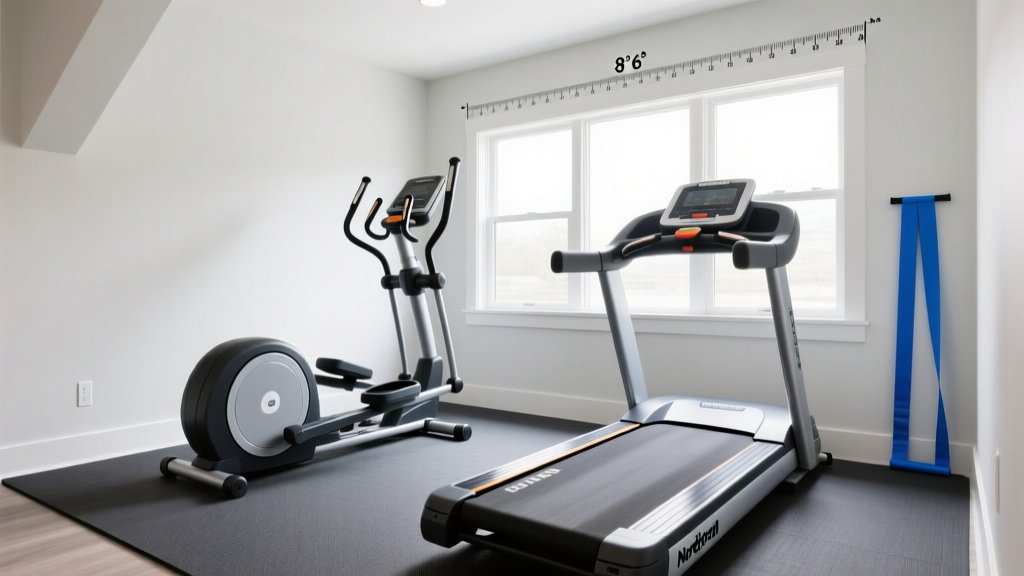
Ellipticals are notorious vertical space hogs. The pedal height on a standard rear-drive elliptical (like the Sole E35) peaks at around 14 to 16 inches above the floor. For that same 6-foot user, the math becomes 72 + 15 + 6 = 93 inches (7 feet, 9 inches). If you have standard 8-foot ceilings, a high-pedal elliptical will force you to hunch, ruining your biomechanics and causing lumbar strain.
Synthesizing Nordic Track Treadmills Reviews: The 'Folding' Illusion
When analyzing recent Nordic Track treadmills reviews, a recurring theme among apartment dwellers is the discrepancy between advertised 'folding' capabilities and the actual usable square footage reclaimed. Let us look at the spatial reality of NordicTrack's lineup through a space-optimization lens.
The Budget SpaceSaver: T Series 6.5S
Priced around $499, the T Series 6.5S features a manual folding deck. While the footprint shrinks from 64.5" x 29" to a base of 29" x 29", the folded height shoots up to 58". The spatial catch: You must leave a 30-inch 'dead zone' in front of the machine to physically walk the deck down and lock it. In a 10x10 room, this folding mechanism is highly effective, essentially turning the treadmill into a temporary vertical column when not in use.
The Premium Behemoth: Commercial 1750
Retailing at $2,499, the Commercial 1750 uses a soft-drop hydraulic folding system. It is an engineering marvel, but spatially, it is a compromise. The folded dimensions are roughly 39" x 32" x 70". Because the heavy motor and 14-inch HD touchscreen are housed in the upright mast, folding it does not drastically reduce its visual mass or its floor footprint depth. Reviews consistently note that while it 'folds,' it remains a permanent fixture in the room's layout.
Layout Warning: Never place a folding treadmill flush against a wall. You require at least 20 inches of clearance behind the treadmill for the deck to lower, and to prevent catastrophic wall damage if a user slips off the rear of the belt during a sprint.Traffic Flow and Safety Buffers
Space optimization is not just about the machine; it is about the human body moving around it. The American College of Sports Medicine (ACSM) guidelines suggest specific safety clearances that directly impact your room layout.
- Treadmill Rear Buffer (The Drop Zone): You must allocate 20 to 30 inches of empty space directly behind a treadmill. If a user falls, they are propelled backward. Placing a treadmill facing a wall with a bookshelf behind it is a severe safety hazard.
- Elliptical Lateral Buffer: Because ellipticals feature moving handlebars that swing outward, you need at least 12 inches of lateral clearance on both sides to prevent knuckle-strikes against walls or furniture.
- Frontal Visual Space: Treadmills require a focal point. Placing a treadmill facing a blank wall 12 inches away induces claustrophobia and motion sickness. Ellipticals, being lower impact and often used with tablets, can be tucked into tighter corner alcoves.
Space-to-Performance Comparison Matrix
To help you finalize your layout, here is a data-driven comparison of top 2026 cardio machines evaluated specifically for spatial efficiency.
| Model | Type | Active Footprint | Folded / Stored Depth | Est. Price |
|---|---|---|---|---|
| Bowflex Max Trainer M6 | Elliptical/Stepper | 49" L x 30.5" W | Non-Folding (49" Depth) | $1,699 |
| NordicTrack SpaceSaver SE7i | Folding Elliptical | 70" L x 28" W | 45" Depth (Folded) | $899 |
| NordicTrack T Series 6.5S | Folding Treadmill | 64.5" L x 29" W | 29" Depth (Folded) | $499 |
| Sole E35 | Standard Elliptical | 70" L x 28" W | Non-Folding (70" Depth) | $1,499 |
The Final Verdict: Choosing Your Layout Strategy
The choice between an elliptical and a treadmill for a space-constrained home gym ultimately depends on your room's specific geometry and your ceiling height.
Choose a Folding Treadmill if: You have low ceilings (under 8 feet), a narrow room where lateral handlebar swing is an issue, and the discipline to actually fold the deck up after every session. The NordicTrack T Series remains the undisputed king of true space reclamation in the budget tier.
Choose an Elliptical if: You have high ceilings (9+ feet), want to eliminate the mandatory 20-inch rear safety drop-zone, and prefer a machine that can be tucked flush into a corner alcove. If raw square footage is your primary enemy, pivot away from traditional ellipticals and investigate vertical stepper hybrids like the Bowflex Max series, which cut the required depth by nearly 40%.
By prioritizing Z-axis clearance, safety buffers, and honest folded dimensions over marketing brochures, you can seamlessly integrate high-performance cardio into even the most demanding architectural layouts.
More gear to consider
All reviews
Treadmill Buying Guide: Setup & How to Dismantle a Treadmill

Beyond the Better Me Treadmill Challenge: Beginner Rowing Guide
Air Bike vs Assault Bike & Vikingastryr Treadmill Care

Curved vs Motorized: WalkingPad R3 Hybrid+ Foldable Treadmill

Air Bike vs Assault Bike Guide: Do They Break Like Treadmill Parts?