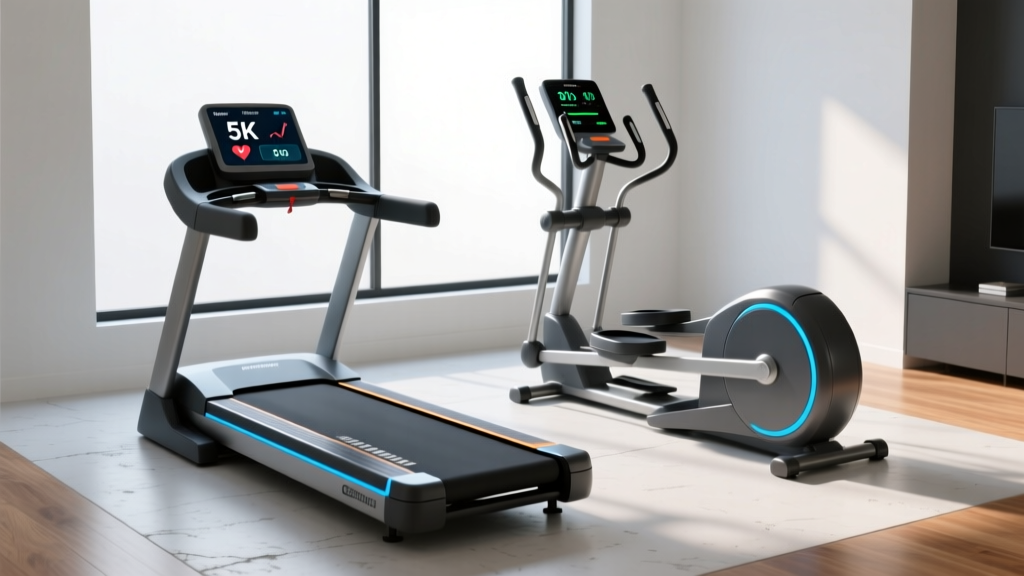
Elliptical vs Treadmill: Budgeting for a 5k Treadmill Workout
Compare elliptical vs treadmill costs for home cardio. We break down the ROI, maintenance, and value for your 5k treadmill workout goals in 2026.

The Core Dilemma: Specificity vs. Joint Preservation
Investing in home cardio equipment in 2026 requires strict financial scrutiny. With inflation stabilizing but premium fitness hardware prices remaining elevated, the debate between purchasing an elliptical vs treadmill for home cardio is no longer just about joint impact—it is a complex budget breakdown. This decision becomes incredibly nuanced when your primary performance objective is executing a structured 5k treadmill workout multiple times a week.
While both machines improve cardiovascular health, their capital expenditure (CapEx), operational expenditure (OpEx), and return on investment (ROI) diverge sharply when analyzed through the lens of distance-running specificity. Below, we deconstruct the true cost of ownership and biomechanical value of both machines to help you allocate your home gym budget effectively.
2026 Capital Expenditure (CapEx) Breakdown
The initial purchase price is merely the entry fee. To sustain a rigorous 5k treadmill workout regimen (which typically demands 3 to 5 hours of machine time per week), you must target the mid-tier equipment bracket. Budget-tier machines simply cannot withstand the continuous kinetic load of daily running without premature motor failure or belt degradation.
| Machine Category | Entry-Level (Avoid for 5k) | Mid-Tier (The Sweet Spot) | Premium / Commercial |
|---|---|---|---|
| Treadmills | $400 - $800 1.5-2.0 CHP, 18" belt |
$900 - $1,600 3.0+ CHP, 20"x55" belt |
$2,200 - $3,800 4.0 CHP, advanced slat belts |
| Ellipticals | $300 - $700 Rear-drive, 15" stride |
$900 - $1,500 Front-drive, 20" stride |
$1,800 - $3,200 Adaptive stride, magnetic resistance |
Model-Specific Value Targets
- Treadmill Mid-Tier Winner: The Sole F63 (approx. $1,099) or Horizon 7.0 AT (approx. $999). Both offer 3.0 CHP motors and adequate deck cushioning to absorb the repetitive impact of 150+ weekly foot strikes.
- Elliptical Mid-Tier Winner: The Sole E25 (approx. $1,199). Features a 20-inch stride length and a heavy 23lb flywheel, preventing the 'choppy' momentum loss common in cheaper models during high-cadence intervals.
Operational Expenditure (OpEx) and Hidden Costs
The true cost of home cardio extends far beyond the checkout cart. When budgeting for your 5k treadmill workout plan, you must factor in maintenance, electricity, and digital ecosystem subscriptions.
Maintenance Realities
Treadmills are high-friction environments. The deck and belt require 100% silicone lubrication every 130 to 150 miles. If you run a 5k (3.1 miles) four times a week, you will need to lubricate the deck roughly every 10 months. Furthermore, treadmill belts stretch and eventually require replacement ($150–$250 part cost) every 3 to 5 years depending on user weight and mileage.
Ellipticals operate on a closed-loop track system with sealed bearings. While pivot points require occasional white lithium grease, the lack of a high-friction belt makes their long-term mechanical OpEx roughly 60% lower than that of a motorized treadmill.
The Subscription Trap
In 2026, hardware is often subsidized by software. If you opt for a connected treadmill (like a Peloton Tread or NordicTrack Commercial series) to guide your 5k treadmill workout, expect to pay $39 to $44 per month in mandatory subscription fees to unlock basic manual modes or structured coaching. Over a 3-year lifecycle, a $44/month subscription adds $1,584 to your total cost of ownership—effectively doubling the price of a mid-tier, non-subscription treadmill.
ROI Analysis: The Biomechanics of a 5k Treadmill Workout
Financial value is meaningless if the machine does not serve your physiological goals. This is where the SAID Principle (Specific Adaptation to Imposed Demands) dictates your purchase.
💡 The SAID Principle: The human body adapts specifically to the exact mechanical and metabolic stressors placed upon it. To improve at running a 5K, you must run.Why the Elliptical Fails the 5K Specificity Test
According to research referenced by the CDC's physical activity guidelines, adults need 150 minutes of moderate-intensity aerobic activity weekly for baseline health. An elliptical easily fulfills this cardiovascular requirement while eliminating the ground-reaction forces (which can reach 2.5x your body weight while running).
However, as highlighted in Runner's World training methodologies, the elliptical cannot replicate the eccentric loading of the hamstrings, calves, and Achilles tendon required for running. The American Council on Exercise (ACE Fitness) notes that while ellipticals match treadmills in VO2 max improvements, they do not condition the skeletal and connective tissues for the impact of a road or track 5K. If your goal is to complete a local 5K race, an elliptical-only training block will result in severe delayed onset muscle soreness (DOMS) and potential injury when you transition to pavement.
The Treadmill Premium: Paying for Biomechanical Accuracy
When you budget for a treadmill, you are paying a premium for biomechanical accuracy. A 3.0 CHP treadmill allows you to manipulate incline (up to 15%) and speed (up to 12 MPH), perfectly mimicking the variable terrain of an outdoor 5K course. You can execute precise interval splits—such as 800-meter repeats at a 7:30/mile pace—with exact digital feedback. The financial premium of a treadmill is justified by its direct transferability to your race-day performance.
Cost-Per-Workout Amortization Matrix
To determine true value, we must amortize the CapEx and 3-year OpEx (including basic maintenance and electricity, excluding premium subscriptions) over a realistic usage schedule of 4 sessions per week (624 total workouts over 3 years).
| Equipment Scenario | Total 3-Year Cost | Cost Per Workout | Value Verdict for 5K Goals |
|---|---|---|---|
| Mid-Tier Treadmill (e.g., Sole F63) | $1,250 (Machine + Lube/Maint) | $2.00 | High ROI. Directly translates to race performance. |
| Mid-Tier Elliptical (e.g., Sole E25) | $1,250 (Machine + Minor Maint) | $2.00 | Low ROI for 5K. Excellent for general cardio, poor for run specificity. |
| Connected Treadmill + Sub | $2,884 (Machine + 36mo Sub) | $4.62 | Moderate ROI. High cost, but guided 5K plans increase adherence. |
| Gym Membership (Alternative) | $1,800 ($50/mo for 36 months) | $2.88 | Variable. Loses value if travel time reduces your workout consistency. |
The Final Verdict: Allocating Your 2026 Cardio Budget
The choice between an elliptical and a treadmill ultimately hinges on the distinction between general fitness and specific performance.
Buy the Treadmill if: Your primary objective is executing a structured 5k treadmill workout, improving your running cadence, and conditioning your lower-body connective tissues for outdoor races. The mid-tier treadmill ($900–$1,600) offers the highest functional ROI for runners. Avoid the budget tier to prevent motor burnout, and bypass the premium connected tiers unless you absolutely require interactive coaching to maintain motivation.
Buy the Elliptical if: Your goal is purely cardiovascular endurance, weight management, or active recovery, and you have a history of tibial stress fractures or plantar fasciitis. The elliptical provides an exceptional, low-impact aerobic base, but you must accept that it will not directly improve your 5K running mechanics or race-day times.
By aligning your budget with the biomechanical demands of your goals, you ensure that every dollar spent in your home gym yields measurable, real-world performance gains.
More gear to consider
All reviews
2026 Under Desk Treadmill Reviews: Treadmill Walking for Weight Loss

Layout Guide: Bikes vs Treadmill Running for Beginners

Beyond Fixing a Treadmill Belt: 2026 Upright, Recumbent & Spin Bikes
Cherokee D'Ass Treadmill Motor Guide: HP vs CHP Compared
Upright, Recumbent, Spin Bike Care & FitThrill Treadmill Maintenance
