How to Lubricate a Merax Treadmill Belt for Maximum Longevity
Learn how to properly lubricate and maintain your Merax treadmill belt. Prevent motor burnout with our step-by-step silicone application and tension guide.

The Hidden Cost of Ignoring Your Merax Treadmill Belt
Merax treadmills have carved out a massive footprint in the home fitness market by offering impressive feature sets—like 12% inclines and 2.5 HP motors—at highly accessible price points. However, this budget-to-mid-range pricing means that the internal components, specifically the running deck and belt interface, require strict adherence to a maintenance schedule. When you neglect treadmill belt maintenance and lubrication, the friction between the belt and the deck skyrockets. This forces the drive motor to draw excessive amperage to maintain your walking or running pace, inevitably leading to thermal overload, melted wiring, or complete motor burnout.
As of 2026, replacing a burnt-out Merax drive motor costs between $130 and $180, plus the labor or frustration of DIY installation. In contrast, a bottle of 100% silicone lubricant costs about $8. Understanding how to properly care for your Merax treadmill belt is not just about preserving a smooth walking experience; it is a critical financial safeguard for your home gym equipment.
⚠️ WARRANTY WARNING: Using petroleum-based lubricants, WD-40, or household oils on your Merax treadmill will immediately void your manufacturer warranty. These chemicals break down the phenolic resin coating on the MDF deck, causing irreversible delamination and requiring a full deck-and-belt replacement.Why Merax Treadmills Require Specific Belt Care
Most Merax folding treadmills utilize a composite wood (MDF) deck coated with a low-friction phenolic or factory-applied silicone layer. Over time, and typically within the first 40 to 60 hours of use, this factory coating wears away in the primary foot-strike zones. Once the bare composite is exposed, the coefficient of friction increases dramatically. According to equipment maintenance guidelines highlighted by Consumer Reports, failing to re-establish that low-friction barrier is the number one cause of premature treadmill failure in the sub-$800 price category.
Furthermore, Merax belts are typically 1.8mm to 2.0mm thick. While durable, they lack the heavy-duty 3.0mm thickness of commercial gym treadmills, making them more susceptible to stretching and heat warping if operated under high-friction conditions.
The 100% Silicone Rule: Choosing the Right Lubricant
Not all lubricants are created equal. The fitness equipment repair industry strictly mandates the use of 100% pure silicone for treadmill belts. Below is a diagnostic matrix of common household lubricants and their effects on your Merax machine.
| Lubricant Type | Chemical Base | Effect on Merax Deck | Verdict |
|---|---|---|---|
| 100% Silicone Lube | Polydimethylsiloxane | Restores slip-plane, repels dust, safe for rubber. | APPROVED |
| WD-40 Multi-Use | Petroleum Distillates | Dissolves deck coating, degrades belt rubber. | NEVER USE |
| PTFE / Teflon Spray | Fluoropolymers | Leaves a sticky residue that attracts abrasive dust. | AVOID |
| White Lithium Grease | Petroleum / Soap | Causes severe belt slipping and motor roller buildup. | NEVER USE |
Step-by-Step Merax Treadmill Belt Lubrication Protocol
Proper application is just as important as using the right chemical. Over-lubricating will cause the belt to slip on the front drive roller, creating a dangerous 'jerking' sensation while running. Follow these exact measurements for optimal results.
- Power Down and Unplug: Safety first. Remove the safety key and unplug the Merax treadmill from the wall outlet to prevent accidental startup.
- Loosen the Rear Roller Bolts: Locate the two end-cap bolts at the rear of the treadmill. Using the 6mm Allen wrench provided with your Merax machine, turn both bolts counter-clockwise exactly three full turns. This releases the tension on the belt.
- Clean the Deck Surface: Lift the edge of the belt. Slide a dry microfiber cloth between the belt and the deck to wipe away accumulated dust, rubber shavings, and old, gummy silicone. For stubborn residue, lightly dampen the cloth with isopropyl alcohol.
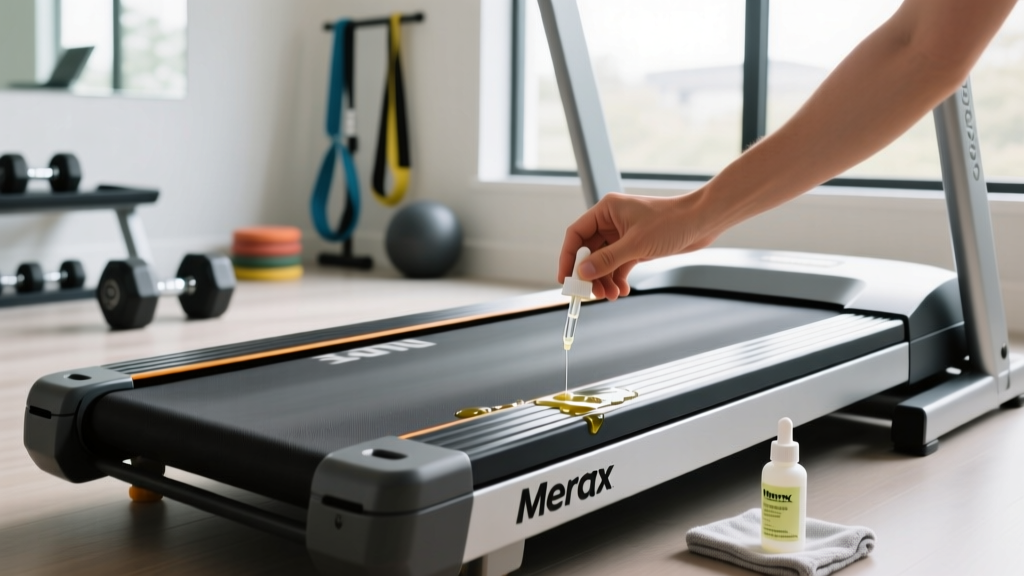
- Apply the Silicone: Lift the belt approximately 2 inches on one side. Squeeze exactly 15ml (0.5 oz) of 100% silicone lubricant in a zig-zag pattern down the center third of the deck. Repeat on the opposite side. Do not exceed 30ml total.
- Re-Tension the Belt: Turn both rear roller bolts clockwise exactly three full turns to restore the factory tension. Ensure both bolts are turned equally to maintain belt alignment.
- Distribute the Lubricant: Plug the treadmill back in. Stand on the side rails, start the machine at 2.0 MPH, and let it run for 3 minutes. Then, walk on the belt at 3.0 MPH for another 2 minutes to evenly spread the silicone across the entire deck surface.
Belt Tension and Alignment: The Post-Lube Check
Lubrication reduces friction, which can sometimes expose pre-existing tension issues. Fitness equipment safety standards emphasized by the American Council on Exercise (ACE) dictate that a treadmill belt must have enough grip to transfer the motor's torque without slipping, but enough slack to prevent bearing wear. Use this diagnostic matrix to adjust your Merax belt post-lubrication:
| Symptom | Root Cause | Corrective Action |
|---|---|---|
| Belt hesitates or 'jerks' when foot strikes | Belt is too loose, slipping on the front drive roller. | Tighten both rear bolts 1/4 turn clockwise. |
| Motor sounds strained; belt stops entirely | Belt is too tight, creating excessive drag on motor bearings. | Loosen both rear bolts 1/4 turn counter-clockwise. |
| Belt drifts to the left edge | Left rear roller is further back than the right. | Tighten left bolt 1/4 turn OR loosen right bolt 1/4 turn. |
| Belt drifts to the right edge | Right rear roller is further back than the left. | Tighten right bolt 1/4 turn OR loosen left bolt 1/4 turn. |
The Break-In Period for New Merax Belts
Expert Insight: If you have just installed a brand-new OEM replacement belt on your Merax treadmill, do not apply additional silicone immediately. Factory-fresh Merax belts come pre-treated with a heavy coating of industrial silicone. Adding more during the first 30 days will over-saturate the deck, causing the belt to hydroplane on the drive roller. Wait until the 45-day mark before performing your first manual lubrication.
Troubleshooting Edge Cases and Failure Modes
Sometimes, lubrication alone will not solve your treadmill's issues. Here is how to identify deeper mechanical failures specific to Merax models:
- The 'Burning Rubber' Smell Post-Lubrication: If you have properly lubricated the belt but still smell burning rubber after 10 minutes of use, your deck is likely delaminated. The phenolic coating has worn through to the raw MDF wood, creating a sandpaper effect. No amount of silicone will fix this; the deck and belt must be replaced as a paired set.
- Drive Roller Wax Buildup: If the belt is perfectly tensioned and lubricated but still slips under heavy footfalls, the front drive roller may have accumulated a glossy layer of hardened silicone and dust. Unplug the machine, remove the motor hood, and scrub the textured metal roller with a stiff nylon brush and isopropyl alcohol to restore its grip.
- Edge Fraying: If the edges of your Merax belt are fraying or curling, the belt has been running misaligned for an extended period, rubbing against the plastic side rails. This structural damage cannot be reversed. Trim the loose threads carefully with scissors to prevent them from catching in the roller, but begin shopping for a replacement belt.
Cost-Benefit Analysis: Maintenance vs. Replacement
To put the importance of this maintenance routine into perspective, consider the current 2026 pricing for Merax replacement parts. A standard 15-inch by 50-inch Merax replacement belt costs between $45 and $65. If a neglected belt causes the motor control board to short out due to amp-draw spikes, a replacement PCB will cost around $85. However, if the motor itself seizes, you are looking at $130 to $180 for a new 2.5 HP drive motor. An $8 bottle of 100% silicone, applied every 3 to 6 months depending on your mileage, effectively insures you against hundreds of dollars in catastrophic mechanical failures.
By committing to a strict, data-driven lubrication schedule, you ensure that your Merax treadmill remains a reliable, joint-friendly cornerstone of your home gym for years to come. Treat the deck with respect, use only pure silicone, and never ignore the early warning signs of friction.
More gear to consider
All reviews
Elliptical vs Treadmill: Matching Treadmills at Lifetime Fitness
X11i Treadmill vs Compact Portable Cardio: 2026 Budget Breakdown
Stair Climber vs Woodway Curved Treadmill: Home Use Mistakes & Fixes

How to Get 10000 Steps on Treadmill: Quiet Setup & Noise Guide

What Treadmills Do Gyms Use? Buying Guide & Feature Comparison