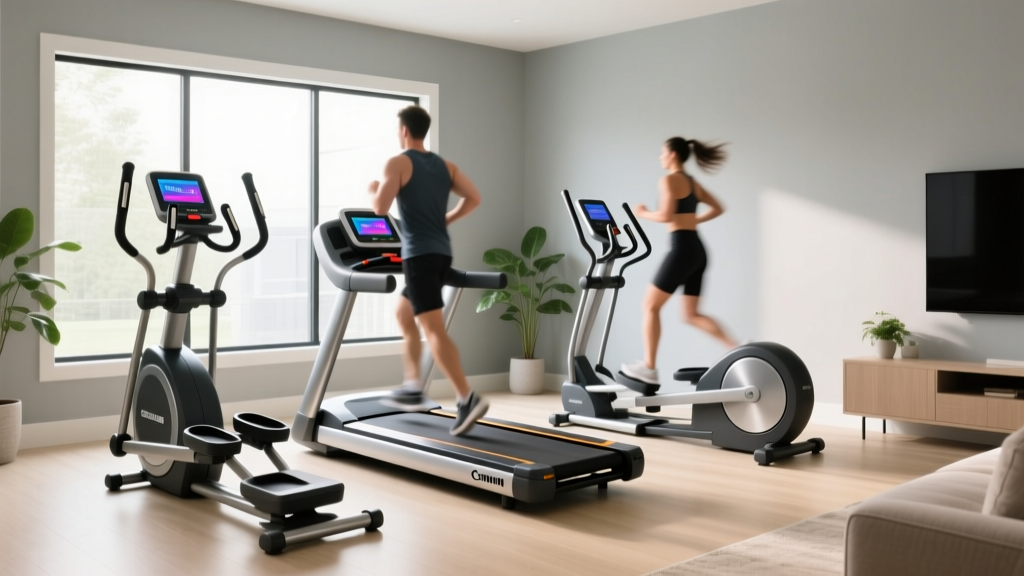
Elliptical vs Treadmill: Budget Breakdown for a 30 Minute Treadmill Workout
Compare the true costs of an elliptical vs treadmill. We break down pricing, maintenance, and ROI to optimize your 30 minute treadmill workout budget.

The Financial Reality of Home Cardio: Elliptical vs. Treadmill
When outfitting a home gym, the debate between an elliptical and a treadmill is rarely just about fitness—it is fundamentally a financial decision. Fitness enthusiasts and financial planners alike often benchmark cardiovascular ROI against the gold standard of indoor cardio: the 30 minute treadmill workout. But when you factor in upfront costs, long-term maintenance, electrical consumption, and depreciation, does the elliptical actually offer a superior budgetary value for that same half-hour window?
In this comprehensive 2026 value analysis, we strip away the marketing fluff and examine the exact dollar figures, mechanical failure rates, and physiological returns of both machines. Whether you are investing $600 or $3,000, understanding the total cost of ownership is critical to maximizing your home fitness budget.
The Upfront Investment: Entry-Level to Premium Pricing
The initial sticker price is the most obvious budgetary hurdle. Treadmills generally command a premium over ellipticals at equivalent tier levels, primarily due to the cost of high-torque Continuous Duty Horsepower (CHP) motors and shock-absorption deck engineering.
| Tier | Treadmill Benchmark (Model / Price) | Elliptical Benchmark (Model / Price) | Price Delta |
|---|---|---|---|
| Entry-Level | Horizon 7.0 AT ($999) | Horizon EX-59 ($599) | $400 Savings (Elliptical) |
| Mid-Range | Sole F80 ($999 - $1,099) | Sole E35 ($899 - $999) | $100 Savings (Elliptical) |
| Premium | NordicTrack Commercial 2450 ($2,799) | NordicTrack Commercial 14.9 ($1,699) | $1,100 Savings (Elliptical) |
Note: Prices reflect average direct-to-consumer retail pricing as of early 2026, excluding delivery fees and optional interactive programming subscriptions.
The 'Cheap Treadmill' Trap
Budget-conscious buyers often attempt to save money by purchasing sub-$500 treadmills. This is a critical financial error. Treadmills in this bracket utilize peak-horsepower motors (often mislabeled as 2.0 HP) rather than continuous-duty motors. If you attempt a vigorous 30 minute treadmill workout on a cheap deck, the motor will overheat, the belt will stutter, and the motherboard will likely fail within 14 months. Conversely, a $500 elliptical, while lacking premium console features, relies on manual momentum and magnetic resistance, meaning the mechanical failure rate is significantly lower at the bottom of the market.
Hidden Costs: Maintenance, Electricity, and Floor Space
The purchase price is merely the down payment. The true budget breakdown requires analyzing the operational expenses over a standard 5-year ownership cycle.
⚠️ Maintenance Warning: The Belt vs. The Pivot
Treadmills require strict adherence to maintenance schedules. A standard running belt must be lubricated with 100% silicone spray every 150 miles (or roughly every 3 months for daily users). Neglecting this increases friction, forcing the motor to draw excess amperage, which eventually fries the motor controller board—a $250 to $400 replacement part. Ellipticals, however, require only annual application of white lithium grease to the pedal arm pivot joints and occasional tightening of the crank bolts, costing less than $10 in supplies over five years.
Electrical Consumption and Home Infrastructure
A premium treadmill with a 4.0 CHP motor can draw up to 15 to 20 amps under heavy load (e.g., a 220 lb user running at 8 mph on a 12% incline). This necessitates a dedicated 20-amp circuit; sharing a circuit with a refrigerator or air conditioner will trip the breaker and risk electrical damage. Ellipticals are vastly more efficient. Many mid-range ellipticals are self-generating, and even those requiring wall power only draw 1 to 2 amps to operate the magnetic resistance brake and LED console, keeping your monthly utility impact negligible.
Caloric ROI: Analyzing the 30 Minute Treadmill Workout vs Elliptical
To determine true value, we must weigh the financial cost against the physiological yield. How does the caloric burn of a standard 30 minute treadmill workout compare to 30 minutes on an elliptical?
According to data published by Harvard Health Publishing, a 155-pound person burns approximately 378 calories in 30 minutes on an elliptical machine, compared to 288 calories walking at a brisk 4.0 mph pace on a treadmill. However, if that same user transitions to running at 6.0 mph (a 10-minute mile pace) for their 30 minute treadmill workout, the caloric expenditure jumps to roughly 378 calories—tying the elliptical.
The Joint-Impact Depreciation Factor
While the treadmill offers superior bone-density benefits due to weight-bearing impact, that same impact accelerates the physical depreciation of the machine. A 200-pound user running 4 miles a day generates thousands of pounds of cumulative downward force on the treadmill's deck and rollers. According to the Mayo Clinic, ellipticals provide a low-impact aerobic alternative that significantly reduces stress on the knees, hips, and back. From a hardware perspective, this low-impact biomechanic also drastically reduces stress on the machine's frame, contributing to the elliptical's longer average lifespan and lower repair frequency.
Longevity and Resale Value: Which Holds Its Worth?
When upgrading your home gym, the secondary market value of your old equipment dictates your net upgrade cost. Treadmills suffer from steep depreciation curves. Because the internal motor and belt condition are difficult for a secondhand buyer to verify, used treadmills typically sell for 20% to 30% of their original retail price. Ellipticals, lacking high-friction wearable parts like motorized belts, hold their value slightly better, often retaining 35% to 45% of their retail value on local marketplaces, provided the pivot joints do not squeak.
The Verdict: Matching Your Budget to Your Biomechanics
Choosing between these two cardio titans requires aligning your financial constraints with your physical needs. Use this decision matrix to finalize your purchase:
- Choose the Treadmill If: You are training for outdoor road races, you require precise pace/incline metrics, you have a dedicated 20-amp electrical circuit, and you have budgeted an extra $50 annually for silicone lubricants and eventual belt replacements. The 30 minute treadmill workout remains unmatched for specific running mechanics and bone loading.
- Choose the Elliptical If: You are operating on a strict sub-$800 budget, you share a bedroom or apartment space (ellipticals are vastly quieter), you have a history of patellar tendonitis or lower back pain, and you want a 'buy it and forget it' machine with near-zero ongoing maintenance costs.
Ultimately, the elliptical wins the pure budgetary breakdown due to lower upfront costs, minimal electrical draw, and negligible maintenance requirements. However, if your primary fitness goal relies on the biomechanical specificity and high-intensity interval capabilities of the 30 minute treadmill workout, the treadmill's premium price tag is a justifiable investment in your long-term cardiovascular health.
More gear to consider
All reviews
Rowing Machine Buying Guide & Setup: Smii7y Treadmill Alternative
Ladder Treadmill Setup Guide & Cardio Machine Noise Comparison
Bowflex Treadmill 7 vs Rowers: Buying Guide & Technique Mistakes
Treadmill or Rowing Machine for Belly Fat? 2026 Walking Pad Guide

Beyond Sole Treadmill Reviews: Air Bike vs Assault Bike Guide
