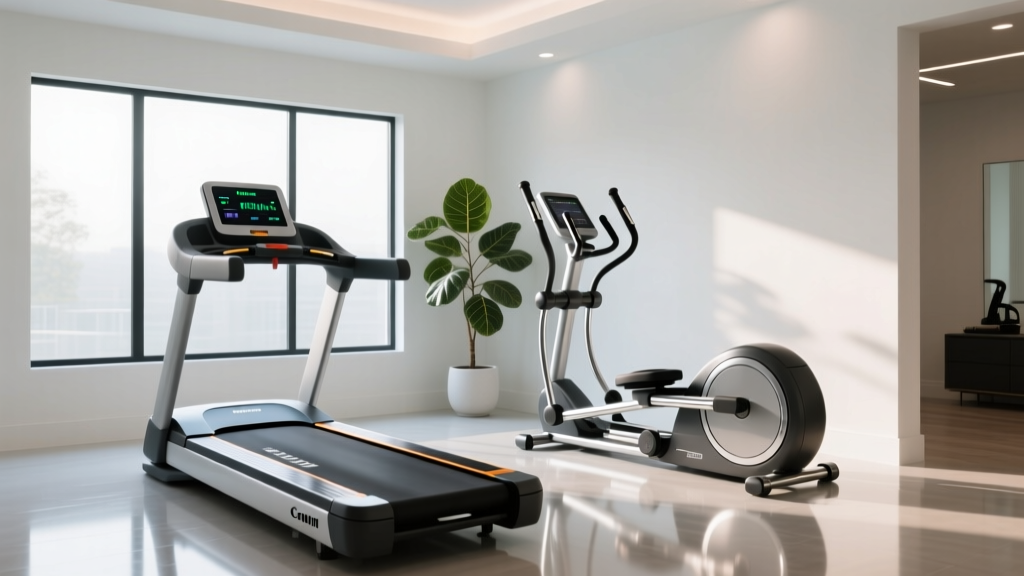
Elliptical vs Treadmill: Budgeting a Treadmill Fitness Program
Compare elliptical and treadmill costs for home gyms. Discover the true budget breakdown and value analysis to fund your treadmill fitness program today.

Home cardio equipment represents a significant financial commitment, and the debate between purchasing an elliptical or a treadmill is one of the most common dilemmas in fitness gear shopping. While most buyers focus exclusively on the retail sticker price, evaluating the true total cost of ownership is critical. This is especially true if you are planning to invest in a rigorous, long-term treadmill fitness program or an equivalent low-impact elliptical routine. In 2026, with rising subscription costs and advanced smart-home integrations, the financial gap between these two machines extends far beyond the initial checkout screen.
This comprehensive budget breakdown and value analysis will dissect upfront costs, hidden ownership fees, maintenance liabilities, and long-term ROI to help you allocate your home gym funds with absolute precision.
The True Upfront Cost: Elliptical vs. Treadmill
The barrier to entry for both machines varies wildly depending on the build quality, motor size, and interactive features. Treadmills inherently require larger, more expensive continuous-duty motors and heavy-duty shock absorption decks, which drives up their baseline manufacturing cost compared to ellipticals.
| Tier | Treadmill Model (Example) | Est. Treadmill Price | Elliptical Model (Example) | Est. Elliptical Price |
|---|---|---|---|---|
| Entry-Level | Horizon Fitness T101 | $699 | Schwinn 430 | $699 |
| Mid-Range | Sole Fitness F80 | $1,199 | Sole Fitness E35 | $1,099 |
| Premium / Commercial | NordicTrack Commercial 1750 | $2,599 | NordicTrack SE7i (FreeStride) | $1,699 |
Budget Takeaway: At the entry-level, pricing is nearly identical. However, once you cross the $1,000 threshold into mid-range and premium tiers, treadmills become significantly more expensive. A commercial-grade treadmill requires a massive 3.5 to 4.0 Continuous Horsepower (CHP) motor, whereas a premium elliptical relies on magnetic resistance and heavy flywheels, capping out at a lower manufacturing cost.
Hidden Ownership Costs: Subscriptions, Power, and Parts
The modern home gym ecosystem is heavily reliant on digital connectivity. If your goal is to follow an interactive, screen-guided treadmill fitness program, you must factor in the recurring software costs and electrical demands.
1. The Subscription Tax
Brands like NordicTrack, ProForm, and Bowflex lock their premium HD touchscreens and live classes behind mandatory paywalls after the initial 30-day free trial.
- iFIT (NordicTrack/ProForm): $39/month ($468/year).
- JRNY (Bowflex/Schwinn): $29/month ($348/year).
- Peloton App+ (for compatible treadmills): $44/month ($528/year).
Over a standard 5-year equipment lifespan, a treadmill fitness program subscription will add between $1,740 and $2,640 to your total cost of ownership. Ellipticals from these same brands are subject to the exact same subscription fees if you want interactive coaching, though many elliptical users opt for manual mode and third-party apps like Apple Fitness+ ($9.99/mo) to save money.
2. Electrical and Installation Demands
Treadmills are power-hungry machines. A motorized treadmill under heavy load can draw between 1,200 and 1,500 watts. Most manufacturers strictly require a dedicated 15-amp or 20-amp circuit. If your home gym is in a shared basement circuit, running a treadmill alongside a space heater or air conditioner will trip the breaker. Hiring an electrician to run a dedicated line costs between $150 and $350.
Ellipticals, conversely, draw minimal power. Motorized magnetic resistance ellipticals typically peak at under 150 watts, and many are entirely self-powered via electromagnetic induction. They can safely share a standard bedroom or living room outlet without risking a tripped breaker.
ROI and Long-Term Value: Joint Health vs. Caloric Burn
When analyzing the return on investment (ROI) of cardio equipment, we must look beyond caloric expenditure and consider the medical and physiological ROI. Consistency is the primary driver of cardiovascular health, and joint pain is the number one reason users abandon their home equipment.
According to the Centers for Disease Control and Prevention (CDC), adults require at least 150 minutes of moderate-intensity aerobic activity weekly to maintain baseline health. However, sustaining this volume requires managing musculoskeletal wear and tear.
Biomechanical studies consistently show that running on a treadmill generates ground reaction forces equal to 2.5 to 3 times your body weight per stride. Over a 3-mile run, a 180-pound runner absorbs over 135,000 pounds of cumulative impact force. Ellipticals reduce this impact to near zero by keeping the foot in constant contact with the pedal, utilizing a fluid, elliptical path.
According to the American Heart Association (AHA), finding a sustainable, joint-friendly modality is crucial for long-term cardiovascular adherence. If you have a history of knee, hip, or lower back issues, the ROI on an elliptical is vastly superior because it prevents the costly physical therapy bills associated with repetitive treadmill impact injuries.
Real-World Failure Modes & Maintenance Budgeting
Every piece of fitness equipment has specific mechanical vulnerabilities. Budgeting for inevitable repairs is a hallmark of a smart home gym investment.
Treadmill Vulnerabilities
- Deck Delamination: The wooden deck under the belt eventually warps and loses its lubrication coating. Replacing a deck and belt costs $150 to $250 in parts, plus labor.
- Incline Motor Burnout: On budget treadmills (under $1,000), the small incline motor frequently strips its plastic gears when users run at high speeds on a 15% grade. Replacement parts cost around $85.
- Preventative Maintenance: Requires 100% silicone belt lubrication every 150 miles ($15 per year).
Elliptical Vulnerabilities
- Bushing and Bearing Wear: The pivot points connecting the pedal arms to the flywheel use polyurethane bushings that eventually wear down, causing a loud, rhythmic squeaking. Replacing them is cheap ($20 in parts) but requires significant mechanical disassembly.
- Cracked Pedal Arms: On entry-level models with light flywheels (under 15 lbs), the lateral torque of heavy users can cause the metal pedal arms to fatigue and snap near the crank. This usually totals the machine, as replacement parts are rarely sold by budget manufacturers.
Decision Matrix: Funding Your Treadmill Fitness Program
Use this practical decision framework to finalize your purchase based on your specific budget and physiological needs.
Choose the Treadmill If:
- You are training for a road race or marathon and require specific biomechanical adaptation to pavement striking.
- You have the budget for a mid-to-high-tier model ($1,200+) with a 3.5+ CHP motor and a 60-inch belt length to accommodate a natural running stride.
- Your home gym has the electrical capacity for a dedicated 15-amp circuit.
- You are fully committed to an interactive, instructor-led treadmill fitness program and have budgeted $400+ annually for software subscriptions.
Choose the Elliptical If:
- Your primary goal is high-volume cardiovascular conditioning without the joint degradation associated with running.
- You are working with a strict budget under $1,000. An $800 elliptical will generally offer a smoother, more durable experience than an $800 treadmill.
- You live in an apartment or shared space where the heavy, rhythmic thud of a treadmill deck would cause noise complaints.
- You prefer self-guided workouts, listening to podcasts or watching TV, and want to avoid mandatory monthly app subscriptions.
Final Verdict on Value
When evaluating an elliptical vs. a treadmill for home cardio, the treadmill is the superior tool for sport-specific running mechanics and peak caloric expenditure, provided you have the budget to support its higher upfront cost, electrical needs, and subscription-based treadmill fitness program requirements. However, the elliptical remains the undisputed champion of long-term value, joint preservation, and low-maintenance ownership. By calculating your true 5-year cost of ownership rather than just the day-one retail price, you can build a home gym that serves your body and your bank account for years to come.
More gear to consider
All reviews
Walking Pad Setup: Avoid the Classic Treadmill Cartoon Chaos

Under Desk Treadmill Review: Budget vs True Treadmill Running Speed

Are Treadmills FSA Eligible? Home Gym Layout & Belt Maintenance

Treadmill Belt Maintenance & Best Mat for Treadmill on Carpet

Elliptical Trainer or Treadmill: Which One is Better? (Rower Guide)
