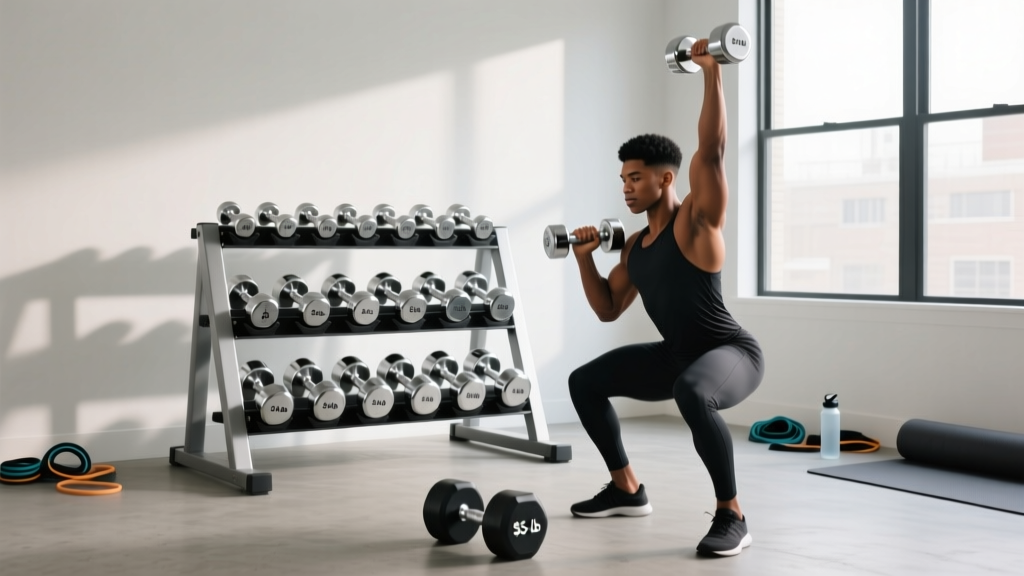
Dumbbell Rack Value: Storing Weights for Quadricep Dumbbell Exercises
Analyze dumbbell rack budgets from $50 A-frames to $600 tiered storage. Learn which rack safely supports heavy sets for quadricep dumbbell exercises.

When outfitting a home or garage gym, lifters typically allocate the lion's share of their budget to the iron itself. However, neglecting the infrastructure required to store and access those weights is a costly mistake—both financially and biomechanically. As of early 2026, fluctuating global steel tariffs and increased shipping surcharges have pushed the baseline cost of commercial-grade 11-gauge steel racks up by roughly 12% compared to a few years ago. This makes a rigorous budget breakdown and value analysis of dumbbell storage solutions more critical than ever.
This guide dissects the true cost, failure modes, and long-term value of various dumbbell racks. More importantly, we will examine why investing in the right storage tier is a non-negotiable safety requirement when you begin progressing to heavy quadricep dumbbell exercises, where the margin for error during the pickup and racking phases is razor-thin.
The Economics of Dumbbell Storage: Cost Per Pound
To evaluate value, we must look beyond the sticker price and calculate the 'cost per pound of stored capacity.' A cheap rack that warps under a 400-pound load offers terrible long-term value compared to a premium rack rated for 1,000 pounds that will survive multiple gym relocations. Furthermore, improper storage leads to damaged flooring, degraded dumbbell coatings, and potential injury, all of which carry hidden financial costs.
⚠️ The Hidden Cost of UHMW Liners
Many budget racks feature bare steel tiers. Dropping rubber or urethane dumbbells onto bare steel repeatedly will shear the rubber coating off your weights over time. Replacing a single pair of premium urethane dumbbells can cost upwards of $250. Always factor in the cost of adding UHMW (Ultra-High Molecular Weight) plastic liners or rubber matting to budget racks to protect your investment.
Budget Tier 1: A-Frame Racks (Entry-Level)
Typical Price Range: $60 – $110
Best For: Light-to-medium sets (5 to 30 lbs), rehabilitation, and high-rep isolation work.
The CAP Barbell 10-Tier A-Frame Rack (typically priced around $79.99) is the undisputed king of entry-level storage. Its vertical footprint is minimal, and assembly takes under ten minutes. However, from a value analysis perspective, A-frames possess a critical failure mode: a high center of gravity.
- The Tipping Hazard: When you lift a heavy 50-pound dumbbell off the top tier, the lateral shift in weight distribution can cause the entire rack to tip forward if it is not anchored or heavily loaded on the bottom tiers.
- Steel Gauge: Most A-frames use 14-gauge or 16-gauge tubular steel. Under the dynamic load of dropping weights onto the tiers, the welds at the base joints are prone to micro-fractures over 18 to 24 months of heavy use.
Expert Insight: Never store hex dumbbells heavier than 35 lbs on an unanchored A-frame rack. The dynamic force of racking a heavy weight exceeds the static weight rating by a factor of 1.5x to 2x.
Budget Tier 2: 3-Tier Commercial Racks (Mid-to-High Range)
Typical Price Range: $350 – $650
Best For: Complete sets (5 to 70+ lbs), heavy compound movements, and commercial environments.
If you are training for strength and hypertrophy, a horizontal 3-tier rack is the gold standard. The Rogue 3-Tier Dumbbell Rack (priced between $495 and $595 depending on the exact model and current 2026 steel pricing) utilizes 11-gauge steel and features a 30-degree angled shelf design. This allows for easy reading of weight markings and ergonomic wrist alignment during the pickup phase.
Value Analysis of Tiered Racks
While the upfront cost is steep, the value proposition is immense. These racks boast static weight capacities exceeding 1,000 pounds. The wide base footprint (often 48 inches wide by 30 inches deep) completely eliminates the tipping hazard. Furthermore, premium tiered racks retain roughly 60% to 70% of their resale value on the secondary market, drastically lowering the net cost of ownership over a five-year period.
Budget Tier 3: Wall-Mounted Solutions (Space-Savers)
Typical Price Range: $150 – $250
Best For: Garages with limited floor space and exposed wooden wall studs.
Wall-mounted racks, such as the Titan Fitness Wall Mounted Dumbbell Rack (approx. $179.99), offer an excellent compromise between floor space preservation and heavy-duty loading. However, the value of a wall-mounted rack is entirely dependent on your wall's structural integrity.
Installation Reality Check: You cannot mount these into drywall. They require 3/8-inch x 3-inch structural lag screws driven directly into 16-inch-on-center wooden studs or poured concrete. If you rent your space or have metal studs (which require specialized toggle bolts and have lower shear strength limits), the hidden cost of retrofitting your wall negates the budget-friendly price tag of the rack itself.
Storage Matrix: Cost vs. Capacity Breakdown
| Rack Type | Est. 2026 Price | Max Capacity | Footprint | Resale Value |
|---|---|---|---|---|
| A-Frame (10-Tier) | $75 - $95 | ~300 lbs | 24" x 24" | Low (20%) |
| 3-Tier Horizontal | $450 - $600 | 1,000+ lbs | 48" x 30" | High (65%) |
| Wall-Mounted (3-Tier) | $160 - $200 | ~500 lbs | 0 sq ft (Wall) | Medium (40%) |
Optimizing Your Setup for Quadricep Dumbbell Exercises
Why does storage matter so much for leg day? When building a home gym, enthusiasts often overlook the biomechanics of the 'pickup.' This is especially true when progressing to heavy quadricep dumbbell exercises like Bulgarian split squats, heavy goblet squats, or dumbbell lunges. According to kinesiology data cataloged by ExRx.net, the dumbbell split squat places immense stabilizing demands on the lumbar spine and core.
If you are performing a Bulgarian split squat with 70-pound dumbbells, picking them up from the floor requires a deep hip hinge. Initiating a heavy leg workout with a fatiguing, unbraced deadlift-from-the-floor just to get your weights into position is a recipe for a herniated disc.
The Biomechanical Imperative of Rack Height
A proper 3-tier horizontal rack positions your heaviest dumbbells at roughly knee-to-mid-thigh height. This allows you to execute a safe, braced 'clean' motion to bring the weights to your shoulders or drop them to your sides for lunges, maintaining a neutral spine throughout the transition.
- Approach the Rack: Stand close to the tier holding your target weight.
- Hinge and Grip: Maintain a neutral spine, hinge at the hips, and grip the dumbbells.
- The Clean: Drive through your heels, using your glutes and traps to pop the weights up to your shoulders in one fluid motion.
- Step Back: Only step back into your split squat stance once the weights are fully secured and your core is braced.
An A-frame rack completely disrupts this flow. Because the weights are stacked vertically, you are forced to twist your torso while holding a heavy load to clear the adjacent dumbbells, introducing dangerous rotational shear forces to the lumbar spine. Therefore, if your training program prioritizes heavy unilateral leg work, a horizontal tiered rack is not a luxury; it is a vital piece of safety equipment.
💡 Pro-Tip: The Matting Multiplier
When budgeting for a heavy-duty rack, allocate an extra $60 to $120 for 3/4-inch thick horse stall mats to place under the rack. Dropping 80-pound dumbbells onto a rack transfers kinetic energy through the steel frame directly into your concrete or subfloor. A high-density rubber mat dampens this vibration, protecting both your rack's welds and your foundation.
Final Value Verdict
When analyzing the budget breakdown of dumbbell storage, the cheapest option is rarely the most economical over a multi-year training cycle. Entry-level A-frames serve a purpose for light, isolation-focused routines, but they fail the safety and ergonomics test for heavy compound lifting.
If your programming includes demanding quadricep dumbbell exercises, the mid-range investment in a 3-tier commercial rack or a structurally sound wall-mounted unit pays dividends in spinal safety, equipment longevity, and workout efficiency. By calculating the cost-per-pound and factoring in the high resale value of premium steel, it becomes clear that proper storage is an investment in your long-term lifting career, not just an organizational afterthought.
More gear to consider
All reviews
Olympic Barbell Buying Guide: Weight, Knurling & the Dumbbells Candy Color Trend

Master the 90 Pound Dumbbell Bench Press & EZ vs Straight Bar

Barbell Collar & Clamp Types for Seated Dumbbell Power Cleans

Dumbbell Hammer Curl Form: Rubber Hex vs Urethane Test

Power Rack vs Squat Stand: Lower Chest Workouts with Dumbbells
