Dumbbell Rack Maintenance: Storage for Wrist Dumbbell Curls & More
Learn essential dumbbell rack maintenance to protect your storage tiers, from heavy presses to the light weights used for wrist dumbbell curls.

Home gym owners and commercial facility managers routinely invest thousands in premium urethane dumbbells and adjustable benches, yet the dumbbell rack is frequently treated as an indestructible afterthought. In 2026, a commercial-grade 3-tier dumbbell rack constructed from 11-gauge steel typically costs between $350 and $600. While these storage solutions are engineered for massive static loads, they are highly susceptible to localized wear, hardware fatigue, and cosmetic degradation if not properly maintained.
Proper dumbbell rack maintenance is not just about wiping down the steel; it requires a tier-specific approach. The stress profile on the bottom tier, which holds heavy implements for Romanian deadlifts, is vastly different from the top tier. Understanding these micro-environments is the key to maximizing the longevity of your free weights and racks.
The Top-Tier Problem: Isolation Exercises and Rack Wear
When athletes perform high-rep, high-sweat isolation movements like wrist dumbbell curls, they almost exclusively reach for the 5 lb to 15 lb pairs housed on the top tier of the rack. These lighter implements are subjected to a unique and often destructive abuse cycle that heavier dumbbells avoid.
First, forearm and wrist training generates immense localized sweat. Because the athlete is seated or leaning over a bench, sweat drips directly onto the handles of these light dumbbells and the top tray of the rack. Second, due to their low mass, users tend to 'toss' or drop 10 lb dumbbells onto the rack lip rather than placing them down with control. Over time, this repetitive micro-impact fractures the protective UHMW (Ultra-High Molecular Weight) plastic liners and slowly bends the steel tray lips outward, compromising the rack's structural geometry.
⚠️ The Chemistry of Sweat and SteelHuman sweat contains urea, lactic acid, and sodium chloride, with a pH ranging from 4.5 to 7.0. This mildly acidic, highly saline environment is aggressively corrosive to both cheap powder coating and bare steel knurling. According to facility maintenance guidelines emphasized by the National Strength and Conditioning Association (NSCA), failing to neutralize these acids within 24 hours can initiate surface oxidation (rust) that spreads beneath the rack's paint layer.
Rack Tier Maintenance Matrix
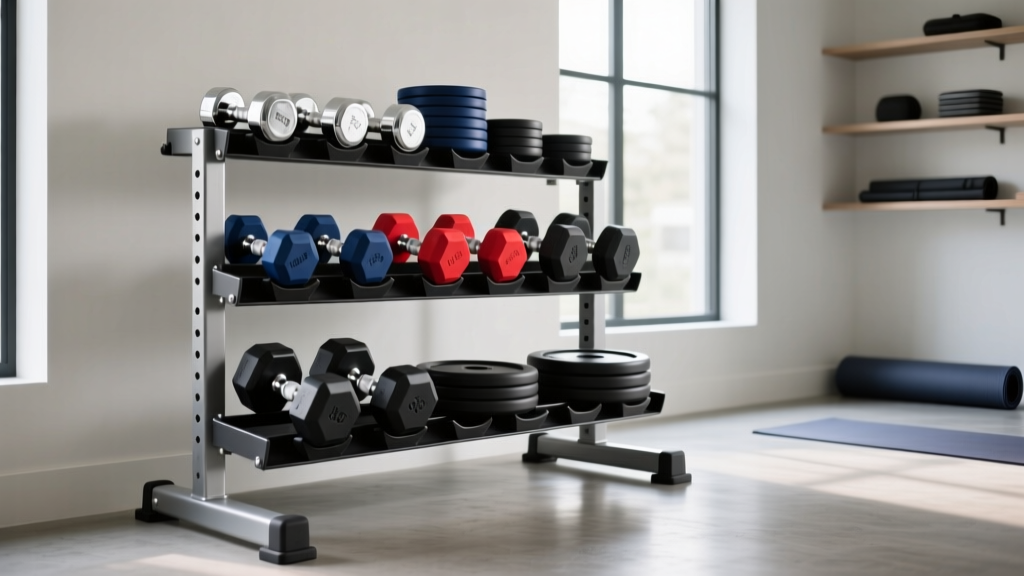
To properly care for your dumbbell storage solution, you must tailor your maintenance to the specific wear patterns of each tier. Below is a diagnostic matrix to help you identify risks and apply the correct interventions.
| Rack Tier | Common Use Case | Primary Wear Risk | Maintenance Action |
|---|---|---|---|
| Top Tier (5-20 lbs) |
Wrist dumbbell curls, lateral raises, tricep kickbacks | Sweat corrosion, UHMW pad compression, lip bending from tossing | Weekly pH-neutral wipe down; monthly lip alignment check |
| Middle Tier (25-50 lbs) |
Chest presses, goblet squats, dumbbell rows | Paint scuffing, bolt loosening from lateral vibration | Bi-annual bolt torquing; touch-up paint application |
| Bottom Tier (55-100+ lbs) |
Heavy RDLs, shrugs, farmer's carry pick-ups | Extreme static load sag, floor anchor pull-out, rubber transfer | Annual structural weld inspection; anchor re-torquing |
Step-by-Step: Restoring Your Rack's UHMW Pads and Steel
Manufacturers like Rogue Fitness utilize UHMW polyethylene pads on their rack trays to protect the dumbbell heads and dampen sound. However, UHMW plastic is a sacrificial component. By year three in a busy gym, these pads will show deep gouges and permanent compression divots. Here is the professional protocol for restoring your rack's contact points and steel framework.
- Clear and Degrease: Remove all dumbbells. Spray the empty trays with a pH-neutral enzymatic cleaner (avoid bleach or ammonia, which degrade powder coat polymers). Wipe with a microfiber cloth to lift embedded chalk and dead skin cells.
- Inspect and Replace UHMW Pads: Run your thumb along the plastic liners. If you feel deep cracks or if the padding has compressed to less than 1/8th of an inch, order a replacement UHMW kit (typically $25 to $45 depending on the brand). Pry the old pads out using a flathead screwdriver wrapped in tape to avoid scratching the steel tray, and press-fit the new liners.
- Torque the Carriage Bolts: The vibration of dropping heavy dumbbells onto the bottom tier travels up the rack's spine, loosening M12 and M16 hardware over time. Use a torque wrench set to 40 Nm (Newton-meters) to tighten all structural bolts. Do not over-torque, as this can strip the threads in the welded nuts.
- Treat Surface Oxidation: If you spot rust on the tray lips (common where the knurling of dropped dumbbells scrapes the paint), use a 3M Scotch-Brite pad to gently remove the oxidation. Do not use wire wheels, which will destroy the surrounding powder coat.
- Apply Protective Wax: Finish the steel surfaces with a thin coat of automotive carnauba wax or a specialized gym equipment sealant. This fills microscopic pores in the powder coat, creating a hydrophobic barrier against future sweat and humidity.
Addressing Knurling Rust on Light Dumbbells
The dumbbells used for wrist dumbbell curls often feature aggressive knurling to prevent slipping during high-rep forearm fatigue. This deep knurling traps moisture and skin oils, leading to rapid rusting. To maintain these specific implements, spray them weekly with Boeshield T-9 or a similar rust-inhibiting solvent, let it sit for three minutes, and wipe it dry. Avoid standard WD-40, which acts as a degreaser and strips the metal of its necessary protective oils, leaving it more vulnerable to long-term oxidation.
Structural Integrity: Welds, Gussets, and Floor Anchoring
A 3-tier rack holding a full set of rubber-coated dumbbells from 5 to 100 lbs can easily exceed 1,500 lbs of total static weight. When a user aggressively racks a heavy pair, the dynamic force multiplies this load. You must inspect the welds at the base gussets annually. Look for 'stress shadows'—hairline cracks in the paint radiating outward from the weld joints. If the paint is cracking, the underlying steel is flexing beyond its yield point.
"Equipment failure rarely happens without warning. The degradation of a dumbbell rack begins with micro-fractures in the powder coating near the base welds and loosened floor anchors. Catching these signs early prevents catastrophic tipping hazards."
If your rack is freestanding, ensure it is anchored to the floor studs or concrete using 3/8-inch wedge anchors. In humid environments (like garage gyms), place a rubber anti-fatigue mat under the base plates to prevent galvanic corrosion between the steel rack and moisture trapped against the concrete floor.
FAQ: Dumbbell Storage and Equipment Longevity
- Can I store rubber or urethane dumbbells in direct sunlight?
No. UV radiation breaks down the chemical bonds in rubber and urethane, causing the dumbbells to become brittle, fade, and eventually crumble. Always position your rack away from direct window exposure or use UV-blocking window films in your gym space. - How do I fix a bent tray lip on the top tier?
If the lip has bent outward from repeatedly tossing light dumbbells used for wrist dumbbell curls, you can carefully bend it back into place using a crescent wrench padded with a rag. Apply slow, steady pressure. Do not heat the steel with a torch, as this will compromise the structural temper and destroy the powder coat. - Is an A-Frame rack better for longevity than a 3-Tier rack?
A-Frames save floor space and are excellent for lighter sets (up to 50 lbs), but they have a higher center of gravity, making them more prone to tipping if loaded unevenly. For sets exceeding 50 lbs, a 3-tier horizontal rack with a wide footprint offers vastly superior long-term structural stability and safer loading ergonomics. - How often should I deep-clean the rack trays?
A quick wipe-down should happen daily in a commercial setting or after every workout in a home gym. A full deep-clean, involving enzymatic degreasers and hardware inspections, should be scheduled every 90 days to maintain warranty compliance and prevent long-term material degradation.
More gear to consider
All reviews
Rubber Hex vs Urethane: Value & Single Arm Dumbbell Row GIF
Push Press Exercise Dumbbells: Olympic vs Standard Plate Mistakes
Top Dumbbell Racks for Lat Muscle Dumbbell Exercises (2026)

Power Rack vs Squat Rack vs Stand: Deadlift Dumbbell Workout Setups
Best Loadable Dumbbells for a Dumbbell Workout for Women (2026)