Dumbbell Lateral Raise Form Guide & Best Adjustable Dumbbells Reviewed
Master the dumbbell lateral raise with our step-by-step beginner form guide, plus a detailed comparison of the best adjustable dumbbells for home gyms.

The Beginner’s Blueprint to the Dumbbell Lateral Raise
If you want to build wider, more capped shoulders, the dumbbell lateral raise is non-negotiable. This isolation movement specifically targets the lateral head of the deltoid, the muscle responsible for that coveted V-taper aesthetic. However, beginners frequently botch this exercise by using excessive momentum, poor joint alignment, and improperly sized equipment.
Furthermore, because the lateral deltoid is a relatively small muscle, it requires precise micro-loading. Hauling out heavy fixed dumbbells often leads to ego-lifting and shoulder impingement. This is where high-quality adjustable dumbbells become the ultimate home gym investment. Below, we provide a step-by-step biomechanical guide to perfecting your form, followed by an in-depth 2026 comparison of the best adjustable dumbbells specifically suited for isolation work.
Step-by-Step: Mastering the Scapular Plane
According to biomechanics experts at ExRx, the most common beginner mistake is raising the arms directly out to the sides (the frontal plane). This jams the greater tubercle of the humerus into the acromion, risking subacromial impingement. Here is how to execute the movement safely and effectively.
Step 1: The Setup and Stance
Stand with your feet shoulder-width apart. Hold a dumbbell in each hand with a neutral grip (palms facing your thighs). Maintain a slight bend in your knees and hinge forward at the hips by about 5 to 10 degrees. This slight lean aligns the resistance curve with the lateral deltoid fibers from the very first inch of the movement.
Step 2: Finding the Scapular Plane
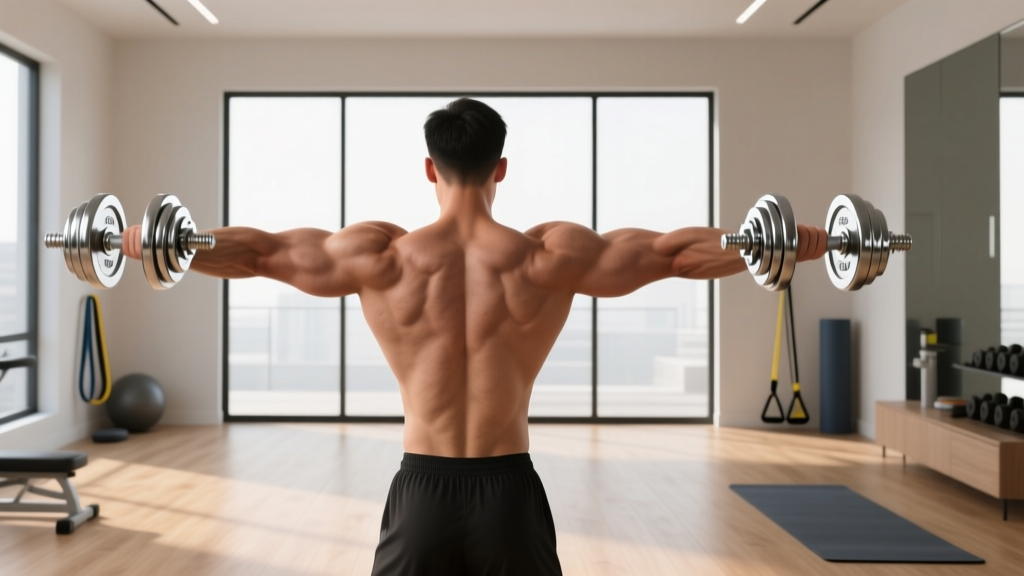
Do not raise your arms directly out to your sides. Instead, bring your hands about 15 to 30 degrees forward into the scapular plane. As noted by the American Council on Exercise (ACE) Exercise Library, this angle aligns with the natural resting position of your shoulder blades, allowing for optimal muscle contraction and joint safety.
Step 3: The Concentric Lift
- Initiate the movement by pushing your elbows out and up, not your hands.
- Imagine your hands are hooks; the elbows should lead the weight.
- Raise the dumbbells until your upper arms are parallel to the floor. Going higher shifts the tension away from the lateral deltoid and onto the upper trapezius.
Step 4: The Eccentric Control
Lower the weight slowly over a count of two to three seconds. The eccentric (lowering) phase causes the most muscle damage, which is a primary driver of hypertrophy. Stop just short of the dumbbells touching your thighs to maintain constant tension on the deltoid.
Pro-Tip for Small Hands: If you experience forearm fatigue before your shoulder burns out, your dumbbell handles are likely too thick. This is a critical factor when choosing adjustable dumbbells for isolation exercises.
Why Adjustable Dumbbells Rule for Isolation Work
For compound movements like goblet squats, jumping from 25 lbs to 30 lbs is manageable. For a dumbbell lateral raise, a 5 lb jump is a massive 20% increase in load. Beginners need to progress in 2.5 lb to 5 lb increments. Buying a full rack of fixed hex dumbbells from 5 lbs to 25 lbs costs upwards of $400 and takes up an entire wall. A single pair of premium adjustable dumbbells solves the micro-loading problem while keeping your home gym footprint under 2 square feet.
2026 Adjustable Dumbbell Comparison Matrix
Not all adjustable dumbbells are created equal, especially for lateral raises. The handle diameter, overall length, and weight distribution drastically alter the biomechanics of isolation lifts. Here is how the top three models stack up this year.
| Model | Weight Range | Handle Diameter | Est. Price (2026) | Lateral Raise Suitability |
|---|---|---|---|---|
| Nuobell 80 LB | 5 - 80 lbs | 1.15" (Knurled Steel) | $449 / pair | Excellent (Feels like fixed DBs) |
| Bowflex SelectTech 552 | 5 - 52.5 lbs | 1.45" (Thick Plastic) | $399 / pair | Poor (Bulky ends hit wrists) |
| PowerBlock Elite USA | 5 - 50 lbs | 1.15" (Cage Design) | $329 / pair | Good (Compact, but restricts grip) |
Deep Dive: Top Adjustable Dumbbells Reviewed for Shoulder Day
1. Nuobell 80 LB: The Gold Standard for Isolation
If your primary goal includes strict isolation work like the dumbbell lateral raise, the Nuobell 80 is currently the undisputed champion. The mechanism uses a twisting handle to lock in the weight plates, but the magic lies in the handle itself. It features a standard 1.15-inch diameter knurled steel shaft, identical to a commercial Olympic dumbbell.
- Pros: True fixed-dumbbell feel; no plastic clacking; standard handle thickness prevents premature grip failure during high-rep lateral raises.
- Cons: The twisting mechanism requires two hands to change weights; dropping them will break the internal plastic gears.
- The Edge Case: Because the handle is standard thickness, beginners with smaller hands can maintain a secure grip without the wrist extension required by thicker handles, keeping the focus entirely on the lateral deltoid.
2. Bowflex SelectTech 552: The Popular but Flawed Option
The Bowflex 552 is the most recognizable adjustable dumbbell on the market, utilizing a dial system for rapid weight changes. However, for lateral raises, it presents significant ergonomic hurdles. The handle is encased in thick plastic, pushing the diameter closer to 1.45 inches. Furthermore, the dumbbell maintains a static 15-inch length regardless of the weight selected.
- Pros: Fastest weight changes; highly intuitive for beginners; excellent warranty support.
- Cons: The bulky plastic ends frequently bump against the user's thighs or wrists during the eccentric phase of a lateral raise.
- The Edge Case: If you are performing a lateral raise and attempt the common cue of 'pouring the pitcher' (slight internal rotation at the top), the thick plastic housing of the Bowflex will physically block your wrist's natural range of motion.
3. PowerBlock Elite USA: The Indestructible Cage
PowerBlock utilizes a welded steel cage design that houses the weight blocks. They are incredibly durable and can withstand being dropped on rubber mats—a fatal error for dial-based dumbbells. The handle diameter is a comfortable 1.15 inches, but the enclosed cage alters the movement.
- Pros: Extreme durability; very compact footprint; highly balanced center of mass.
- Cons: The square cage restricts hand placement. You cannot grip the dumbbell off-center.
- The Edge Case: For strict lateral raises, the PowerBlock is excellent. However, if you want to perform variations like the leaning single-arm lateral raise, the cage can dig into the back of your forearm when you brace against a bench.
Beginner Programming and Progression Framework
According to hypertrophy guidelines published by the National Strength and Conditioning Association (NSCA), smaller muscle groups like the lateral deltoids respond best to moderate loads and higher time-under-tension.
The 3-Phase Progression Model
Phase 1: Neuromuscular Control (Weeks 1-4)
- Weight: 5 to 10 lbs per hand.
- Volume: 3 sets of 12-15 reps.
- Tempo: 1 second up, 3 seconds down.
- Goal: Master the scapular plane and eliminate trap shrugging.
Phase 2: Metabolic Stress (Weeks 5-8)
- Weight: 10 to 15 lbs per hand.
- Volume: 4 sets of 15-20 reps.
- Technique: Implement 'partials' at the end of the set. When you can no longer lift the weight to parallel, perform half-reps from the bottom to completely fatigue the muscle fibers.
Phase 3: Mechanical Tension (Weeks 9-12)
- Weight: 15 to 25 lbs per hand.
- Volume: 3 sets of 10-12 reps.
- Technique: Use a slight 'cheat' (momentum from the hips) to get the weight up, but fight the eccentric descent for a full 4 seconds. This is where the Nuobell's 2.5 lb micro-increments become invaluable for steady progression.
Troubleshooting Common Beginner Failure Modes
1. 'My Traps Are Taking Over'
The Fix: You are likely elevating your scapula (shrugging) as you lift the weight. Depress your shoulder blades down and back before initiating the raise. Think about pushing the dumbbells out toward the walls, rather than up toward the ceiling.
2. 'My Forearms Burn Out First'
The Fix: This is almost always an equipment issue. If you are using thick-handled adjustable dumbbells or hex dumbbells with a fat grip, your grip strength will fail before your lateral deltoids do. Switch to a dumbbell with a standard 1.15-inch handle (like the Nuobell or PowerBlock) or use lifting straps to remove grip from the equation entirely.
3. 'I Feel Pinching in My Shoulder'
The Fix: You are raising the dumbbells in the frontal plane (directly out to the sides) or internally rotating your shoulder too early. Keep your pinkies slightly higher than your thumbs, but do not aggressively 'pour the pitcher' until the very top of the movement. If pain persists, switch to a cable lateral raise, which provides a smoother resistance curve.
Final Verdict
The dumbbell lateral raise is a masterclass in strict form and controlled tension. By keeping the movement in the scapular plane and respecting the eccentric phase, beginners can safely build impressive shoulder width. However, your success is heavily dictated by your equipment. Ditch the bulky, thick-handled dial dumbbells that compromise your wrist mechanics. Invest in a pair of adjustable dumbbells with a standard steel shaft, prioritize micro-loading, and watch your lateral deltoids transform.
More gear to consider
All reviews
EZ Bar vs Straight Bar & Dumbbell Bench Press or Floor Press

Loadable Dumbbell Care: Longevity Tips & a Dumbbell Row Alternative

Barbell Guide: Knurling, Weight & What Muscle Does Dumbbell Curls Work?

Bumper vs Iron Plate Care: Surviving Dumbbell Lateral Pulls & Drops

Beginner Dumbbell Workout Routine: Rubber Hex vs Urethane Budget