Power Rack vs Squat Rack vs Stand: Dumbbell Goblet Split Squat Guide
Compare power racks, squat racks, and stands for your home gym. Includes a step-by-step dumbbell goblet split squat guide and 2026 gear picks.

Building Your Leg Day Foundation: Why Rack Selection Matters
When outfitting a home gym in 2026, beginners often face a critical bottleneck: choosing the right squatting infrastructure. While your immediate focus might be mastering foundational unilateral movements like the dumbbell goblet split squat, your equipment purchase is a long-term investment. You need a setup that provides immediate spatial boundaries for balance, ensures safety during heavy dumbbell holds, and seamlessly transitions to barbell work as your strength adapts.
According to research published by the National Center for Biotechnology Information (NCBI), unilateral lower-body training is essential for correcting muscle imbalances and reducing spinal loading compared to heavy bilateral back squats. However, holding a 40 lb to 60 lb hex dumbbell in a goblet position shifts your center of mass anteriorly, demanding strict balance. This is where the physical footprint and uprights of a rack become invaluable training tools.
The Contenders: Power Rack vs. Squat Rack vs. Squat Stand
Before diving into exercise execution, let us break down the three primary categories of free weight enclosures. Understanding the structural differences in steel gauge, footprint, and safety mechanisms will dictate which unit belongs in your garage or spare room.
| Feature | Power Rack (Full Cage) | Squat Rack (Half Rack) | Squat Stand (Dual Uprights) |
|---|---|---|---|
| Footprint | 48' x 48' to 49' x 49' | 48' x 48' (with front stabilizer) | 48' x 24' (highly compact) |
| Steel Construction | 11-Gauge 3x3' or 2x4' | 11-Gauge 2x4' or 3x3' | 11-Gauge 2x2' or 3x3' |
| Safety Mechanisms | Pin pipes or UHMW strap safeties | Front-mounted catch arms | Rear spotter arms (often sold separately) |
| Best For | Heavy barbell progressions, kipping, full enclosure | Openness, plate storage, accessory work | Small spaces, strict dumbbell work, budget builds |
| Avg. 2026 Price | $800 - $1,500+ | $500 - $900 | $250 - $450 |
1. The Power Rack (Full Cage)
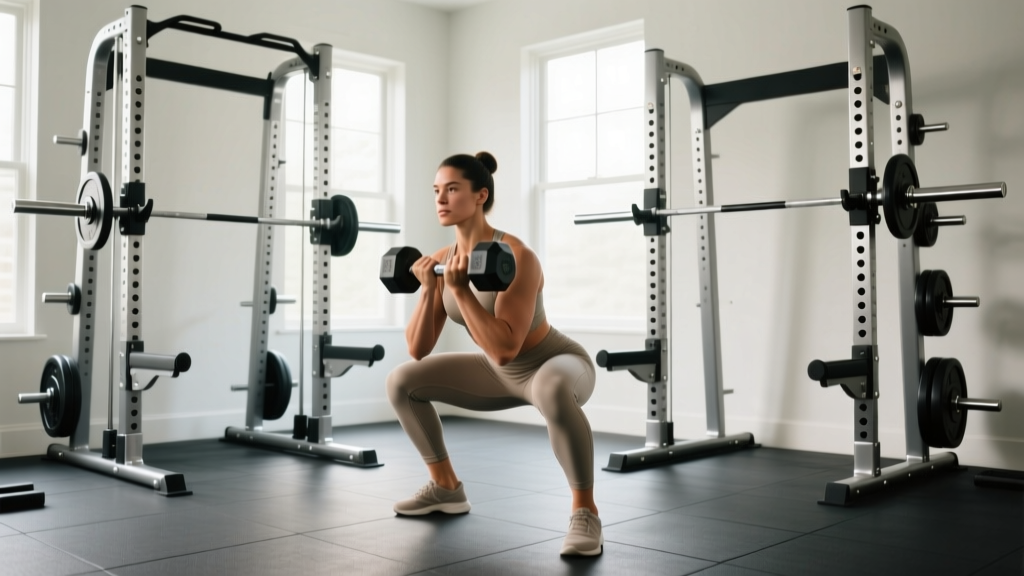
A power rack features four vertical uprights connected by crossmembers. It is the gold standard for safety. If you plan to eventually transition from the dumbbell goblet split squat to heavy barbell front squats or overhead presses, the four-point safety catch system ensures you can fail a rep without being crushed. The primary drawback is the 16-square-foot footprint and the visual bulk it introduces to a room.
2. The Squat Rack (Half Rack)
Half racks utilize two main front uprights and a rear stabilizing base, often integrating weight plate storage horns. This counterbalances the unit, preventing forward tip-overs. They offer more lateral freedom for exercises like walking lunges or lateral split squats, but the front-mounted safety arms can sometimes interfere with the natural bar path if not spaced correctly.
3. The Squat Stand
Squat stands are minimalist, featuring just two independent uprights. Modern iterations, like the Rogue S-2 Squat Stand 2.0 (Rogue Fitness), include a rear crossbar for stability and adjustable heights. For a beginner focusing heavily on dumbbell work, goblet squats, and split squats, a squat stand provides the necessary tactile boundary without dominating your floor space.
Step-by-Step: Executing the Dumbbell Goblet Split Squat
The ExRx.net biomechanics database classifies the goblet split squat as a premier compound movement targeting the quadriceps, gluteus maximus, and adductor magnus, with heavy isometric demand on the core. Here is how to use your rack environment to perfect the movement.
Pro-Tip: The Upright Tactile CueIf you are using a Squat Stand or Power Rack, position your lead foot so that your front knee lightly grazes the vertical upright at the bottom of the movement. This provides instant tactile feedback on your depth and ensures your torso remains upright, preventing the common beginner mistake of excessive forward lean.
- The Stance and Setup: Stand roughly two feet in front of your rack. Hold a single rubber hex dumbbell (35-50 lbs for intermediate beginners) vertically against your chest. Cup the top head of the dumbbell with both hands, keeping your elbows tucked tightly to your ribs.
- The Split: Step one foot back about 2.5 to 3 feet. Your heels should remain on the same lateral plane—do not walk on a tightrope. A wider lateral base drastically improves pelvic stability.
- The Descent: Initiate the movement by dropping your back knee straight down toward the floor. Keep your front shin relatively vertical. The anterior load of the goblet hold forces your thoracic spine to extend; fight the urge to round your shoulders.
- Depth and Boundary: Lower until your back knee is 1 to 2 inches from the rubber matting. If using the rack upright as a depth gauge, tap it gently with your front thigh.
- The Drive: Push through the mid-foot of your front leg. Do not push off your back toe; the rear leg is merely a kickstand for balance. Exhale sharply as you pass the midpoint of the ascent.
Spatial Clearances and Flooring Requirements
When installing your chosen rack, you must account for both ceiling height and flooring compression.
- Ceiling Clearance: Standard power racks are 84' or 90' tall. If you have standard 8-foot (96') ceilings, an 84' rack leaves only 12 inches of clearance. Factor in a 6-inch pull-up bar clearance and the thickness of your flooring. For low ceilings, seek out 'Short' variants (usually 72' or 82' tall).
- Subfloor Protection: Never drop dumbbells or rack barbells on bare concrete or hardwood. Invest in 3/4-inch (4x6 ft) vulcanized rubber horse stall mats. They cost roughly $50 to $60 each at agricultural supply stores and provide the exact 4mm compression resistance needed to keep squat stands from 'walking' across the floor during heavy split squats.
'The biggest mistake beginners make with unilateral leg training is treating the rear leg as a primary mover. The dumbbell goblet split squat is a single-leg exercise; the rear foot is just a balance aid. Your rack setup should allow you to fail safely forward, not laterally.'
2026 Equipment Recommendations for Beginners
Best Budget Squat Stand: Fitness Reality 810XLT
Priced around $220, this 2x2' steel stand is a staple for apartment dwellers. It lacks Westside hole spacing (it uses standard 2' spacing), meaning you might have to do a micro-squat to rack the barbell later, but for dumbbell goblet split squats and kettlebell work, it is exceptionally stable when bolted to a wooden platform.
Best Mid-Tier Power Rack: Rep Fitness PR-1100
At roughly $349, the PR-1100 offers 14-gauge steel and a 44' x 44' footprint, making it slightly more compact than the Rogue R-3. It includes a multi-grip pull-up bar and basic pin safeties, providing a full cage experience for those who want to progress to heavy barbell squats without breaking the $1,000 barrier.
Best Premium Half Rack: Titan Fitness T-3 Series
Hovering around $699, the T-3 Half Rack features 11-gauge 3x3' steel with 1' Westside hole spacing in the bench zone. The open sides are perfect for stepping into and out of split squat variations without feeling claustrophobic inside a full cage.
Frequently Asked Questions
Can I do split squats inside a standard power rack?
Yes, but space is limited. A standard power rack has an internal width of 43 inches. While sufficient for a stationary split squat, walking lunges or dynamic lateral movements will feel cramped. If unilateral dumbbell work is your primary focus, a squat stand or half rack offers superior lateral freedom.
Do I need safety spotter arms for dumbbell work?
Strictly speaking, no. If you fail a dumbbell goblet split squat, you simply drop the dumbbell or step forward. However, if you plan to use the same rack for barbell back squats or bench presses within the next 6 to 12 months, purchasing a rack with integrated or attachable safety spotter arms is non-negotiable for solo training.
What weight dumbbell should I start with?
Most beginners should master the bodyweight split squat first. Once your balance is secure, start with a 20 lb to 25 lb neoprene or urethane dumbbell. Focus on a 3-second eccentric descent. Once you can comfortably perform 3 sets of 10 reps per leg with strict form, graduate to a 40 lb rubber hex dumbbell to stimulate true muscular hypertrophy.
More gear to consider
All reviews
Olympic vs Standard Plates & Love Handles Workout With Dumbbells

Barbell Knurling Guide: Olympic Shafts vs Thomas Inch Dumbbell Trick

Budgeting Loadable Dumbbells for Squat Exercises With Dumbbells
Optimize Dumbbell HIIT Training With Top 2026 Rack Picks

Dumbbell Chest Exercises (No Bench): Rack Storage & Maintenance
