
Dumbbell Deadlift to Curl to Press: Kettlebell Space Guide
Optimize your home gym layout. Compare cast iron vs competition kettlebells as a space-saving alternative to the dumbbell deadlift to curl to press.

The Spatial Reality of the Dumbbell Deadlift to Curl to Press
When designing a high-density home gym, every square foot costs money and limits movement flow. The classic dumbbell deadlift to curl to press is a staple hypertrophy and conditioning complex, combining a posterior chain hinge, an isolation pull, and a vertical push. However, executing this specific movement pattern safely requires significant lateral clearance. A standard adult male with a 70-inch wingspan needs at least a 6x6 foot (36 sq ft) clearance zone to avoid striking walls, mirrors, or power racks during the eccentric and concentric phases of the curl and press.
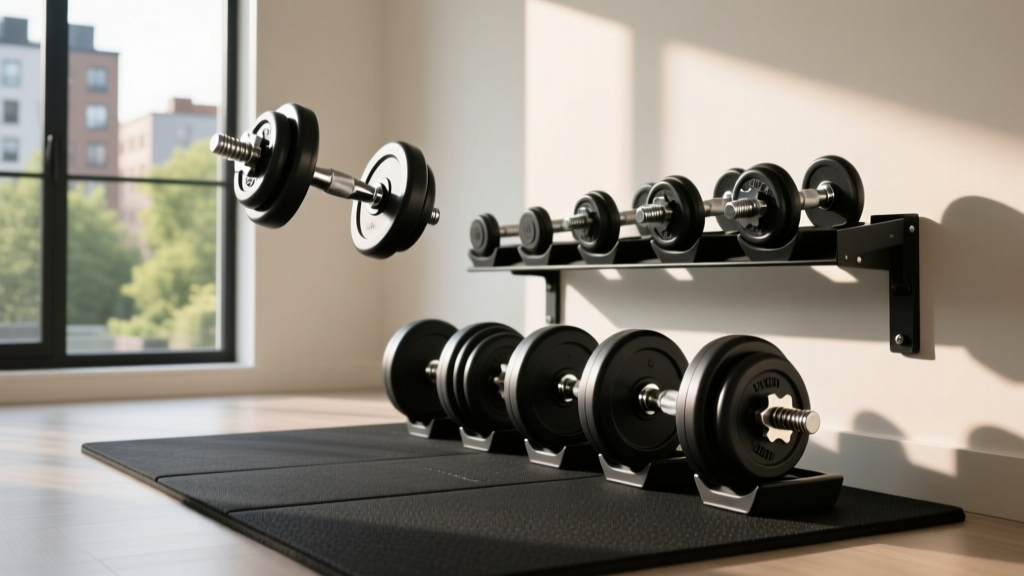
Furthermore, supporting this complex requires a comprehensive dumbbell rack. A typical 5-to-50 lb rubber hex dumbbell set on a 3-tier rack (like the REP Fitness SR-3000) demands a footprint of roughly 44 inches wide by 24 inches deep, plus 3 feet of frontal loading clearance. In a garage gym or spare bedroom, this single station can consume over 50 square feet of usable floor space. For lifters optimizing tight layouts, this spatial tax is untenable. The solution lies in replacing the dumbbell rack with a highly curated set of kettlebells, but choosing between cast iron and competition models requires a deep understanding of spatial geometry.
Cast Iron vs. Competition Kettlebells: A Dimensional Analysis
To replace the dumbbell rack while maintaining the ability to perform heavy, full-body complexes, lifters must evaluate the physical footprint of their implements. The market is divided into two primary categories: traditional Cast Iron and steel Competition kettlebells. From a space optimization perspective, their differences are stark.
| Feature | Traditional Cast Iron | Competition Steel |
|---|---|---|
| 16kg Diameter | ~8.5 inches (varies by brand) | 210mm (8.27 inches) exact |
| 32kg Diameter | ~11.5 inches | 210mm (8.27 inches) exact |
| Handle Clearance | Variable (4.0 to 4.5 inches) | Standardized for two-hand fits |
| Rackability | Poor (requires staggered shelving) | Excellent (uniform stacking) |
| Avg. Price (16kg) | $65 - $80 | $110 - $140 |
The most critical data point for space optimization is dimensional uniformity. According to international standards, competition kettlebells maintain a strict 210mm (8.27-inch) diameter across all weights from 8kg to 32kg. The weight difference is achieved by altering the internal filler material, not the outer steel shell. This means a 12kg, 16kg, and 20kg set will stack perfectly on a compact, single-tier wall-mounted rack, consuming less than 2 square feet of floor space. Cast iron bells, conversely, scale in physical volume. A 32kg cast iron bell can exceed 11 inches in diameter, making uniform racking impossible and forcing you to store them scattered on the floor, creating tripping hazards in tight layouts.
Adapting the Complex: Biomechanics in Tight Spaces
How do we translate the dumbbell deadlift to curl to press into a kettlebell flow for a compact gym? Here, anatomical reality dictates a mandatory modification. Attempting a strict bicep curl with a competition kettlebell is a biomechanical mismatch. The thick handle (33mm to 35mm) and the offset center of mass place extreme torque on the wrist and medial epicondyle. Furthermore, the bell's horn will severely bruise the forearm at the top of the curl.
Expert Modification: The Clean ReplacementReplace the 'curl' with a 'clean.' The Kettlebell Deadlift to Clean to Press achieves the exact same tri-phasic loading (posterior chain pull, anterior deceleration, vertical push) but respects the implement's geometry. As noted by StrongFirst, the clean pulls the bell into the 'rack' position, keeping the elbows tucked and protecting the joints.
Because the clean pulls the bell into the rack position (resting against the forearm and chest), your elbows stay tucked to your ribs. This reduces your lateral wingspan requirement from 6 feet down to roughly 3 feet. You can now perform this heavy complex in a 4x4 foot corridor or the corner of a bedroom, facing a wall with only 12 inches of clearance. This spatial efficiency is impossible to replicate with dumbbells, where the hands must travel outward away from the body's center of mass during the curl phase.
2026 Space-Optimized Buying Guide: Top Picks
When outfitting a micro-gym, your purchasing decisions must balance budget, durability, and spatial efficiency. Here are the top tier options for 2026.
1. Rogue E-Coat Cast Iron Kettlebells
While cast iron lacks the uniform sizing of competition bells, Rogue's E-Coat series is remarkably compact for its weight class. The e-coating prevents rust without adding the thick, space-wasting rubber or urethane layers found on cheaper brands. A set of 16kg and 24kg Rogue bells will cost around $155 total. They are best stored on the floor in a designated corner, utilizing their flat, wide bases for stability. However, be warned: as you scale past 24kg, the physical footprint of the bell expands significantly, which can clutter a tight workout zone.
2. Kettlebell Kings Competition Series
For the ultimate space-saving layout, the Kettlebell Kings Competition line is the gold standard. Priced at roughly $125 per 16kg bell, the premium is justified by the 210mm uniform diameter. You can mount a single 36-inch wide wooden or steel shelf on your wall, and your entire 8kg-24kg collection will sit neatly in a row, completely freeing up your floor space for the deadlift to clean to press complex. The 33mm handle diameter is also optimal for high-repetition flows without tearing the calluses on your palms.
3. Bells of Steel Adjustable Kettlebell (The Ultimate Compromise)
If your layout is so constrained that even three competition bells are too many, the Bells of Steel Adjustable Kettlebell (approx. $250) ranges from 12kg to 32kg in a single footprint. While the handle clearance is slightly tighter than a competition bell, making two-handed swings slightly cramped, it entirely eliminates the need for a rack. It is the apex predator of apartment gym space optimization.
Designing the 4x4 Foot Kettlebell Zone
To safely execute high-velocity kettlebell flows in a micro-layout, your flooring and wall clearances must be engineered precisely. Drop a standard 4x6 foot, 3/4-inch vulcanized rubber horse stall mat (typically $50-$70 at local agricultural supply stores) and trim it down to a 4x4 foot square. This provides adequate shock absorption for dropped bells during the eccentric phase of the clean or press.
According to research published in the National Center for Biotechnology Information (NCBI), kettlebell training elicits high cardiovascular and muscular demands simultaneously, meaning your workout zone will experience heavy sweat and dropped implements. Ensure your wall clearance is at least 18 inches if you are using cast iron bells to account for the wider swing arc of the larger weights, whereas competition bells can be safely pressed within 10 inches of a drywall surface due to their compact, predictable geometry.
Finally, consider your storage hardware. Avoid traditional A-frame kettlebell racks, which consume 8 to 10 square feet of floor space and create visual clutter in small rooms. Instead, utilize heavy-duty wall-mounted brackets rated for 300+ lbs of shear force. By moving your storage vertically, you maintain the open floor plan necessary to transition seamlessly from a heavy deadlift into an explosive press, proving that you do not need a massive dumbbell rack to achieve elite full-body conditioning.
More gear to consider
All reviews
A Beginner's List of Dumbbell Workouts Using Neoprene Weights

What Weight Dumbbells Should I Use Female KG? 2026 Loadable Trends
Master the Dumbbell Chest Fly with Space-Saving Loadable Dumbbells

Cast Iron vs Competition Kettlebells: Solving the Dumbbell Overhead Press Shoulders Dilemma in Small Gyms

Which Orbital is Shaped Like a Dumbbell? Physics & Adjustable Weights
