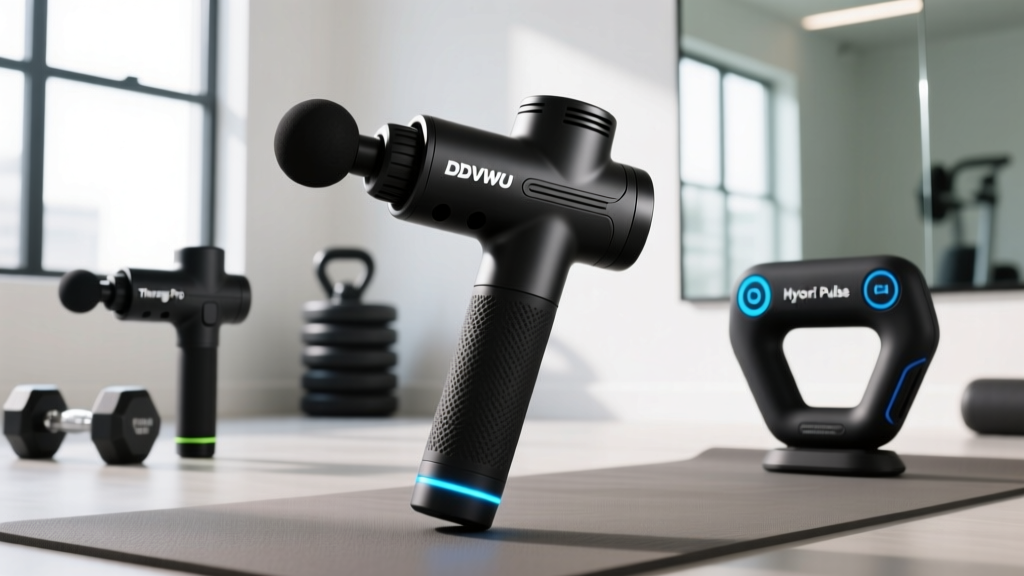
DDVWU Massage Gun vs Premium Brands: 2026 Buying Guide
Is the budget-friendly DDVWU massage gun worth it? Compare its specs, stall force, and value against Theragun and Hyperice in our 2026 buying guide.

The Rise of Budget Percussion Therapy: Where Does DDVWU Fit?
The percussion therapy market has exploded over the last few years, creating a massive divide between $600 clinical-grade devices and $40 e-commerce knockoffs. The DDVWU massage gun sits firmly in the ultra-budget category, frequently trending on online marketplaces as an accessible entry point for casual gym-goers. But when it comes to myofascial release, does a budget price tag mean you are sacrificing therapeutic efficacy, or are premium brands simply relying on marketing hype?
In this 2026 in-depth buying guide, we dismantle the DDVWU massage gun to evaluate its internal mechanics, real-world stall force, and battery longevity. We then compare it directly against mid-tier and elite-tier recovery tools to help you decide where your money is best spent.
Quick Verdict: The DDVWU massage gun is a viable option for light, superficial muscle stimulation and travel. However, with a stroke amplitude of roughly 10mm and a stall force under 30 lbs, it lacks the mechanical power required for deep-tissue myofascial release on large muscle groups like the glutes and hamstrings.DDVWU Massage Gun: Deep Dive into Specs and Real-World Performance
To understand the value of the DDVWU massage gun, we must look past the Amazon listing bullet points and examine the biomechanical realities of its hardware. Budget percussion massagers typically utilize generic, mass-produced reciprocating mechanisms that prioritize cost-efficiency over torque.
Amplitude, Stall Force, and the Depth Deficit
The two most critical metrics for any percussion device are amplitude (how deep the attachment travels) and stall force (how much pressure you can apply before the motor stops). The DDVWU massage gun features an estimated 10mm to 12mm amplitude. While this is sufficient for stimulating superficial nerve endings and promoting localized blood flow, it falls short of the 16mm amplitude required to reach deep fascial layers in dense muscle tissue.
Furthermore, the DDVWU’s brushless motor yields a stall force of approximately 20 to 25 lbs. If you attempt to dig the device into your quadriceps or IT band with moderate pressure, the internal sensor will trigger a safety shutoff to protect the motor. This makes it largely ineffective for heavy athletes or individuals with high muscle density.
Edge Case Warning: Battery Degradation. Budget lithium-ion cells often lack advanced Battery Management Systems (BMS). Users of generic OEM massage guns frequently report severe battery drain and cell imbalance after 6 to 8 months of regular use, effectively turning a $45 device into e-waste.Noise Profile and Ergonomics
One area where the DDVWU massage gun surprisingly competes with premium models is acoustic output. Because the motor operates at a lower maximum torque, it generates less vibrational resonance against its ABS plastic housing. Operating at roughly 45 to 55 decibels on lower speed settings, it is quiet enough to use in a shared living space without causing disruption. The ergonomic grip is standard, though the lack of a multi-grip handle (found on higher-end models) can cause wrist fatigue during extended 15-minute full-body sessions.
2026 Percussion Massager Comparison Matrix
How does the DDVWU stack up against the industry benchmarks? Below is a side-by-side technical comparison of the ultra-budget, mid-tier, and premium tiers.
| Feature | DDVWU (Budget) | Bob and Brad C2 (Mid-Tier) | Theragun PRO Plus (Premium) |
|---|---|---|---|
| Retail Price (2026) | $39 - $55 | $99 - $129 | $599 |
| Amplitude (Stroke) | 10mm - 12mm | 10mm | 16mm |
| Stall Force | ~25 lbs | ~40 lbs | 60 lbs |
| RPM Range | 1800 - 3200 | 1750 - 3200 | 1750 - 2400 |
| Smart Features | None | Basic LCD | Bluetooth, OLED, App Integration |
| Warranty | 30-Day Seller Return | 1-Year Limited | 2-Year Premium |
The Science of Percussive Therapy: What the Data Says
When deciding between a $45 DDVWU and a $600 Theragun, it helps to understand what percussion therapy actually achieves on a cellular level. According to the American Council on Exercise (ACE), percussive therapy operates on two primary physiological mechanisms: the Gate Control Theory of pain and mechanotransduction.
The rapid tapping motion overloads local nerve receptors, effectively "closing the gate" to pain signals traveling to the brain. This provides temporary, localized analgesic relief. However, for actual tissue remodeling and the reduction of Delayed Onset Muscle Soreness (DOMS), the mechanical force must penetrate deep into the muscle belly to stimulate cellular repair—a process known as mechanotransduction.
Furthermore, the Mayo Clinic notes that while massage therapy broadly improves circulation and reduces muscle tension, the specific depth of pressure is paramount for breaking up fascial adhesions. This is where the DDVWU massage gun hits its ceiling; its 10mm amplitude simply cannot deliver the mechanical load required for deep mechanotransduction in thick muscle groups, limiting its utility to superficial nerve stimulation and warm-up routines.
Decision Framework: Which Tier Belongs in Your Gym Bag?
Selecting the right recovery tool requires an honest assessment of your training volume, tissue density, and budget. Use this framework to make your 2026 purchasing decision.
Tier 1: The Ultra-Budget Route (DDVWU)
- Best For: Desk workers, casual walkers, and travelers needing a lightweight, inexpensive tool for superficial neck and shoulder tension.
- Avoid If: You are a powerlifter, CrossFit athlete, or runner who requires deep-tissue intervention for the glutes, calves, and hamstrings.
- Pro Tip: If buying the DDVWU, use it primarily for "flushing" (light, sweeping motions over the skin) rather than digging into trigger points, which will stall the motor.
Tier 2: The Mid-Tier Sweet Spot (Bob and Brad, Hypervolt Go 2)
- Best For: Amateur athletes, weekend warriors, and physical therapy patients who need reliable stall force (35-45 lbs) without spending over $200.
- The Advantage: Mid-tier guns use higher-quality internal gears and branded lithium-ion cells, ensuring the device lasts for years rather than months.
Tier 3: The Elite Clinical Tier (Theragun PRO, Hyperice Hypervolt 2 PRO)
- Best For: Elite athletes, massage therapists, and individuals with chronic, deep-seated myofascial pain syndrome.
- The Advantage: 16mm amplitude and 60+ lbs of stall force allow for true deep-tissue manipulation. Smart-app integration also guides users through specific neurological recovery protocols.
Frequently Asked Questions (FAQ)
Can the DDVWU massage gun help with sciatica?
Percussion therapy should be used with extreme caution around the sciatic nerve. While the light vibration of the DDVWU may temporarily soothe the surrounding gluteal muscles (like the piriformis), applying a percussion device directly to the nerve pathway can exacerbate inflammation. Always consult a physical therapist before treating nerve-related pain.
Why does my budget massage gun stop when I press hard?
This is a safety mechanism triggered by exceeding the device's "stall force." Budget motors lack the torque to push through high resistance. When the internal sensor detects the motor slowing down beyond a safe threshold, it cuts the power to prevent the internal plastic gears from stripping or the lithium-ion battery from overheating.
Are expensive massage guns just a placebo?
No. The premium price of elite devices pays for high-torque brushless motors, aerospace-grade aluminum housings, and advanced battery management systems. More importantly, the 16mm amplitude on premium devices physically reaches deeper muscle layers that a 10mm budget device simply cannot touch, resulting in measurable differences in fascial release and DOMS reduction.
How should I maintain a budget massage gun to extend its life?
To maximize the lifespan of a budget lithium-ion battery, never let it drain to 0%, and never leave it plugged in overnight once it reaches 100%. Store the device in a climate-controlled environment, as extreme heat or cold will rapidly degrade the cheap battery cells and cause the internal lubricants in the reciprocating arm to thicken or thin out.
More gear to consider
All reviews
Home Ice Bath Maintenance & Brookstone Massage Gun Care

Phoenix A2 Massage Gun vs Infrared Sauna Blanket & Panel Guide

Massage Gun Makes Me Itchy? Heat Therapy Pad and Wrap Comparison

Theragun vs Hyperice vs Bondir Massage Gun: 2026 Value Breakdown

Heat Pads, Wraps, or a Massage Gun: 2026 Recovery Guide
