What's the Advantage of a Curved Treadmill? Curved vs Motorized
Discover what's the advantage of a curved treadmill in our head-to-head test. We compare the TrueForm Runner and Sole F80 to help you choose.

When building a high-performance home gym in 2026, the debate between self-powered curved treadmills and traditional motorized flat decks is more relevant than ever. If you have been researching high-end cardio equipment, you have likely asked: what's the advantage of a curved treadmill? The short answer lies in biomechanical activation, self-regulated pacing, and long-term mechanical simplicity. However, curved treadmills are not a universal replacement for motorized models, especially when interactive programming and steady-state incline walking are your primary goals.
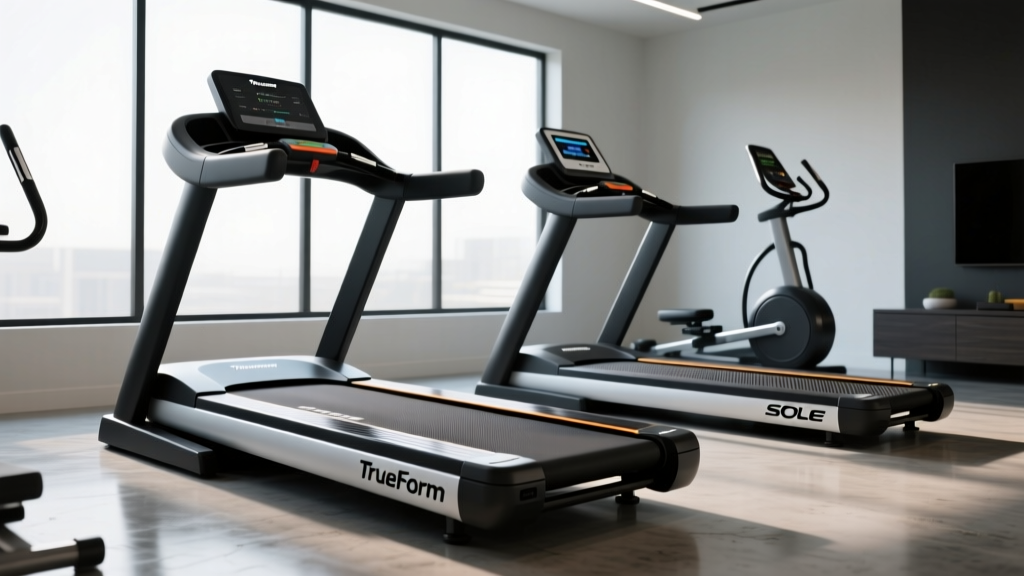
To provide a definitive answer, we are putting the premium TrueForm Runner (a hallmark curved, non-motorized treadmill) head-to-head against the Sole F80 (a top-tier motorized flat treadmill). This buying guide comparison will dissect belt mechanics, failure modes, and caloric output to help you make an informed investment.
Quick Data Highlight: Curved vs. Flat Output
- Caloric Expenditure: Studies show curved treadmills demand up to 30% more energy at the same perceived pace compared to motorized flat decks.
- Ground Reaction Forces: Curved decks naturally encourage a forefoot or midfoot strike, reducing peak impact forces on the tibial tuberosity and patellofemoral joint.
- Top Speed Limitations: Motorized decks cap at 12-15 mph; curved decks are limited only by your biomechanical output (often exceeding 18+ mph for sprint athletes).
The Biomechanical Edge: Why Curve Matters
To truly understand what's the advantage of a curved treadmill, we must look at ground reaction forces and muscle recruitment. On a motorized treadmill like the Sole F80, the belt pulls your foot backward. Your primary muscular focus is on stabilizing the pelvis and lifting the leg. On a curved treadmill like the TrueForm Runner, the user must actively push the belt backward, engaging the posterior chain—specifically the gluteus maximus, hamstrings, and calves—during the drive phase.
According to biomechanical research indexed in PubMed studies on non-motorized treadmill kinematics, running on a curved surface significantly increases the activation of the biceps femoris and alters the foot strike pattern. The downward curve at the front of the deck naturally discourages heavy heel-striking, which is a common culprit for shin splints and knee pain in over-striding runners.
Head-to-Head Matchup: TrueForm Runner vs. Sole F80
Let us break down the raw specifications and feature sets of these two category leaders to see how they stack up for home use in 2026.
| Feature Category | TrueForm Runner (Curved) | Sole F80 (Motorized Flat) |
|---|---|---|
| Price (2026) | $4,295 | $1,999 |
| Belt Material | Vulcanized Rubber Slats | Continuous PVC Multi-ply |
| Running Surface | 17' W x 62' L (Curved) | 20' W x 60' L (Flat) |
| Incline/Decline | Fixed Curve (Simulates 3-5%) | 0% to 15% Motorized Incline |
| Interactive Tech | Optional Bluetooth Pod (Metrics only) | 9-inch HD Touchscreen (Sole+ App) |
| Footprint | 66' L x 33' W x 65' H | 82' L x 35' W x 63' H |
Drive Systems and Belt Mechanics
The Sole F80 utilizes a 3.5 Continuous Horsepower (CHP) DC motor driving a continuous PVC belt over a medium-density fiberboard (MDF) deck. The deck is coated with a silicone-based lubricant to reduce friction. This setup provides a consistent, predictable surface ideal for steady-state Zone 2 cardio and long-distance pacing where maintaining an exact speed (e.g., 8.5 mph) is critical.
Conversely, the TrueForm Runner uses 72 individual vulcanized rubber slats mounted on a sealed ball-bearing track. There is no motor, no drive belt, and no MDF deck to lubricate. The resistance comes from the natural friction of the guide rails and the incline of the curve. This means your speed is entirely dictated by your center of mass: lean forward and push to accelerate, sit back to decelerate. This 1:1 input-to-output ratio is why sprinters and CrossFit athletes prefer curved models for high-intensity interval training (HIIT).
Interactive Tech and Incline Capabilities
Where the motorized Sole F80 completely dominates is in programmed variability. With its 15% motorized incline and integrated Sole+ app connectivity, you can simulate hill climbs, follow guided scenic routes, and execute automated speed intervals. As noted in the Consumer Reports Treadmill Buying Guide, motorized incline capabilities are a primary driver for consumers focused on walking pad alternatives and low-impact rucking routines.
Curved treadmills lack mechanical incline adjustment. The curve itself simulates a mild 3% to 5% grade, but if you want to do a 12-3-30 workout (12% incline, 3 mph, 30 minutes), a curved treadmill physically cannot accommodate that specific protocol. If interactive, gamified fitness classes are your primary motivator, a motorized deck with a large screen is the superior choice.
Expert Insight: Real-World Failure Modes
Understanding how these machines break down is crucial for long-term ownership. Here are the actual edge cases and failure points we see in the field:
- Motorized (Sole F80): The 3.5 CHP motor relies on a Pulse Width Modulation (PWM) motor controller. Dust accumulation on the MOSFET heat sink causes thermal throttling and eventual control board failure. Additionally, continuous use without re-tensioning the drive belt causes the front roller to slip, creating a noticeable 'stutter' or hesitation at heel strike.
- Curved (TrueForm): With no motor to burn out, the failure points shift to the polyurethane slat bearings and the UHMW (Ultra-High Molecular Weight) polyethylene guide rail strips. If a user consistently runs with a heavy lateral asymmetry (favoring one leg), the inner guide rails wear unevenly, causing a subtle lateral drift and increased rolling resistance over time.
Caloric Expenditure and Training Adaptation
When evaluating cardiovascular equipment, efficiency matters. Because the user must manually propel the belt on a curved treadmill, the metabolic cost is significantly higher. Mayo Clinic guidelines on aerobic exercise emphasize the importance of reaching specific heart rate zones for cardiovascular adaptation. On a TrueForm Runner, you will reach your target heart rate zone at a noticeably slower physical speed compared to the Sole F80.
For example, a 175 lb runner might hit 145 BPM (Zone 3) at 7.0 mph on a flat motorized deck. On a curved treadmill, that same runner will likely hit 145 BPM at just 5.8 mph. This makes curved treadmills exceptionally valuable for athletes recovering from lower-leg impact injuries who need to maintain cardiovascular conditioning without the high-velocity joint pounding.
The Buyer's Decision Framework
Do not buy based on hype; buy based on your specific training modalities. Use this framework to make your final decision:
- Choose the Curved Treadmill (TrueForm/Woodway) if: You prioritize HIIT, sprint intervals, and posterior chain activation. You want a zero-maintenance machine with no motor to replace. You have limited floor length (curved models are generally shorter). You want to eliminate the risk of being thrown off the back of a moving belt.
- Choose the Motorized Flat Treadmill (Sole/NordicTrack) if: You rely on structured, screen-guided programming or automated incline/decline workouts. You primarily do steady-state Zone 2 jogging or walking. You need a wider belt (20+ inches) for lateral movement or a more forgiving surface for heavy heel-strikers. You are on a budget under $2,500.
Frequently Asked Questions
Can you walk on a curved treadmill?
Yes, but it requires practice. Because the belt is self-propelled, walking at very slow speeds (under 2.0 mph) can feel jerky as you must overcome the static friction of the slat track with each step. Motorized treadmills are much smoother for slow, rehabilitation-level walking.
Do curved treadmills require electricity?
Standard curved treadmills like the TrueForm Runner require zero electricity to operate the belt. However, if you purchase an optional digital display or Bluetooth metrics pod, those small accessories will require occasional battery changes or a low-voltage plug, but the machine's core function is entirely human-powered.
Which is better for knee pain?
Curved treadmills generally offer an advantage for knee pain sufferers. The curved geometry naturally forces a midfoot or forefoot strike, which reduces the sharp braking forces transmitted through the knee joint that occur during heavy heel-striking on flat decks. Additionally, the thick vulcanized rubber slats provide superior shock absorption compared to standard MDF flat decks.
More gear to consider
All reviews
Walk on Treadmill to Lose Weight vs Stationary Bike Types
Apple Fitness Treadmill Belt Maintenance: Cost & Value Guide
Walking on Treadmill with Weighted Vest vs Spin & Recumbent Bikes

Top Compact Picks for Your Treadmill Exercise Plan (2026 Review)
2026 Under Desk Treadmill Review: Seeking True Treadmill Soft System
