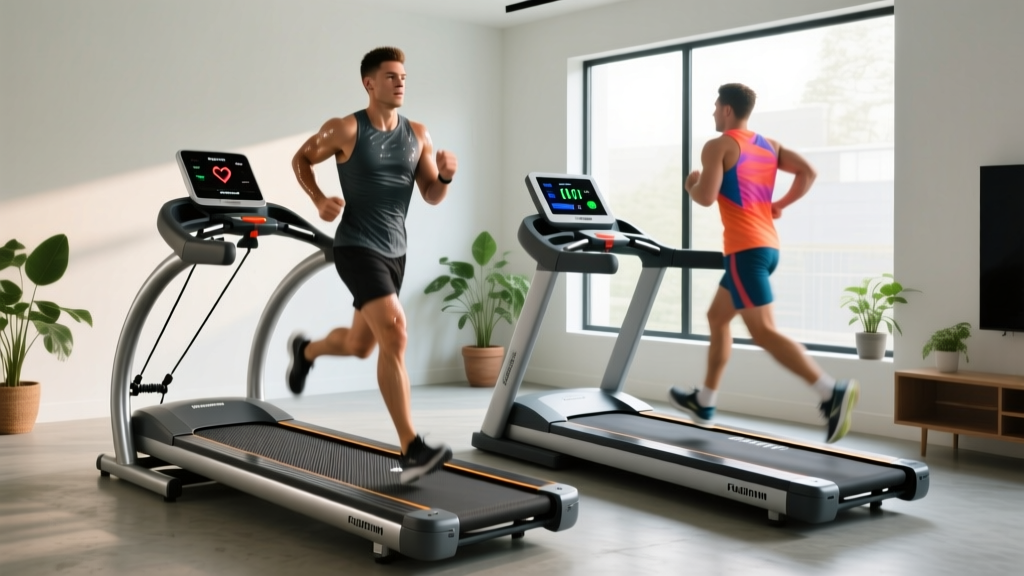
Curved vs Motorized: High Intensity Workout on Treadmill Guide
Master your high intensity workout on treadmill with our beginner guide. Compare curved manual vs motorized treadmills for HIIT, with step-by-step plans.

The Biomechanics: Curved Manual vs. Motorized Treadmills
When designing a high intensity workout on treadmill equipment, beginners often overlook the mechanical differences between the machine types. The choice between a curved manual treadmill and a traditional motorized treadmill fundamentally alters your biomechanics, energy expenditure, and interval timing. As of 2026, the fitness industry has clearly delineated these two categories, each serving distinct physiological purposes.
Curved treadmills (like the TrueForm Runner or Assault AirRunner) are non-motorized, slat-belt machines driven entirely by your stride. The concave shape forces a forefoot strike and engages the posterior chain (glutes and hamstrings) to pull the belt. Conversely, motorized treadmills (like the Sole F80 or NordicTrack Commercial 1750) use a continuous horsepower (CHP) motor to pull the belt beneath you, which heavily engages the hip flexors and quadriceps to keep pace.
According to the American College of Sports Medicine (ACSM), High-Intensity Interval Training (HIIT) relies on rapid spikes in heart rate. The machine you choose dictates how quickly you can achieve and recover from those spikes.
Head-to-Head Comparison Matrix
| Feature | Curved Manual (e.g., TrueForm Runner) | Motorized (e.g., Sole F80) |
|---|---|---|
| Average Price (2026) | $3,495 - $4,995 | $999 - $2,499 |
| Drive Mechanism | Self-powered (Gravity & Friction) | Electric Motor (3.0 - 4.0 CHP) |
| Speed Transition | Instantaneous (0 to 15mph in 1 second) | Delayed (3 to 8 seconds ramp-up) |
| Incline Capability | Fixed curve (simulates 8-10% grade) | Adjustable (0% to 15%) |
| Caloric Expenditure | Up to 30% higher per minute | Standard baseline |
| Ideal HIIT Style | Short, explosive sprints (10-20s) | Longer intervals, incline surges |
Step-by-Step: High Intensity Workout on Treadmill (Curved Edition)
Executing a high intensity workout on treadmill models with a curved deck requires specific form adjustments. Because there is no motor to pull your feet, you must become the engine. Beginners frequently make the mistake of standing too upright, which stalls the belt.
⚠️ Beginner Safety Warning: Never attempt to jump off a moving curved treadmill belt. To stop, gradually slow your pace to a walk, grasp the side handrails, and step laterally onto the stationary side platforms.The 15-Minute Curved Sprint Protocol
- The Mount (0:00 - 3:00): Step onto the side rails. Grasp the front handles, lean forward at a 5-to-10-degree angle, and begin walking. As you gain confidence, drop the handles and let your arms swing naturally.
- The Posture Check (3:00 - 5:00): Maintain a slight forward lean from the ankles, not the waist. Your foot should strike the lowest point of the curve. Striking too high on the front arc acts as a brake; striking too far back will cause you to slip.
- The Sprint Intervals (5:00 - 13:00): Perform 15 seconds of all-out sprinting. Drive your knees up and push through the balls of your feet. Follow immediately with 45 seconds of active recovery (a slow, deliberate walk). Repeat this 1:4 work-to-rest ratio 8 times.
- The Dismount (13:00 - 15:00): Slow to a walking pace. Grab the handrails, step onto the side rails, and perform static calf stretches while your heart rate descends.
Step-by-Step: High Intensity Workout on Treadmill (Motorized Edition)
Motorized treadmills offer a different challenge: machine lag. If you are programming a high intensity workout on treadmill equipment with a standard 3.0 CHP motor, the belt takes time to accelerate. Waiting 8 seconds for the belt to reach 10 mph ruins the efficacy of a 20-second sprint interval.
To bypass this, we use the 'Straddle and Incline' method, heavily endorsed by experts at the Mayo Clinic for maintaining cardiovascular intensity without relying solely on top-end speed.
The 20-Minute Motorized Incline Surge Protocol
- Safety First: Clip the magnetic safety lanyard to your shirt. If you stumble during a speed transition, this will instantly kill the motor.
- Baseline Warmup (0:00 - 5:00): Set the incline to 1% (to simulate outdoor wind resistance) and walk at 3.0 mph. Gradually increase to a light jog at 5.0 mph.
- The 'Straddle' Sprint Setup: Instead of waiting for the motor to speed up, increase the speed to your sprint target (e.g., 9.0 mph) while standing on the stationary side rails. Hold the handrails, place your feet on the moving belt one at a time, and let go.
- The Incline Intervals (5:00 - 17:00): Keep the speed at a brisk run (6.5 mph). Every 60 seconds, use the 'Quick Incline' buttons to spike the grade to 12% for 30 seconds. Return to 2% incline for 30 seconds of recovery. Repeat 12 times. This spikes the heart rate identically to flat sprinting but saves your Achilles tendons from high-impact forces.
- Cool Down (17:00 - 20:00): Drop the incline to 0% and reduce speed to 2.5 mph. The American Council on Exercise (ACE) emphasizes that a gradual 3-minute cool down is critical for preventing blood pooling in the lower extremities after intense motorized intervals.
Real-World Edge Cases & Maintenance Failures
Beginners rarely consider the mechanical failure modes of cardio equipment until they are mid-sprint. Here are the specific edge cases you must manage depending on your machine type:
- Curved Treadmill Slat Slippage: The polyurethane slats on a curved treadmill run on ball bearings. If you live in a low-humidity climate, the PTFE (Teflon) lubricant can dry out within 6 months. Symptom: The belt feels 'sticky' or requires excessive force to start. Fix: Apply a manufacturer-approved silicone/PTFE spray to the guide rails every 200 miles.
- Motorized Drive Belt Snapping: Many beginners purchase budget motorized treadmills with 2.5 CHP (Continuous Horsepower) motors. If a user weighing over 220 lbs attempts repeated HIIT sprint intervals, the sudden torque demand can snap the internal drive belt or overheat the motor controller. Rule of Thumb: Never use a machine with less than 3.25 CHP for sprint-based HIIT.
- Console Freezing During iFit/Peloton Updates: Smart motorized treadmills frequently push firmware updates over Wi-Fi. If an update initiates during your 30-second rest period, the console may reboot, dropping the belt speed to 0 mph unexpectedly. Always force a manual firmware check via the settings menu before beginning a high intensity workout on treadmill hardware.
The 2026 Buyer’s Decision Framework
Which machine should you dedicate your garage or guest room to? Use this quick framework to decide:
Choose a Curved Manual Treadmill If:
- Your primary goal is athletic performance, sprint mechanics, and maximum calorie burn in under 20 minutes.
- You want zero electrical dependency and lower long-term maintenance (no motor to burn out, no electronic console to fail).
- You have a dedicated space (curved machines are heavier and harder to move once placed).
Choose a Motorized Treadmill If:
- You prefer guided, screen-based workouts with automatic speed/incline adjustments.
- You want to incorporate long, steady-state Zone 2 endurance runs alongside your HIIT sessions.
- You need joint-friendly shock absorption systems (like the Sole F80's Cushion Flex deck) which are superior to the firm rubber slats of a curved runner.
Expert Takeaway: A high intensity workout on treadmill equipment is only as effective as your ability to safely transition between work and rest phases. Master the straddle technique on motorized decks, and perfect your forefoot strike on curved decks, and you will unlock elite cardiovascular adaptations right in your living room.
More gear to consider
All reviews
2026 Trends: Portable Cardio & The Treadmill Max Incline Race

Best Walking Pads for a Beginner on Treadmill Workouts (2026)

Under Desk Treadmill Review: Garmin Treadmill Walk Value Analysis

IN10CT Treadmill: How to Use, Maintain, and Maximize Longevity

Curved vs Motorized Treadmill Setup: Stress Test No Treadmill Guide
