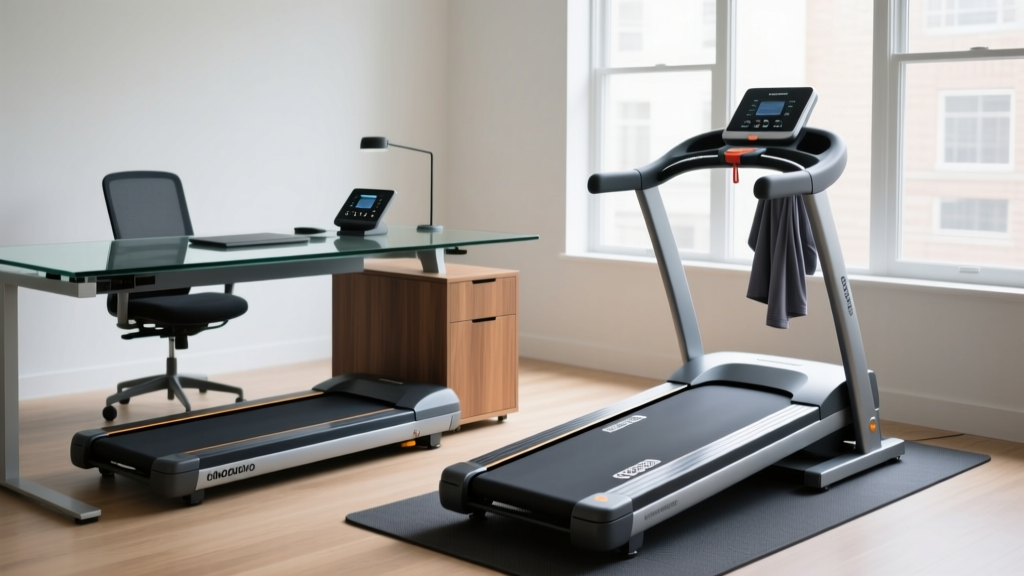
Curved Manual vs Motorized: ProForm 650 LT Treadmill Compared
We compare the biomechanics, durability, and cost of a curved manual treadmill against the motorized ProForm 650 LT treadmill to help you choose.

The Treadmill Paradigm Shift: Budget Motorized vs. Premium Curved
The home fitness market in 2026 is defined by a stark divergence in cardio technology. On one end of the spectrum, you have traditional, budget-friendly motorized models like the ProForm 650 LT treadmill, which relies on a continuous-duty motor to pull a PVC belt across a wooden deck. On the other end, curved manual treadmills (such as the TrueForm Trainer or AssaultRunner Elite) utilize a slatted, self-powered design that demands 100% human effort. Comparing a sub-$600 entry-level motorized machine against a $3,000+ premium curved manual might seem like comparing apples to oranges. However, understanding the mechanical, biomechanical, and financial chasm between these two designs is critical for buyers trying to decide whether to save money upfront or invest in long-term athletic performance.
This head-to-head analysis strips away the marketing fluff. We will examine the exact failure modes, ground reaction forces, and real-world pacing limitations of the ProForm 650 LT treadmill when pitted against the physics of a curved manual alternative.
Biomechanics and Belt Mechanics: Slats vs. PVC
The most profound difference between these two machines lies in how they interact with human biomechanics. The ProForm 650 LT features a standard 18-inch by 55-inch 1-ply PVC belt gliding over a medium-density fiberboard (MDF) deck. Because the motor pulls the belt backward, the user is forced to react to the machine's pace. According to gait analysis principles supported by the American College of Sports Medicine, this motorized pull often encourages a rearfoot (heel) strike, which increases the braking forces and sends higher vertical ground reaction shocks directly up the tibia and into the knee joint.
Conversely, a curved manual treadmill features a running surface made of 70 to 80 individual rubber slats mounted on ball bearings. The curve itself is not a gimmick; it is a biomechanical necessity. To move the belt, the user must push down and back, which naturally forces a midfoot or forefoot strike. This engages the posterior chain (glutes, hamstrings, and calves) and significantly reduces the impact load on the patellofemoral joint. You are not falling forward and catching yourself on a moving belt; you are actively propelling the mass of the machine.
Expert Insight: The Posture Factor
On the ProForm 650 LT, users frequently lean back slightly to counter the belt's pull, especially at the machine's top speed of 10 MPH. On a curved manual treadmill, leaning forward shifts your center of gravity past the apex of the curve, naturally accelerating the belt. Your posture dictates your speed, promoting a much more natural, overground running form.
Power Output: 2.0 CHP Motor vs. The Human Engine
The ProForm 650 LT is equipped with a 2.0 Continuous Horsepower (CHP) motor. In the budget motorized category, a 2.0 CHP motor is designed primarily for walking and light jogging. If a 220-pound user attempts to run at 8 MPH on a 5% incline, the motor must draw significantly more amperage to overcome the friction and weight. This is where the machine meets its physical ceiling. The motor controller will heat up, and if pushed past its duty cycle, it will trip the internal thermal breaker or degrade the motor brushes prematurely.
A curved manual treadmill has no motor, meaning its top speed is entirely limited by human output. Elite sprinters can push a curved treadmill past 16 MPH for short intervals, generating upwards of 1,200 watts of power output. Furthermore, studies on non-motorized ergometers, frequently cited by the American Council on Exercise, demonstrate that running on a curved manual treadmill requires up to 30% more caloric expenditure than running at the exact same speed on a motorized treadmill. The absence of a motor means you are doing 100% of the work to overcome the inertia of the heavy slatted belt.
Head-to-Head Specification Matrix
| Feature | ProForm 650 LT (Motorized) | Benchmark Curved Manual (e.g., TrueForm) |
|---|---|---|
| Drive System | 2.0 CHP Electric Motor | Self-Powered (72 Rubber Slats) |
| Top Speed | 10 MPH (Fixed Limit) | Unlimited (User-Dependent) |
| Belt Dimensions | 18' x 55' PVC | 17' Wide Slatted Curve |
| Incline | 0% to 10% Motorized | Fixed Curve (Simulates 6-8% grade) |
| Weight Capacity | 300 lbs | 400+ lbs |
| Footprint | 70' x 28' (Folding) | 72' x 32' (Non-Folding) |
| Avg. 2026 Price | $499 - $599 | $3,200 - $3,800 |
Long-Term Durability and Real-World Failure Modes
When investing in cardio equipment, understanding how a machine breaks is just as important as knowing how it performs. The failure modes of the ProForm 650 LT and a curved manual treadmill are entirely different, dictated by their respective mechanical complexities.
ProForm 650 LT Failure Modes
- Deck Friction and MCB Burnout: The MDF deck requires regular application of 100% silicone lubricant. If neglected, the friction coefficient between the PVC belt and the deck spikes. This forces the motor to draw excess current, which eventually blows the MOSFET transistors on the Motor Control Board (MCB). Replacing an MCB out of warranty costs roughly $120 to $180.
- Belt Stretching and Tracking: Over 150 to 200 hours of use, the PVC belt will stretch. Users must manually adjust the rear roller tension bolts. Over-tightening these bolts to fix a slipping belt will destroy the front and rear roller bearings within weeks.
- Electronic Console Degradation: Budget LCD consoles are susceptible to power surges and moisture ingress from sweat, leading to dead pixels or unresponsive membrane buttons after 3 to 5 years.
Curved Manual Failure Modes
- Bearing Seizure: The 72 individual slats ride on sealed ball bearings along a curved track. While the track requires no lubrication, high-humidity environments combined with heavy sweat drip can cause surface rust on the guide rails, leading to a grinding sensation and eventual bearing seizure.
- Slat Degradation: The rubber slats are highly durable, but aggressive use with improper footwear (like deep-lugged trail running shoes) can prematurely wear down the rubber tread pattern, requiring a full belt replacement (a $400+ service).
While the ProForm 650 LT requires frequent, low-cost maintenance (silicone lube, belt tensioning), a curved manual treadmill requires almost zero daily maintenance but carries a much higher cost if a catastrophic component failure occurs outside the warranty period.
The 2026 Buyer’s Decision Framework
Choosing between the ProForm 650 LT treadmill and a curved manual alternative comes down to your specific biomechanical needs, budget, and training goals. Use this framework to make your final decision.
Who Should Buy the ProForm 650 LT?
- Strict Budget Constraints: If your absolute ceiling for fitness equipment is under $700, the 650 LT offers a reliable, folding platform for daily movement.
- Walkers and Light Joggers: If your primary routine consists of walking at 3.0 to 4.0 MPH while watching television or listening to podcasts, the motorized convenience is superior. Curved treadmills are notoriously difficult to 'walk' slowly on due to the resistance of the heavy slats.
- Space-Constrained Homes: The 650 LT features a folding deck mechanism, allowing it to be tucked away in a closet or corner, whereas curved treadmills are rigid, welded steel structures that demand permanent floor space.
Who Should Buy a Curved Manual Treadmill?
- HIIT and Sprint Athletes: If you perform Tabata or high-intensity interval training, the ability to jump on the rails, sprint at 14 MPH, and instantly slow down without waiting for a motor to decelerate is a game-changer.
- Heavy Runners (220+ lbs): The 300 lb weight capacity and 2.0 CHP motor of the ProForm 650 LT will struggle and degrade quickly under heavier, faster runners. Curved treadmills easily support 400 lbs because the structural load is distributed across the steel frame and slat bearings, not a small electric motor.
- Biomechanical Rehabilitation: Runners recovering from patellar tendonitis or shin splints will benefit immensely from the reduced impact and forced forefoot strike of the curved design.
Frequently Asked Questions
Can I do sprint intervals on the ProForm 650 LT?
While the ProForm 650 LT tops out at 10 MPH, it is not recommended for true sprint intervals. The 55-inch belt length is too short for the elongated stride of a heavy sprinter, and the 2.0 CHP motor cannot accelerate fast enough to simulate the explosive demands of track sprinting. Furthermore, jumping onto a moving motorized belt poses a significant safety risk compared to the self-paced acceleration of a curved manual treadmill.
Does the ProForm 650 LT require a special electrical outlet?
No, but it should be plugged directly into a dedicated 120V, 15-amp wall outlet. Avoid using extension cords or power strips. If the motor draws a sudden spike in amperage during an incline jog, a standard extension cord can cause a voltage drop, which will starve the motor control board and potentially cause it to fail prematurely.
Is a curved manual treadmill completely silent?
No. While they lack the hum of an electric motor, curved treadmills produce a distinct, rhythmic 'thwack' as the rubber slats hit the guide rails with every footstrike. In a multi-story home, this low-frequency vibration can transfer through the floor joists, making a high-density rubber equipment mat an absolute necessity for noise dampening.
More gear to consider
All reviews
Curved vs Motorized: Best Treadmill Workout to Lose Weight

Walking Machine Treadmill vs Stationary Bike Types: Value Analysis
Air Bike vs Assault Bike: Space & Average Treadmill Dimensions

Rowing Machine vs 10 Speed Treadmill: Beginner Step-by-Step Guide
Treadmill Dimensions & Noise: Head-to-Head 2026 Comparison