Curved Manual vs Motorized: FreeMotion 850 Treadmill Guide
Discover the differences between curved manual and motorized treadmills. Our step-by-step guide compares the FreeMotion 850 treadmill for beginners.

The Ultimate Beginner's Guide: Curved Manual vs. Motorized Treadmills
Stepping into the world of home cardio can be overwhelming, especially when faced with the ultimate equipment debate: curved manual treadmills versus traditional motorized models. As we navigate the fitness landscape in 2026, both technologies have evolved significantly, catering to vastly different biomechanical needs and fitness goals. If you are a beginner trying to decide which machine deserves a spot in your home gym, you are in the right place.
In this step-by-step guide, we will break down the mechanics, costs, and real-world applications of both styles. To give you a concrete benchmark for the motorized category, we will be comparing curved manual units against the premium FreeMotion 850 treadmill, a gold-standard motorized model renowned for its durability and advanced features. Let's walk through the decision-making process together.
Step 1: Understand the Core Biomechanical Differences
Before looking at price tags or digital screens, you must understand how these machines interact with your body. The fundamental difference lies in who is doing the work to move the belt.
How Curved Manual Treadmills Work
Curved treadmills are entirely self-powered. The running surface is made of individual rubber slats attached to a ball-bearing track, shaped in a concave curve. To move the belt, you must push backward and downward with your feet. This design naturally forces a forefoot or midfoot strike, engaging your posterior chain (glutes, hamstrings, and calves) much more heavily than a flat surface. Because there is no motor, your top speed is limited only by your physical capability.
How Motorized Treadmills Work
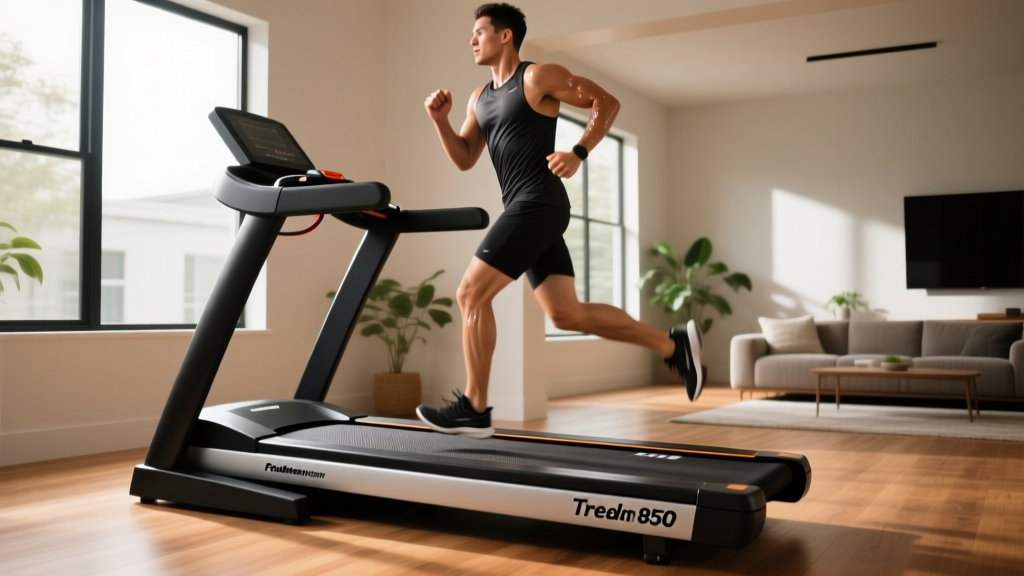
Motorized treadmills, like the FreeMotion 850 treadmill, rely on an electric motor to pull the continuous rubber belt beneath your feet. Your primary physical job is to keep up with the belt's pace and lift your feet. This setup allows for a more traditional heel-to-toe running gait and makes it significantly easier to maintain a steady-state pace while watching a screen or listening to a podcast. According to the Mayo Clinic, maintaining a consistent, moderate pace on a motorized treadmill is an excellent, low-barrier entry point for beginners building cardiovascular endurance.
Step 2: Compare the Hardware, Specs, and Pricing
As a beginner, it is crucial to understand what you are actually buying. Below is a direct comparison matrix between a standard premium curved manual treadmill (such as the TrueForm Runner or AssaultRunner Elite) and our motorized benchmark, the FreeMotion 850 treadmill.
| Feature | Curved Manual Treadmill | FreeMotion 850 Treadmill (Motorized) |
|---|---|---|
| Average Price (2026) | $3,500 - $5,500 | $2,800 - $3,200 |
| Power Source | 100% Human-Powered (No outlet needed) | Standard 120V / 15-Amp Dedicated Circuit |
| Motor Size | N/A | 4.0 Continuous Horsepower (CHP) |
| Running Surface | ~17" x 63" (Slat Belt) | 20" x 60" (Continuous Rubber Belt) |
| Top Speed | Infinite (User-Dependent) | 12 MPH |
| Incline/Decline | Fixed Curve (Simulates ~8% grade) | Automated 0% to 15% Incline |
| Maintenance | Low (Occasional slat lubrication) | Medium (Belt alignment, motor dusting) |
Step 3: Align the Machine With Your Fitness Goals
Your choice should ultimately be dictated by how you plan to exercise. The American Heart Association recommends at least 150 minutes of moderate-intensity or 75 minutes of vigorous aerobic activity per week. Here is how each machine helps you hit those targets.
Choose a Curved Manual Treadmill If:
- You want High-Intensity Interval Training (HIIT): Curved treadmills allow for instant speed changes. You can go from a walk to an all-out sprint in a single stride, making them perfect for Tabata or sprint intervals.
- You want to improve running form: The curve punishes heel-striking and encourages a higher cadence, which can translate to better outdoor running mechanics and reduced joint impact over time.
- You have limited power access: If your home gym is in a basement, garage, or shed without dedicated electrical circuits, a self-powered curve is the only safe option.
Choose the FreeMotion 850 Treadmill (Motorized) If:
- You prefer steady-state cardio: If your goal is to maintain a 10-minute mile pace for 45 minutes while watching TV, a motorized belt does the heavy lifting of pacing you.
- You need incline versatility: The FreeMotion 850 treadmill allows you to simulate rolling hills with automated incline adjustments up to 15%, something a fixed-curve manual treadmill cannot replicate.
- You are recovering from an injury: The predictable, flat, and cushioned surface of a high-end motorized deck is generally safer for beginners dealing with Achilles or calf issues, which can be aggravated by the forefoot strike required on curved models.
Step 4: Evaluate Your Home Gym Infrastructure
Before clicking 'checkout', measure your space and check your electrical panel.
Footprint and Floor Loading
Curved treadmills are typically shorter in length (around 70 inches) but are incredibly heavy, often weighing between 350 and 400 pounds due to their steel frames and dense slat belts. You must ensure your floor joists can support this concentrated weight. The FreeMotion 850 treadmill is longer (roughly 80 inches) and requires an additional 24 inches of clearance behind it for safety. It weighs around 280 pounds, which is easier for standard residential flooring.
Electrical Requirements
A common beginner mistake is plugging a premium motorized treadmill into a shared living room outlet. The 4.0 CHP motor on the FreeMotion 850 treadmill requires a dedicated 15-amp circuit. If you share the circuit with a space heater or a large television, you risk tripping the breaker or damaging the treadmill's control board. Curved treadmills bypass this issue entirely.
Step 5: Execute Your First Beginner Workout Safely
Transitioning to a new machine requires a specific approach. If you have chosen a curved manual treadmill for your home, follow this step-by-step protocol for your first week to avoid severe delayed onset muscle soreness (DOMS) in your calves.
- The Mount (Day 1): Stand with one foot on the side rail and one foot on the curve. Do not step directly onto the center of the belt while stationary. Hold the front handles, place your second foot on the belt, and begin walking slowly to get the slats moving.
- Posture Check: Keep your chest up and eyes forward. Beginners often hunch over the handles on curved treadmills. This shifts your center of gravity too far forward, causing the belt to accelerate uncontrollably. Stand tall and let your legs push the curve.
- The 15-Minute Progression: For your first three sessions, limit your time to 15 minutes. Alternate between 2 minutes of brisk walking (pushing the belt from the middle of the curve) and 1 minute of light jogging (moving slightly up the front arc of the curve to increase speed).
- The Safe Dismount: Never jump off a moving curved treadmill. Gradually slow your walking pace, move toward the back of the curve where the belt naturally slows down, and step onto the side rails only when the belt has completely stopped.
"The learning curve on a manual treadmill is entirely neurological. Your brain is used to a belt pulling your feet back. On a curve, you must actively recruit your hamstrings to pull the belt. Expect to feel fatigued in your posterior chain much earlier than you would on a motorized deck."
— Biomechanics & Endurance Coaching Principles
Troubleshooting and Maintenance for Beginners
Even the best equipment requires basic upkeep. Here is what you need to watch out for in your first year of ownership.
Curved Treadmill Edge Cases
If your curved treadmill begins to squeak or feels 'sticky' in one specific spot on the belt, it is usually a sign that a single slat's ball-bearing track has accumulated dust or lost its factory lubrication. Consult your manual to apply a silicone-based lubricant to the specific guide rail. Never use WD-40, as it will degrade the rubber slats.
Motorized Treadmill Edge Cases
With the FreeMotion 850 treadmill, the most common beginner issue is belt drift. If the belt starts sliding to the left or right during a run, it means the tension is uneven. Locate the two adjustment bolts at the very back of the deck. Using an Allen wrench, turn the bolt on the side the belt is drifting toward by exactly one-quarter turn clockwise. Test the belt at 3 MPH. Repeat if necessary, but never over-tighten, as this will strain the 4.0 CHP motor and void your warranty.
Final Verdict: Which Should You Choose?
There is no universally 'better' machine—only the right tool for your specific job. If your primary goal is to build explosive power, improve your running cadence, and execute high-intensity intervals without worrying about electrical constraints, a curved manual treadmill is a phenomenal, albeit expensive, investment.
However, if you want a versatile, user-friendly machine that accommodates long steady-state runs, automated hill climbs, and offers a more forgiving learning curve for absolute beginners, the FreeMotion 850 treadmill remains a top-tier motorized choice in 2026. Assess your space, check your electrical panel, and choose the machine that will keep you consistently moving toward your health goals.
More gear to consider
All reviews
Head-to-Head: Best Treadmill Buttons & Consoles (2026)
Compact Cardio: Avoiding a Mike Tyson Daughter Treadmill Accident
Walking Pad Review: Troubleshooting Recovery for Rock Treadmill Classes

Curved vs Motorized Treadmills: Treadmill Animation & Biomechanics

Arc Trainer vs Treadmill: Top Folding Picks for Small Spaces