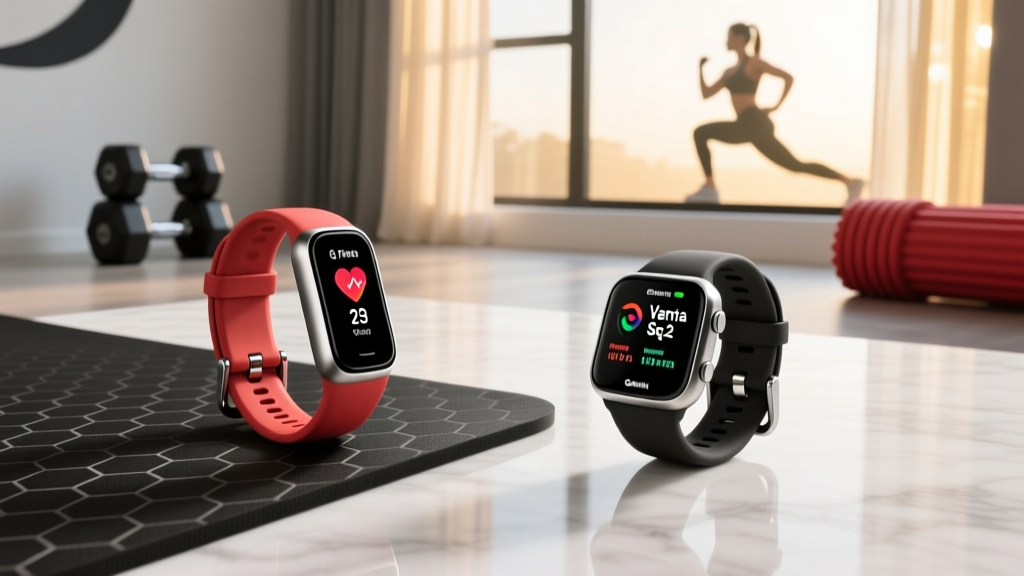
Crane Fitness Tracker vs GPS Running Watches: 2026 Feature Comparison
Is the budget Crane fitness tracker enough for runners? We compare its features against top 2026 GPS running watches to help you decide on your next upgrade.

Walking down the electronics aisle at your local Aldi, the temptation is undeniable. For roughly $25, you can pick up a Crane fitness tracker that promises step counting, heart rate monitoring, and smartphone notifications. For the casual walker or the beginner trying to build a daily movement habit, it is an incredible bargain. But for dedicated runners, the conversation quickly shifts from basic activity tracking to precise spatial data, pacing metrics, and training loads. This brings us to a critical crossroads for many budget-conscious athletes: Is a Crane fitness tracker sufficient for your running journey, or is it time to invest in a dedicated GPS running watch?
In this comprehensive 2026 hands-on review and feature comparison, we break down the exact hardware limitations of budget trackers and contrast them against the advanced capabilities of modern entry-level GPS watches like the Garmin Forerunner 165 and the Coros Pace 3. Whether you are training for your first 5K or chasing a Boston Qualifier, understanding these hardware distinctions will save you from race-day frustrations and inaccurate training data.
The Anatomy of a Budget Tracker: What the Crane Actually Offers
To make an informed decision, we must first objectively evaluate what the Crane fitness tracker brings to the table. Typically manufactured by an OEM (Original Equipment Manufacturer) and rebranded for discount supermarket chains, the Crane tracker is designed for general wellness, not athletic performance.
Expert Insight: The Connected GPS IllusionMany budget trackers advertise 'GPS tracking,' but they lack an internal GPS chip. Instead, they use Connected GPS, which tethers to your smartphone's location services via Bluetooth. While this maps your route, it introduces significant latency, drains your phone battery, and results in 'GPS drift' if your phone is tucked in a pocket or armband rather than mounted on your wrist.
When you wear a Crane fitness tracker on a run, you are primarily relying on a 3-axis accelerometer to estimate distance based on your stride length. If your pace changes, or if you run on uneven terrain like trails, the distance and pace calculations will inherently degrade. Furthermore, the optical heart rate sensor utilizes basic single-wavelength green LED technology, which struggles to maintain accuracy during high-intensity interval training (HIIT) or in cold weather when peripheral blood flow is restricted.
The GPS Gap: Dedicated Multi-Band GNSS vs. Smartphone Tethering
The most significant leap from a budget tracker to a dedicated GPS running watch is the onboard positioning hardware. In 2026, even entry-level running watches have largely adopted dual-band or multi-band GNSS (Global Navigation Satellite Systems). This means the watch simultaneously connects to multiple satellite frequencies (L1 and L5), allowing the signal to bounce off urban skyscrapers and penetrate dense tree canopies with remarkable precision.
According to extensive hardware teardowns and field testing by the wearable experts at DC Rainmaker, multi-band GPS chips reduce route mapping errors by up to 40% in challenging environments compared to older single-band chips, and exponentially outperform the Bluetooth-tethered connected GPS found on budget trackers. When you are trying to hold a specific pace for a marathon, the difference between a watch that updates your pace every second versus a tracker that averages it out over a minute is the difference between a successful race and hitting the wall.
Barometric Altimeters and Elevation Data
Another missing component on the Crane fitness tracker is the barometric altimeter. Budget trackers attempt to guess elevation changes using your phone's GPS, which is notoriously inaccurate for vertical measurements. Dedicated running watches use internal barometric sensors to measure atmospheric pressure changes, providing exact data on elevation gain, loss, and grade-adjusted pace. This is a non-negotiable feature if you train in hilly areas or are preparing for trail races.
Hands-On Comparison Matrix: 2026 Market Leaders
Below is a side-by-side comparison of the typical Aldi Crane tracker against two of the most highly recommended entry-to-mid-level GPS running watches currently dominating the market.
| Feature / Metric | Crane Fitness Tracker (Budget) | Coros Pace 3 | Garmin Forerunner 165 |
|---|---|---|---|
| Retail Price | ~$24.99 | $229.00 | $249.00 |
| GPS Hardware | None (Connected via Phone) | All-Systems Dual-Frequency GNSS | Multi-Band GPS |
| Heart Rate Sensor | Basic Optical (Green LED) | Advanced 5-LED Optical Array | Elevate V5 Optical Sensor |
| Battery Life (GPS) | N/A (Drains Phone Battery) | Up to 38 Hours | Up to 17 Hours |
| Running Dynamics | None | Native (Cadence, Stride, Ground Contact) | Native (Via HRM-Pro or Wrist) |
| Training Metrics | Basic Step/Calorie Count | EvoLab, VO2 Max, Threshold, Load | Body Battery, Training Status, VO2 Max |
Heart Rate Accuracy and the 'Cadence Lock' Phenomenon
One of the most frustrating edge cases runners experience with budget wearables is 'cadence lock.' This occurs when the optical heart rate sensor confuses the rhythmic swinging of your arm and the impact of your footstrike with your actual pulse. Instead of showing your true heart rate (e.g., 155 BPM), the tracker locks onto your running cadence (e.g., 170 BPM) and displays that number for the remainder of your run.
Modern GPS watches combat this using multi-wavelength sensors (incorporating red and infrared light alongside green) and advanced algorithmic filtering. As noted in cardiovascular tracking guidelines by the American Heart Association, accurate heart rate monitoring is essential for ensuring you are training in the correct physiological zones to improve cardiovascular health without overtraining. If your Crane fitness tracker is displaying a heart rate of 185 BPM while you are comfortably holding a conversation on an easy run, you are likely experiencing cadence lock or sensor failure due to sweat interference.
Advanced Training Metrics: Beyond the Calorie Counter
The fundamental difference in software ecosystems is how they treat your physiological data. The app accompanying a Crane fitness tracker treats a 5-mile run simply as a calorie-burning event. It does not differentiate between a grueling hill workout and a light recovery jog.
What You Get with Dedicated GPS Ecosystems
- Training Load & Recovery: Platforms like Garmin Connect and Coros EvoLab measure your Excess Post-exercise Oxygen Consumption (EPOC) to tell you exactly how many hours of recovery you need before your next hard effort.
- VO2 Max Estimation: By correlating your GPS pace with your heart rate over time, these watches estimate your maximal oxygen uptake, providing a benchmark of your cardiovascular fitness.
- Running Power & Efficiency: Brands like Coros have democratized running power metrics, allowing athletes to measure the actual watts they are outputting on hills versus flats, ensuring even effort distribution across variable terrain.
"The transition from a budget step-counter to a dedicated GPS watch is the single most impactful gear upgrade a runner can make. It shifts your mindset from simply 'exercising' to actively 'training' with measurable, actionable physiological data."
Expert Verdict: The 2026 Upgrade Decision Framework
So, should you ditch the Crane fitness tracker? The answer depends entirely on your current running goals and environment.
Stick with the Crane Fitness Tracker If:
- You run exclusively on a treadmill or a measured local track where distance is already known.
- Your primary goal is general weight management and closing daily movement rings.
- You are on a strict sub-$50 budget and always run with your smartphone strapped to your arm.
Upgrade to a GPS Running Watch If:
- You are training for a specific race distance (10K, Half Marathon, Marathon) and need precise pacing.
- You run on trails, in forests, or in cities with tall buildings where phone GPS drifts.
- You want to track your VO2 Max, lactate threshold, and structured interval workouts.
- You are tired of carrying a heavy smartphone on your runs just to map your route.
Frequently Asked Questions
Can I use a chest strap heart rate monitor with a Crane tracker?
No. Budget trackers like the Crane typically lack the ANT+ or Bluetooth Smart protocols required to pair with external chest straps like the Polar H10 or Garmin HRM-Pro. You are limited to the onboard optical sensor, which is a major limitation for serious interval training.
Do GPS watches require a monthly subscription?
Unlike some smart rings or premium recovery wearables (such as Whoop or Oura), the core GPS and training features of Garmin and Coros watches do not require a monthly subscription. You pay for the hardware upfront, and the software ecosystem, including training plans and route mapping, is entirely free for the life of the device.
How long do entry-level GPS watches last before needing replacement?
With proper care, a mid-tier GPS watch from a reputable brand will easily last 4 to 6 years. The lithium-ion battery will slowly degrade over hundreds of charge cycles, but the physical hardware and GPS chips remain highly relevant for multiple Olympic cycles, making the $229-$249 investment vastly more cost-effective over time than repeatedly replacing broken $25 budget trackers.
More gear to consider
All reviews
Router vs Fitness Tracker: Key Differences

Best Budget Senior Fitness Tracker Under $100: 2026 Market Trends

Fitbit Inspire Fitness Tracker vs. Garmin for Lifting

Whoop 5.0 Fitness Tracker: Sport-Specific Care & Longevity

Chest Strap vs Wrist HR: Fitness App Not Tracking Steps Without Apple Watch