Cast Iron vs Competition Bells: Care & Convert Dumbbell to Kettlebell
Compare cast iron vs competition kettlebells for longevity. Plus, safety and maintenance truths about using adapters to convert dumbbell to kettlebell.

Building a resilient, lifetime home gym requires looking past the initial price tag and evaluating how equipment ages, oxidizes, and withstands repetitive kinetic loading. As of 2026, the secondary market for space-saving fitness hacks has exploded, leading many lifters to explore ways to convert dumbbell to kettlebell using aftermarket grips. However, when it comes to true longevity and ballistic safety, nothing replaces a dedicated kettlebell.
This guide bridges the gap between the buying decision and the maintenance reality. We will dissect the metallurgical and coating differences between cast iron and competition kettlebells through the lens of long-term care, while also exposing the structural failure modes of dumbbell-to-kettlebell adapters.
The 'Convert Dumbbell to Kettlebell' Trend: Longevity & Safety Risks
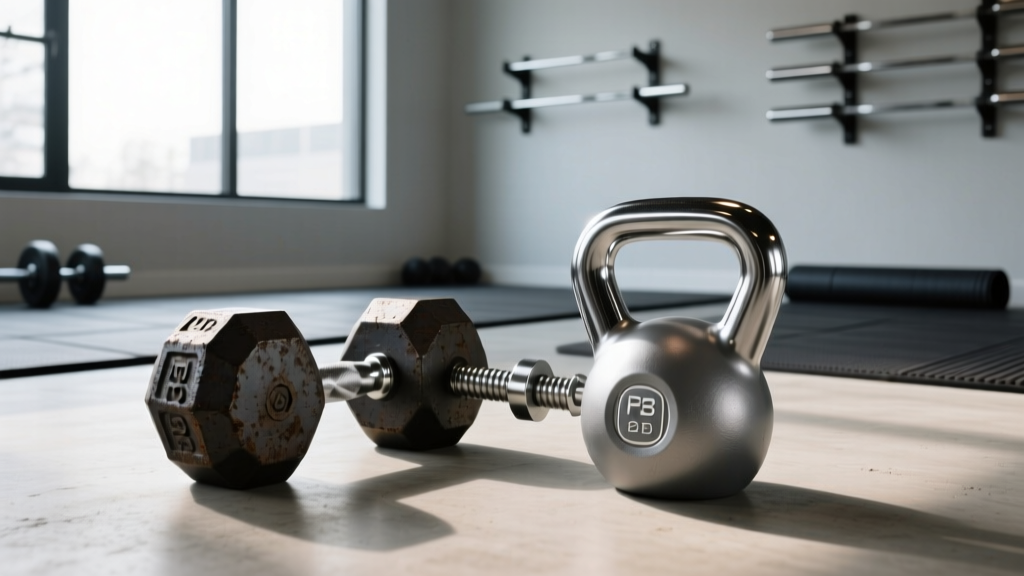
The desire to convert dumbbell to kettlebell usually stems from a need to save space or money. Adapters like the Kettle Gryp or various TPU strap systems allow you to clamp a standard hex or round dumbbell into a makeshift kettlebell handle. While these devices are adequate for static or slow-tempo movements (like goblet squats or halos), they introduce severe longevity and safety risks when subjected to ballistic movements.
Shear Stress and Material Fatigue
During a heavy kettlebell swing or snatch, the bell accelerates and decelerates rapidly. At the apex of a swing, a 35 lb dumbbell can generate up to 4.5 Gs of force, translating to over 150 lbs of sheer pulling force on the adapter's locking mechanism.
- ABS Plastic Housings: Most rigid adapters use ABS plastic. Over 6 to 12 months of repetitive loading, micro-fractures develop along the hinge and clasp seams. A catastrophic snap mid-swing can send a steel dumbbell flying toward your face or shins.
- TPE Foam Inserts: To protect the dumbbell handle, adapters use TPE or EVA foam inserts. Human sweat contains urea and salts that rapidly degrade these foams. Within a year, the foam compresses permanently, causing the dumbbell to rattle and shift inside the housing, ruining the center of mass required for safe cleans and snatches.
Expert Insight: If you must use an adapter to convert dumbbell to kettlebell, restrict its use strictly to grind movements (presses, squats, Turkish get-ups). For high-repetition ballistic work, investing in a dedicated bell is non-negotiable for joint and structural safety.
Cast Iron vs. Competition Kettlebells: A Durability Deep Dive
If you are abandoning the adapter route and investing in dedicated equipment, you face the classic buying dilemma: cast iron or competition? According to BarBend's comprehensive kettlebell testing, the choice dictates not just your training feel, but your maintenance routine for the next decade.
Cast Iron Kettlebells: Coatings and Corrosion
Cast iron bells are poured into molds, resulting in varying wall thicknesses and a smaller overall profile. The primary longevity factor here is the finish.
- Bare Cast Iron: Offers the best grip but will flash-rust within 48 hours if exposed to ambient humidity above 60% and the salts from your hands.
- Powder Coated: A baked-on dry powder that provides a textured grip. However, powder coating is brittle. Dropping a powder-coated bell onto a concrete garage floor will chip the coating down to the bare iron, creating a localized epicenter for rust.
- E-Coated (Electrophoretic): The gold standard for longevity. E-coating uses an electrical current to deposit paint into the microscopic pores of the iron. As noted in Rogue Fitness equipment specifications, high-quality e-coat finishes can withstand over 1,500 hours of salt-spray testing without blistering, making them virtually rust-proof for indoor home gyms.
Competition Kettlebells: Steel Shells and Internal Ballast
Competition kettlebells are manufactured to exact IUKF (International Union of Kettlebell Lifting) dimensions: 280mm tall, 210mm wide, with a 35mm handle diameter, regardless of weight. An 8kg bell and a 32kg bell are the exact same size on the outside.
To achieve this, competition bells feature a hollow steel shell. The lighter weights are filled with steel shot or scrap metal ballast, sealed with a plastic or metal plug at the base.
⚠️ Competition Bell Failure Mode: The Base Plug
The greatest longevity threat to a competition bell is moisture ingress. If the base plug loosens from repeated floor impacts, or if the bell is stored in a damp garage, moisture enters the hollow cavity. This causes internal rust that cannot be sanded or treated. Over time, the internal steel shot rusts into a solid, unbalanced clump, or worse, the rust expands and splits the outer steel weld seam. Always store competition bells indoors and check the base plug torque annually.
Comparative Maintenance & Longevity Matrix
Use the table below to evaluate which option aligns with your maintenance willingness and training environment.
| Feature | Cast Iron (E-Coat) | Competition (Steel) | Dumbbell Adapter |
|---|---|---|---|
| Drop Durability | High (Solid core, may chip) | Medium (Dents shell, risks weld) | Very Low (Plastic shatters) |
| Rust Vulnerability | Low (If e-coated) | Medium (Internal cavity risk) | N/A (But foam degrades) |
| Handle Maintenance | Requires occasional sanding | Requires paint touch-ups | Wipe down sweat immediately |
| Expected Lifespan | 50+ Years | 20-30 Years | 1-2 Years |
| Ballistic Safety | Excellent | Excellent | Poor to Moderate |
Step-by-Step Longevity Protocol for Your Bells
Whether you choose cast iron or competition, implementing a strict maintenance protocol will ensure your bells outlive you. Follow this bi-annual care routine.
1. Handle De-Scaling and Chalk Removal
Gym chalk (magnesium carbonate) mixes with sweat to form a highly alkaline paste that embeds into the knurling or porous texture of the handle. Over time, this traps moisture against the metal.
- Tools: A stiff brass wire brush (never use steel wire, as it will embed iron particles into your bell, causing immediate flash rust).
- Action: Scrub the handle vigorously in circular motions. Follow up with a 50/50 mix of white vinegar and water to neutralize the alkaline chalk residue, then wipe completely dry with a microfiber cloth.
2. Surface Rust Remediation (Cast Iron Only)
If you spot orange oxidation on a cast iron bell, address it before it pits the metal.
- Use 400-grit wet/dry sandpaper to gently buff away the rust spot.
- Wipe the area with mineral spirits to remove iron dust.
- Apply a micro-thin layer of a rust-inhibiting protectant.
3. The Right Protectant
Avoid standard WD-40, which is a solvent that strips away existing protectants and leaves a weak moisture barrier. Instead, use Boeshield T-9 or a dedicated 3-IN-ONE Silicone Spray. Apply to a rag first, then wipe onto the handle and bell body. Let it cure for 12 hours before your next training session.
4. Competition Bell Paint Touch-Ups
Competition bells are color-coded by weight (e.g., Yellow for 16kg, Red for 24kg). Chipped paint exposes the bare steel shell. Keep a small bottle of enamel model paint (like Testors) matched to your bell's color. Dab it onto chips with a toothpick to seal the steel from ambient humidity.
Expert Verdict: Which Should You Buy?
If your goal is a zero-maintenance, drop-heavy garage gym where you perform high-volume CrossFit-style workouts, E-Coated Cast Iron is the undisputed king of longevity. It lacks the fragile internal cavities of competition bells and the catastrophic shear-stress risks of trying to convert dumbbell to kettlebell with plastic adapters.
However, if you are pursuing strict Kettlebell Sport, or require the uniform 35mm handle diameter to master your grip mechanics without relearning the bell on every weight jump, Competition Bells are mandatory. Just respect the base plug, keep them out of the rain, and treat them like precision instruments rather than demolition tools.
More gear to consider
All reviews
Bulgarian Split Squat with Dumbbells & Barbell Collar Types Compared

Bumper vs Iron Plates & Best Glute Exercise with Dumbbells

Olympic vs Standard Plates: Fixing Dumbbell Bench Press Variations
Avoid Fake Bowflex Dumbbells: Barbell Collar and Clamp Guide
Beyond Tricep Workouts Dumbbells Only: Barbell Collar Types Compared