
Compact Home Gym: Tricep Dumbbell Workout With Loadable Plates
Maximize your home gym layout with loadable dumbbells. Discover space-saving storage tips and a targeted tricep dumbbell workout for interchangeable plates.

The Spatial Economics of Home Tricep Training
When designing a home gym layout, the traditional approach to arm training is a spatial nightmare. A standard commercial-grade rubber hex dumbbell set ranging from 10 to 50 pounds (in 5-pound increments) requires a 5-tier, 6-foot-wide A-frame rack. This setup consumes roughly 18 square feet of valuable floor space, weighs over 1,000 pounds, and costs upward of $1,500 in 2026. For the isolated muscle groups of the triceps brachii, which generally require loads between 15 and 45 pounds for optimal hypertrophy, this footprint is wildly inefficient.
Enter the loadable dumbbell with interchangeable plates. By utilizing a single pair of ergonomic handles and a compact stack of fractional and standard plates, you can replicate an entire 17-pair dumbbell rack in a 1.5-square-foot footprint. This spatial efficiency allows you to reclaim your garage or spare room for functional movement zones, while still maintaining the heavy, progressive overload required for serious arm development.
Loadable Dumbbell Comparison Matrix
Not all loadable dumbbells are created equal, especially when considering the biomechanics of arm isolation. The handle geometry, collar thickness, and plate profile dictate whether a dumbbell is suitable for close-grip tricep work or if it will awkwardly clash with your forearms. Below is a structural comparison of the top contenders for compact layouts.
| Model (2026 Specs) | Base Price | Max Load | Head Geometry | Plate Change Time |
|---|---|---|---|---|
| Ironmaster Quick-Lock V2 | $399 | 165 lbs (w/ addon) | Square, flush caps | ~15 seconds |
| PowerBlock Elite USA | $329 | 90 lbs | Caged, rectangular | ~2 seconds |
| Titan Fitness Loadable | $149.99 | Depends on plates | 1-inch Olympic sleeves | ~30 seconds |
| Nuobell Adjustable | $349 | 80 lbs | Traditional contoured | ~1 second |
As noted in Garage Gym Reviews' extensive testing of loadable dumbbells, the Titan Fitness model requires standard or bumper plates, which creates a massive lateral footprint that interferes with close-grip pressing. Conversely, the Ironmaster Quick-Lock V2 mimics the exact dimensions of a fixed dumbbell, making it the superior choice for complex tricep isolation movements.
Designing the 4x4 Foot Tricep Training Zone
To optimize your layout for an effective arm day, carve out a dedicated 4x4 foot zone. This micro-station requires three elements:
- Foundation: A 4x4 foot interlocking rubber mat (3/4-inch thickness) to absorb the acoustic shock of dropped steel plates.
- The Anchor: A compact, adjustable FID (Flat/Incline/Decline) bench. The Rep Fitness AB-3100 is a 2026 favorite because its rear stabilizer tucks tightly, preventing trip hazards in tight spaces.
- Plate Storage: Vertical wall-mounted pegs. Instead of leaving plates scattered on the floor, mount a pair of 10-inch steel wall pegs at waist height (36 inches from the floor) to keep your interchangeable plates organized and off the training surface.
The Loadable Tricep Dumbbell Workout Protocol
Executing a high-quality tricep dumbbell workout with interchangeable plates requires strategic exercise ordering. Because loading and unloading plates on systems like the Ironmaster or Titan takes 15 to 30 seconds per dumbbell, you must structure your workout to minimize weight changes while maximizing muscle fiber recruitment across all three heads of the triceps (long, lateral, and medial).
1. Incline Overhead Extensions (The Geometry Test)
According to the ACE Fitness Exercise Library, overhead shoulder flexion is mandatory for maximizing stretch and activation in the long head of the triceps. Set your FID bench to a 60-degree incline.
Layout Tip: Position the bench exactly 14 inches away from your wall-mounted plate pegs. This allows you to grab your heavy plates, load the dumbbells, and sit down without taking more than two steps, preserving your rest intervals.
Perform 4 sets of 10-12 reps. Use a neutral grip. If you are using caged dumbbells like PowerBlocks, be hyper-aware of the steel cage striking your forehead at the bottom of the eccentric stretch. Square-profile loadable dumbbells eliminate this clearance issue entirely.
2. Heavy Tate Presses (Micro-Loading Advantage)
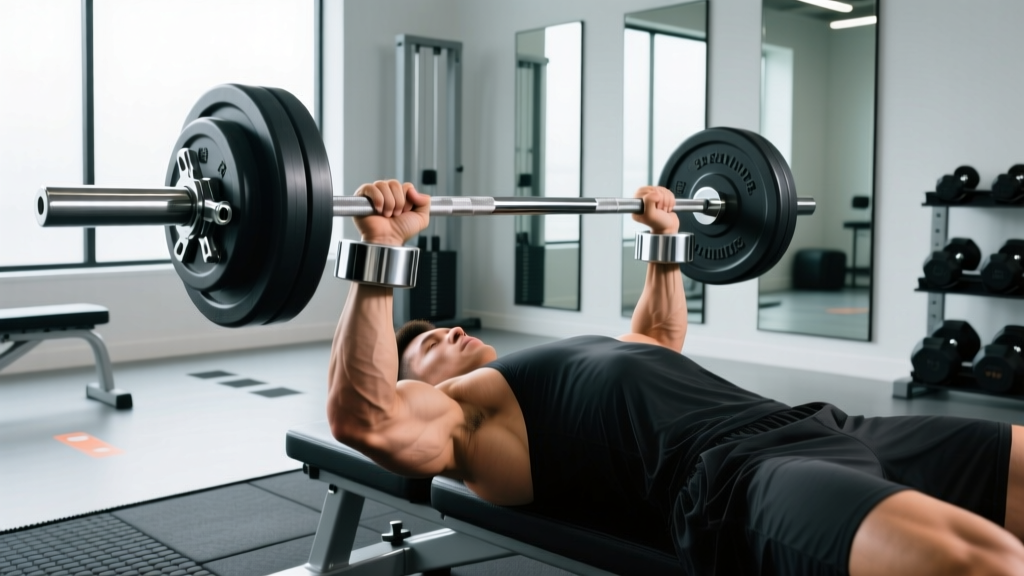
The Tate Press targets the medial and lateral heads by combining a pressing motion with an elbow extension. Lie flat on the bench, press the dumbbells up, and rotate your palms to face forward. Lower the inner plates toward your upper chest, then flex the triceps to push them back together.
This is where loadable dumbbells outshine fixed sets. The Tate Press requires precise micro-loading; a 5-pound jump between fixed dumbbells often leads to form breakdown. With a loadable handle and a set of 1.25 lb and 2.5 lb fractional plates, you can progress in 2.5 lb increments, ensuring continuous progressive overload without sacrificing joint integrity. Aim for 3 sets of 8-10 reps.
3. Neutral-Grip Kickbacks (Clearance Optimization)
Finish the workout by targeting the lateral head with strict kickbacks. Hinge at the hips, keeping your torso parallel to the floor. Loadable dumbbells with thick collars or protruding spin-lock threads can dig into your wrists during the peak contraction phase of a kickback. If your interchangeable system has bulky end-caps, use lifting straps or wrist wraps to pad the contact point. Execute 3 sets of 15 reps to failure, utilizing a lighter load and focusing entirely on the isometric squeeze at full extension.
Edge Cases: Handle Geometry and Plate Rattle
When integrating loadable dumbbells into a high-rep hypertrophy block, you will encounter specific mechanical edge cases. The most common failure mode in budget loadable dumbbells is 'plate rattle'—the acoustic and physical vibration of plates shifting against the collar during dynamic movements.
During a tricep extension, plate rattle disrupts the mind-muscle connection and destabilizes the load at the point of maximum leverage disadvantage. To combat this, always use machined steel plates rather than cast iron with painted finishes, as the paint chips and creates uneven tolerances. Furthermore, systems utilizing a drop-pin mechanism (like the Ironmaster Quick-Lock) inherently eliminate rattle by applying lateral pressure against the plate stack, whereas traditional threaded spin-lock handles will inevitably loosen over a 45-minute arm session.
Vertical Storage Solutions for Interchangeable Plates
The final step in space optimization is managing the interchangeable plates themselves. A 100-pound loadable dumbbell kit typically includes handles, four 10 lb plates, four 5 lb plates, and various fractional plates. Left in their original shipping box, they become a clutter hazard.
Biomechanical analyses and gym layout guides featured on BarBend frequently highlight that visual clutter increases cognitive fatigue before a workout. Install a dedicated 1-inch diameter steel plate tree mounted directly to a wall stud. Arrange your plates by descending diameter, keeping the 2.5 lb and 1.25 lb micro-plates on a small magnetic parts tray mounted adjacent to the tree. This transforms your loadable dumbbell station into a sleek, hyper-efficient arm-building laboratory that occupies less space than a single yoga mat.
More gear to consider
All reviews
Dumbbell Press No Bench: Standard vs Olympic Plates

Compact Gym Layouts: Loadable Dumbbells & Single Arm Dumbbell Z Press

Bumper vs Iron Plate Care & Close-Grip Dumbbell Press Tips
Barbell Collars vs Clamps: Securing the Incline Bench Dumbbell Row

EZ Bar vs Straight Bar & Rear Delt with Dumbbells: Budget Breakdown
