
Compact Gyms: Bumper vs Iron Plates & Best Dumbbell Lat Exercises
Optimize your small home gym layout. Compare bumper vs iron plates for space, and discover the best dumbbell lat exercises for compact workouts.

The Micro-Gym Dilemma: Spatial Constraints in 2026
As urban living spaces shrink and garage gym footprints are increasingly forced into single-car bays, basements, or spare bedrooms, the modern home fitness landscape is dominated by spatial optimization. Designing a functional free weight zone in a room under 100 square feet requires ruthless prioritization. You are constantly weighing the biomechanical benefits of Olympic barbell training against the sheer physical footprint it demands.
This guide dissects the spatial realities of outfitting a compact gym, specifically comparing the storage and operational footprints of bumper plates versus cast iron plates. Furthermore, when ceiling heights and floor clearances render barbell rows impossible, we pivot to the best dumbbell lat exercises that maximize muscle hypertrophy without requiring a 7-foot barbell swing radius.
Bumper Plates vs. Iron Plates: A Spatial & Acoustic Breakdown
Choosing between bumper and iron plates is rarely just about the type of lifting you do; in a small space, it is entirely about geometry, acoustics, and floor preservation. Both plate types serve the same loading purpose, but their physical dimensions dictate entirely different layout strategies.
| Feature | Bumper Plates (Urethane/Rubber) | Cast Iron / Steel Plates |
|---|---|---|
| Diameter | Universal 450mm (17.7 inches) | Varies (14.5' to 17.7' based on brand) |
| Thickness (45lb / 20kg) | ~3.25 inches (e.g., Rogue Echo) | ~1.3 inches (e.g., Rogue Machined) |
| Drop Zone Requirement | Minimum 4' x 4' reinforced area | Strictly no-drop; requires controlled lowering |
| Acoustic Profile | Low-frequency thud (dead bounce) | High-frequency clang (high decibel transfer) |
| Avg. Cost per Pound | $3.00 - $4.50 / lb | $1.50 - $2.50 / lb |
The Thickness Tax on Plate Trees
The most critical spatial difference is thickness. A standard pair of 45lb Rogue Echo Bumpers measures roughly 6.5 inches combined. If you own three pairs of 45s, two pairs of 25s, and a pair of 10s, a standard vertical plate tree will struggle to hold the bumpers without them spilling off the pegs. Bumper plates demand heavy-duty A-frame storage racks or horizontal wall-mounted shelves, which protrude up to 18 inches from the wall and consume valuable walkway clearance.
Conversely, cast iron plates are incredibly dense. That same 270lb iron load can easily slide onto a compact, 18-inch by 18-inch vertical tree tucked into a tight corner, freeing up your primary walls for mirrors or cable attachments.
⚠️ Layout Warning: The Rust & Humidity FactorIf your compact gym is located in an unclimate-controlled garage or a damp basement, cast iron plates will oxidize rapidly. The resulting rust flakes onto your flooring and ruins the knurling on your barbell sleeves. In high-humidity micro-gyms, urethane-encased iron plates or rubber bumpers are mandatory to preserve your equipment and indoor air quality.
Acoustic Transfer and Floor Layering Strategy
Space optimization is not just visual; it is also acoustic. In a small, enclosed room, the acoustic transfer of iron plates clanking together can exceed 95 decibels, easily penetrating drywall and disrupting the rest of the household. Bumper plates mitigate airborne noise but generate significant structure-borne vibrations (impact shock).
To optimize a small layout for heavy loading, you must engineer a localized drop zone. Instead of matting an entire 10x10 room with expensive rubber flooring, utilize a layered approach in a 4x4 foot footprint directly in front of your rack:
- Base Layer: 3/4-inch thick vulcanized rubber horse stall mats (approx. $55 each).
- Impact Layer: 2-inch thick high-density EVA foam puzzle mats placed directly under the barbell path.
- Top Layer: A specialized 3/8-inch silent drop pad (like the Rogue Drop Pads) to absorb the kinetic energy of bumper plates.
Equipment Footprints: Adjustable Dumbbells vs. Hex Racks
When your layout cannot accommodate a 7-foot Olympic barbell's 86-inch wingspan, dumbbells become your primary tool for hypertrophy. However, traditional hex dumbbell racks are spatial nightmares. A standard 3-tier rack holding pairs from 5lbs to 50lbs requires a footprint of roughly 42 inches wide by 22 inches deep (6.4 square feet), plus an additional 2 feet of clearance for a user to step in and retrieve them.
The Space-Saving Solution: High-end adjustable dumbbells. A pair of Nuobell 80lb adjustable dumbbells rests on a dock measuring just 17 inches by 8 inches (0.94 square feet). By switching to adjustables, you reclaim over 5 square feet of floor space—enough room to add a dedicated plyometric box or a folding utility bench.
The Best Dumbbell Lat Exercises for Tight Layouts
When ceiling heights are under 84 inches or floor space restricts barbell bending rows, you must adapt. According to biomechanical analyses cataloged in the ExRx Exercise Directory, the latissimus dorsi functions primarily in shoulder extension, adduction, and internal rotation. You can achieve maximum lat stimulation without a barbell by utilizing the following space-efficient dumbbell movements.
1. The Single-Arm Dumbbell Row (Kroc Row Style)
Space Required: 4 feet by 2 feet (Bench footprint + arm swing clearance).
Execution: Brace your non-working hand and knee on a flat utility bench. Hinge at the hips, maintaining a neutral spine. Pull the dumbbell toward your hip pocket, not your armpit, to ensure the latissimus dorsi is the primary mover rather than the rhomboids or rear delts. The 'Kroc Row' variation involves using a heavier dumbbell and allowing a slight torso rotation at the bottom of the movement to achieve a maximal lat stretch.
2. Floor-Based Dumbbell Pullover
Space Required: 2 feet by 6 feet (Ideal for low-clearance basements).
Execution: Lie supine on the floor with your knees bent and feet flat. Hold a single heavy dumbbell with both hands over your chest. Keeping a slight bend in your elbows, lower the weight backward over your head until it lightly taps the floor. The floor acts as a natural depth stopper, preventing shoulder capsule overextension while providing an intense stretch to the lats and serratus anterior. This is arguably the safest lat exercise for solo lifters in cramped spaces.
3. Chest-Supported Incline Dumbbell Row
Space Required: 4 feet by 3 feet.
Execution: Set an adjustable bench to a 30 or 45-degree incline. Lie face down with a dumbbell in each hand. Pull the weights upward, driving your elbows toward the ceiling and squeezing your shoulder blades together at the peak. By removing the need for lower-back stabilization, this movement isolates the lats and mid-back with zero spatial footprint beyond the bench itself. It is highly recommended for lifters dealing with lumbar fatigue.
The Triangle Workflow Layout
To maximize efficiency in a micro-gym, arrange your equipment in a 'Triangle Workflow'. Place your adjustable dumbbell dock at Point A, your folding utility bench at Point B, and your plate tree/barbell at Point C. This ensures that transitioning between the best dumbbell lat exercises and heavy barbell compound lifts requires a maximum of two steps, keeping your heart rate elevated and your equipment centralized.
Final Thoughts on Spatial Compromises
Designing a highly optimized home gym in 2026 requires abandoning the 'commercial gym' mindset. You do not need a wall of dumbbells or a massive Olympic lifting platform to build a world-class physique. By selecting cast iron plates or urethane-encased options to minimize storage bulk, engineering localized acoustic drop zones, and mastering unilateral dumbbell lat movements, you can transform an 80-square-foot spare room into an elite training facility. Measure your space, respect the acoustic limits of your home, and train with spatial intent.
Frequently Asked Questions
Can I use bumper plates on a standard vertical plate tree?
Most standard vertical trees are designed for the thin profile of iron plates. If you load more than three pairs of 45lb bumper plates onto a single vertical peg, the rubber will bind and stack unevenly, creating a tipping hazard. Use horizontal wall racks or wide-base A-frames for bumper storage.
Are adjustable dumbbells durable enough for heavy lat rows?
Modern adjustable dumbbells (like PowerBlock Elites or Nuobells) are rated for drops from waist height, but they should never be dropped from the top of a standing position. For heavy single-arm rows, they are exceptionally durable, provided you control the eccentric (lowering) phase and rest them gently on the bench or floor.
What is the minimum ceiling height for a home gym?
More gear to consider
All reviews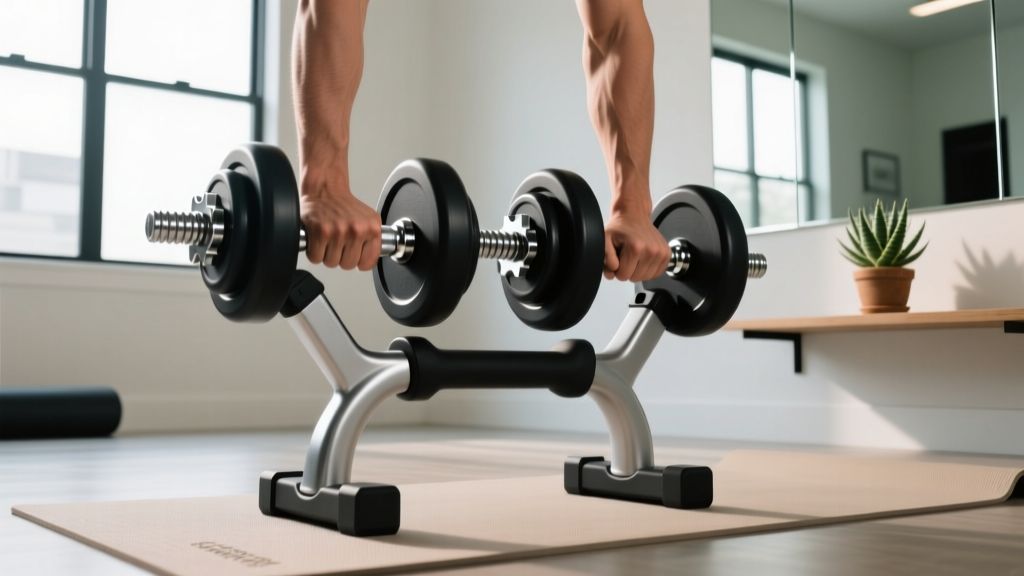
Best Adjustable Dumbbells for Arm and Shoulder Exercises

Barbell Bench Press With Dumbbells: 2026 Adjustable Review

Bumper vs Iron Plates: Space Layouts & Wide Dumbbell Curl Zones

Barbell Collar Types and Adjusting Weight Dumbbells Setup Guide

2026 Market Trends: Loadable Dumbbells for Progressive Lunges with Dumbbells
