Barbell Collar vs Clamp: Securing Weight Bench Dumbbells & Bars
Compare barbell collars and clamps for your barbell and weight bench dumbbells. Expert analysis of spring, lever, and spinlock locks for safe lifting.

The Hidden Danger of Shifting Iron
When loading up a barbell for a heavy squat or assembling loadable weight bench dumbbells for a high-volume chest day, the locking mechanism you choose is the only thing standing between a successful rep and a catastrophic injury. A shifting plate alters the center of gravity in milliseconds, turning a controlled bench press into a dangerous rotational hazard. Yet, the debate between traditional spring collars and modern lever clamps remains highly polarized in the lifting community.
In this comprehensive head-to-head comparison, we break down the exact physics, failure modes, and spatial mathematics of barbell collars versus clamps. More importantly, we address a massive blind spot in most equipment guides: how to properly secure plates on Olympic loadable weight bench dumbbells, where sleeve space is at an absolute premium.
Head-to-Head Matrix: Collar vs. Clamp Technologies
Before diving into specific models, it is crucial to understand the mechanical differences between the primary locking categories. According to BarBend's comprehensive equipment testing, clamping force and sleeve footprint are the two most critical metrics for safety and utility.
| Lock Type | Avg. Clamping Force | Sleeve Footprint | Best Use Case | Price Range (Pair) |
|---|---|---|---|---|
| Spring Collars | 30 - 50 lbs | 0.75 inches | Olympic lifting, quick changes | $15 - $25 |
| Lever Clamps | 120 - 160 lbs | 1.5 - 1.8 inches | Powerlifting, heavy bench/squats | $30 - $45 |
| Spinlock Nuts | 100+ lbs (Threaded) | 0.5 - 1.0 inches | Loadable weight bench dumbbells | $10 - $20 |
| Competition Clamps | 200+ lbs | 2.0+ inches | Sanctioned meets, heavy deadlifts | $50 - $80 |
Spring Collars: The Traditionalist's Workhorse
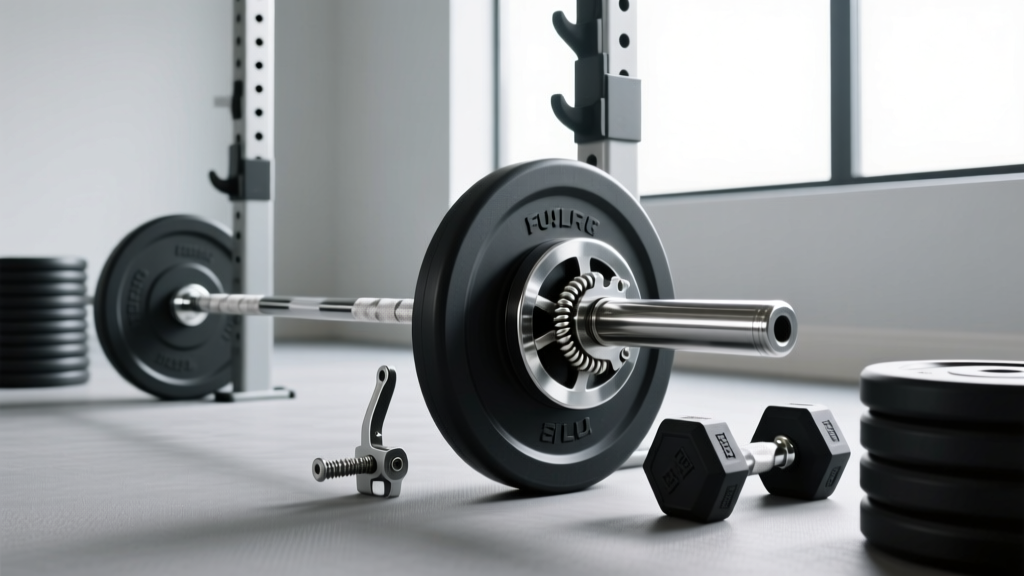
Spring collars rely on the tensile strength of coiled steel to apply inward radial pressure against the barbell sleeve. They are lightweight, incredibly fast to apply, and have a minimal footprint.
Model Spotlight: Rogue Spring Collars ($17.50)
The Rogue Spring Collars are a staple in commercial gyms and CrossFit boxes. Constructed from high-carbon spring steel, they provide roughly 40 lbs of clamping force. This is sufficient to keep plates flush during dynamic movements like the clean and jerk, where the barbell experiences extreme 'whip' (oscillation).
- Pros: Lightning-fast application, lightweight (0.2 lbs each), low profile.
- Cons: Prone to metal fatigue over time, can scratch chrome sleeves, difficult to squeeze for lifters with weaker grip strength or arthritis.
- Failure Mode: If left compressed on the bar for weeks, the steel loses its memory, resulting in a loose fit that allows plates to rattle outward during heavy eccentric lowering.
Lever Clamps: The Modern Gym Standard
Lever clamps use a mechanical cam or latch system, often constructed from glass-reinforced nylon or extruded aluminum, to bite down on the sleeve. They offer vastly superior clamping force compared to springs.
Model Spotlight: Lock-Jaw Pro ($32.95) vs. Rogue AB-2 ($35.00)
The Lock-Jaw Pro is widely considered the gold standard for commercial and home gyms. Its patented latch mechanism generates approximately 150 lbs of inward force, effectively welding the plates to the sleeve. The Rogue AB-2 Aluminum Barbell Clamps offer a similar cam-lock design but utilize an aluminum body for greater durability in harsh environments.
- Pros: Massive clamping force, zero grip strength required to lock, highly durable.
- Cons: Bulky footprint takes up valuable sleeve space, plastic variants can become brittle in unheated garage gyms during winter.
- Failure Mode: The internal metal cam pin can bend if the clamp is dropped repeatedly on concrete floors from a height of 6+ feet, preventing the latch from fully engaging.
Securing Loadable Weight Bench Dumbbells: A Unique Challenge
Many home gym owners purchase 2-inch Olympic loadable dumbbell handles to use on their weight bench, saving thousands of dollars compared to buying a full rack of fixed urethane dumbbells. However, this introduces a severe spatial problem that most barbell collar guides completely ignore.
WARNING: The Sleeve Space TrapA standard Olympic dumbbell handle offers roughly 7.5 inches of loadable sleeve space. A standard lever clamp (like the Lock-Jaw Pro) consumes 1.6 inches of that space. If you load a 10lb bumper plate (which is roughly 2.5 inches wide), you have already used 4.1 inches of space. You are left with only 3.4 inches for additional plates, severely limiting the maximum weight of your weight bench dumbbells.
The Solution: Spinlock Collars vs. Mini Quick-Release Clamps
When building heavy weight bench dumbbells, you must abandon standard barbell lever clamps. Instead, you have two optimal choices:
- Traditional Spinlock Nuts (e.g., Ivanko OB-2, $12/pair): Threaded collars take up less than 0.75 inches of space and provide immense, vibration-proof security. The downside is the time required to thread them on and off between sets.
- Low-Profile Dumbbell Clamps (e.g., Titan Fitness Dumbbell Clamps, $25/pair): These are specialized, scaled-down lever clamps designed specifically with a 0.9-inch footprint. They offer the quick-release convenience of a barbell clamp without sacrificing the plate capacity on your weight bench dumbbells.
Elite Tier: Olympic and Powerlifting Clamps
If you are training for sanctioned competition, the USA Weightlifting rulebook mandates specific collar weights and security standards. For elite lifters moving 500+ lbs, standard gym clamps are insufficient.
Eleiko HG-2 ($70.00) and Ivanko Alumni ($45.00)
The Eleiko HG-2 is a masterpiece of engineering, featuring a dual-lever aluminum design that applies over 200 lbs of clamping force. It is designed to withstand the violent rotational torque of a heavy clean and jerk. The Ivanko Alumni clamp uses a heavy-duty steel screw mechanism that physically bites into the sleeve, guaranteeing zero lateral movement even during the most aggressive deadlift drops. These are overkill for casual fitness but mandatory for elite powerlifting and Olympic weightlifting environments.
Real-World Failure Modes & Edge Cases
Understanding how your equipment fails in the real world is the hallmark of an informed lifter. Here are the non-obvious edge cases to watch for:
- The Knurling Grind: Using cheap, poorly fitted plastic clamps on a barbell with aggressive Olympic knurling can cause the clamp to vibrate and shave off the zinc coating over time, leading to rust rings on your sleeves.
- Thermal Contraction: If you train in a garage gym where temperatures drop below 40°F (4°C), glass-reinforced nylon lever clamps lose their elasticity. The plastic becomes brittle, and the shockwave from dropping a barbell can cause the clamp housing to shatter instantly.
- The Bumper Plate Gap: When using calibrated steel plates alongside rubber bumper plates, the differing diameters and friction coefficients can cause the bumpers to 'walk' outward if only light spring collars are used. Always use lever clamps when mixing plate materials.
Final Decision Framework
Choosing the right locking mechanism depends entirely on your specific training modality and equipment setup:
- For Olympic Weightlifting & CrossFit: Choose Spring Collars (Rogue or Titan). The low profile and fast application are essential for high-heart-rate workouts where seconds matter, and the bar whip requires a collar that moves dynamically with the steel.
- For Powerlifting & Heavy Barbell Bench Press: Choose Lever Clamps (Lock-Jaw Pro or Rogue AB-2). The massive clamping force ensures that plates do not shift during heavy eccentrics or when the barbell is aggressively racked.
- For Loadable Weight Bench Dumbbells: Choose Threaded Spinlocks or Low-Profile Mini Clamps. Preserving sleeve space is your number one priority to ensure you can actually load enough weight to stimulate muscle growth on your chest and shoulder presses.
By matching the physics of the lock to the biomechanics of the lift, you ensure that your focus remains on moving the iron, rather than worrying about it sliding off the sleeve.
More gear to consider
All reviews
8 lbs Dumbbell Value: Rubber Hex vs Urethane Cost Breakdown

Beyond Workouts Using Dumbbells Only: 2026 Kettlebell Trends

Olympic Barbell Weight & Knurling vs Dumbbell Home Workout No Bench

Rubber vs Urethane Dumbbells: Maintenance & Dumbbell Set Rack Care

Beyond a Big 5 Dumbbell Set: Barbell Collar Comparison