Cold Plunge Layouts: Space Tips & Do Massage Guns Work for Knots?
Optimize your home recovery space with our cold plunge layout guide. We cover drainage, electrical, and answer: do massage guns work for knots post-ice?

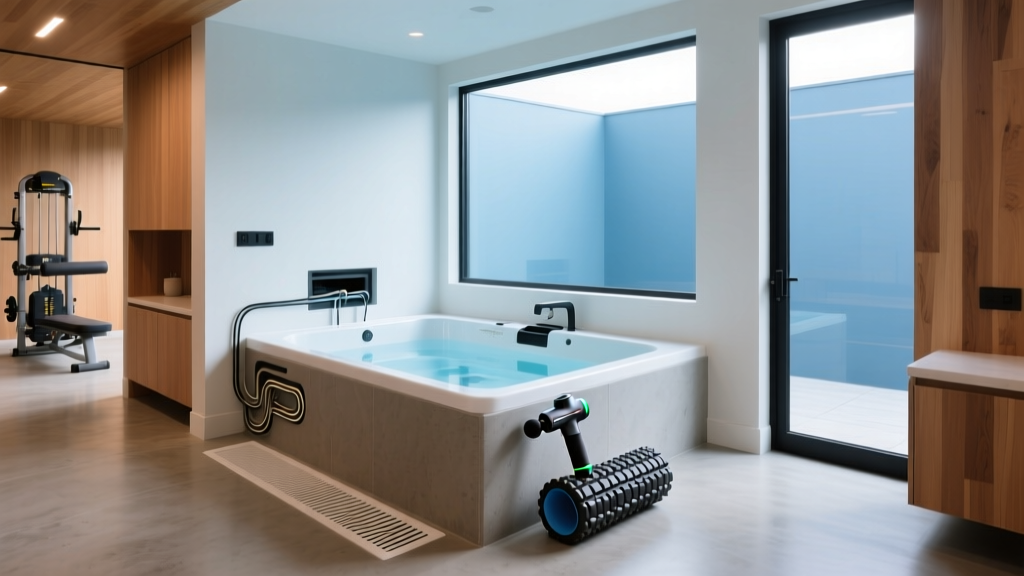
As we move through 2026, the dedicated home recovery room has transitioned from a luxury reserved for elite athletes to a mainstream staple for fitness enthusiasts. However, integrating an ice bath and cold plunge tub for home use alongside dry recovery tools requires meticulous space optimization and layout design. You are essentially merging a 'wet zone' with a 'dry zone' in a confined footprint, often within a spare bedroom, garage corner, or basement alcove.
This guide breaks down the exact spatial requirements, infrastructure needs, and ergonomic layouts for a modern cold plunge station. Furthermore, we will address a critical recovery protocol question: do massage guns work for knots when transitioning from freezing water to percussive therapy? Let us dive into the blueprints.
Zoning Your Recovery Space: Wet vs. Dry
The most common failure mode in home recovery room design is treating the space as a single, uniform environment. A cold plunge generates ambient humidity, condensation, and splash-over, while percussive therapy tools (like the Theragun PRO Plus or Hyperice Hypervolt 2 Pro) require a dry, dust-free environment with accessible power for charging docks.
Space Optimization Rule #1: The 3-Foot Buffer
Always maintain a minimum 36-inch (3-foot) buffer between the edge of your cold plunge tub and your dry recovery bench. This prevents water splash from reaching electrical charging stations and provides adequate clearance for entering and exiting the tub safely when your motor control is temporarily impaired by cold shock.
Wet Zone Specifications: Cold Plunge Footprints
When selecting an ice bath and cold plunge tub for home use, you must account for the physical footprint, the external chiller placement, and the necessary maintenance clearances. Below is a comparison of the top 2026 models and their spatial requirements.
| Model | Footprint (L x W x H) | Chiller Clearance Needed | Estimated 2026 Cost |
|---|---|---|---|
| Plunge Evolve Series | 68" x 30" x 38" | 24" side clearance for hoses | $5,490 - $6,200 |
| Sun Home Cold Plunge Pro | 72" x 33" x 36" | 30" rear clearance for venting | $6,995 - $7,500 |
| RENU Therapy Cold Stoic | 84" x 32" x 38" | 24" side/rear clearance | $9,995 - $10,500 |
Note: The chiller unit (often the size of a mini-fridge) must be placed on the same level as the tub to prevent pump strain. Never place the chiller on a raised platform above the water line.
The Dry Zone: Designing a Percussive Therapy Station
Your dry zone should feature a moisture-resistant bench (teak or sealed marine-grade polymer), a dedicated wall-mounted charging shelf, and a towel warmer. This is where you transition from cold exposure to targeted muscle manipulation.
The Science of the Protocol: Do Massage Guns Work for Knots?
As you step out of the cold plunge and sit on your recovery bench, you might reach for your percussive device. But do massage guns work for knots effectively, especially after cold water immersion? The short answer is yes, but the timing is critical to avoid injury.
According to the Cleveland Clinic, muscle knots (myofascial trigger points) are hyperirritable spots in taut bands of skeletal muscle caused by localized spasms and restricted blood flow. Percussive therapy devices operating at 30-40 Hz stimulate the Golgi tendon organs, promoting autogenic inhibition which forces the muscle spindle to relax the taut band.
Expert Insight: While percussive therapy is highly effective for releasing knots, using a massage gun immediately upon exiting a 45°F cold plunge is a mistake. Cold water immersion causes severe peripheral vasoconstriction. The muscle tissue is stiff, and the fascia is contracted. Applying high-velocity percussion to cold, restricted tissue can cause micro-tearing and bruising. You must allow a 10-to-15-minute rewarming period for vasodilation to return before targeting trigger points.
For a deeper look into how percussive therapy alters fascial stiffness, Therabody's clinical research blog outlines the precise amplitude and frequency required to safely increase local blood flow without damaging cold-stressed tissue.
Layout Blueprints: 3 Space-Optimized Configurations
Depending on your available square footage, choose one of the following layout blueprints to optimize flow and safety.
- The Compact Corner (Min. 50 Sq Ft): Ideal for garages or basement corners. The tub is tucked into a 90-degree corner with a waterproof curtain or glass splash guard on the adjacent walls. The dry bench is placed directly opposite the tub's exit step. Requires a floor drain or a low-profile sump pump.
- The Linear Corridor (Min. 75 Sq Ft): Best for narrow spare rooms. The tub is placed against the longest wall. The chiller is hidden behind a slatted, moisture-resistant privacy screen at the foot of the tub. The dry zone is a continuous teak bench running parallel to the tub, allowing you to step out, sit, and immediately reach your charging dock.
- The Dedicated Spa Room (Min. 120 Sq Ft): The ultimate setup. Features a built-in floor trench drain, a dedicated wet-room shower for rinsing off chlorine/ozone, and a separate climate-controlled dry zone with an infrared sauna panel to accelerate the rewarming process before massage gun application.
Critical Infrastructure: Plumbing, Electrical, and Flooring
A beautiful layout will fail if the underlying infrastructure is ignored. Here are the non-negotiable technical specifications for your 2026 home cold plunge build:
1. Electrical Clearances and GFCI Requirements
Cold plunge chillers (like the Plunge Pro Chiller) draw between 8 to 12 amps continuously. If you plug your chiller into a shared 15-amp bathroom circuit alongside a towel warmer or hair dryer, the breaker will trip. You must install a dedicated 20-amp GFCI (Ground Fault Circuit Interrupter) circuit exclusively for the wet zone. All outlets must be positioned at least 5 feet away from the water's edge and elevated 18 inches off the floor to prevent splash-damage.
2. Flooring and Moisture Management
Never install a cold plunge over standard hardwood or laminate. The ambient condensation from uninsulated chiller hoses and inevitable splash-over will destroy the subfloor. Opt for:
- Porcelain Tile with Epoxy Grout: Impervious to water and mold.
- Rubber Gym Flooring (3/8" thick): Excellent slip resistance when wet, though seams must be sealed with waterproof tape.
- Marine-Grade Decking: Ideal for outdoor or garage setups, allowing water to drain through the slats.
Ensure your floor has a minimum slope of 1/4 inch per foot directed toward a floor drain or a sump pump basin to prevent standing water, which is a severe slip hazard when transitioning to your dry bench.
3. Condensation Mitigation
In 2026, most premium chillers feature insulated housings, but the connecting hoses remain a vulnerability. Wrap all chiller-to-tub hoses in closed-cell foam insulation sleeves. Place a high-capacity dehumidifier (rated for at least 50 pints/day) in the wet zone to protect drywall and metal fixtures from rust and mold.
The 15-Minute Rewarm & Release Routine
To safely answer the question of whether percussive tools are effective post-plunge, follow this spatially optimized routine designed for your home layout:
- Minute 0-3 (The Exit & Dry): Exit the tub using the integrated grab bar. Step onto the slip-resistant mat. Towel off completely to stop evaporative cooling.
- Minute 3-10 (The Passive Rewarm): Move to the dry zone bench. Put on a thermal robe. Engage in light, dynamic movements (arm circles, bodyweight squats) to encourage natural vasodilation and restore core temperature.
- Minute 10-15 (Targeted Percussive Therapy): Once the skin is warm to the touch and redness returns (indicating restored blood flow), retrieve your massage gun from the charging shelf. Apply the dampener attachment. Use 20-30 second sweeps over the major muscle groups. For specific knots, apply moderate pressure for no more than 15 seconds per trigger point, allowing the autogenic inhibition response to release the spasm.
Final Thoughts on Space and Recovery
Designing an effective home recovery room is about respecting the physical boundaries of your equipment and the physiological boundaries of your body. By properly zoning your wet and dry spaces, installing dedicated electrical circuits, and understanding the science behind when and how percussive therapy interacts with cold-stressed muscles, you can build a space that rivals elite sports facilities. Whether you are utilizing a compact 50-square-foot corner or a sprawling 120-square-foot spa room, the key to success lies in the details of your layout and the precision of your protocol.
For more insights on optimizing your recovery environment, consult the comprehensive guides on cold water immersion safety and ensure all electrical and plumbing modifications are performed by licensed professionals in accordance with local building codes.
More gear to consider
All reviews
Prevent the Massage Gun Bruise: Athlete Cupping Equipment & Space Layouts
Massage Gun Ankle Recovery: Percussion vs Vibration Therapy & Care

Cupping for Athletes: 2026 Trends & How to Use Massage Gun Protocols

Nuvomed Massage Gun Recovery: Heat Therapy Pads vs Wraps

Josh Allen Massage Gun: Percussion vs. Vibration Therapy
