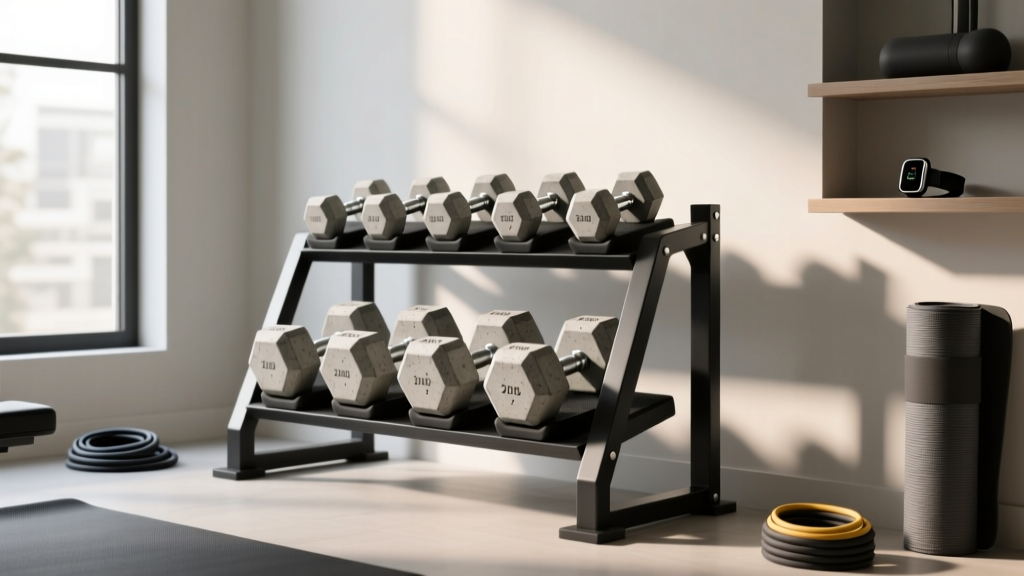
Cement Dumbbells Storage: 2026 Rack Trends and Market Analysis
Explore 2026 market trends for storing cement dumbbells. Discover specialized rack solutions, dimensional challenges, and budget storage frameworks.

The Market Shift: Why Cement Dumbbells Are Dominating Budget Gyms
The home fitness equipment market has undergone a massive bifurcation over the last few years. On one end, premium urethane and cast-iron gear cater to commercial and high-end residential gyms. On the other, vinyl-encased cement dumbbells have captured a dominant share of the entry-level and budget home gym segment. According to comprehensive analyses of the global fitness equipment market, budget-friendly, space-conscious gear continues to drive volume sales among first-time home gym builders.
However, this surge in cement dumbbell popularity has exposed a critical blind spot in the accessory market: storage. Traditional dumbbell racks are engineered for the compact, high-density profile of cast iron. When consumers attempt to store bulky, oversized cement dumbbells on standard 3-tier or 5-tier A-frame racks, the result is a cascade of structural failures, safety hazards, and damaged equipment. As we navigate the 2026 fitness equipment landscape, specialized storage solutions for non-standard free weights have become a vital sub-sector of the market.
Industry Insight: "The dimensional mismatch between budget cement weights and premium cast-iron racks is the leading cause of home gym storage frustration. Consumers are buying $50 weight sets and realizing they need to completely rethink their $300 rack investments." — Fitness Equipment Ergonomics Report, 2025
The Dimensional Crisis: Cast Iron vs. Cement Specs
To understand the storage crisis, we must look at the raw geometry of the equipment. Cement dumbbells (often branded by companies like CAP Barbell, Yes4All, and Tone Fitness) use a concrete-aggregate core encased in a thick polyethylene or vinyl shell. Because cement is significantly less dense than iron, the physical volume required to achieve the same weight is drastically larger.
| Specification | Standard Cast Iron (20 lb) | Vinyl-Encased Cement (20 lb) | Standard 3-Tier Rack Spec |
|---|---|---|---|
| Overall Length | 11.5 inches | 15.2 - 16.5 inches | 12-inch tier width |
| Head Width | 3.5 inches | 5.8 - 6.2 inches | 4-inch tier depth |
| Handle Thickness | 1.1 inches | 1.3 - 1.5 inches | Standard saddle curve |
| Center of Mass | Perfectly centralized | Prone to internal shifting | Assumes centralized balance |
The data highlights the core failure point. A standard 12-inch tier width cannot accommodate a 15.5-inch cement dumbbell. When forced onto these racks, the dumbbells overhang, creating a severe tipping hazard. Furthermore, the thick, often ergonomically contoured plastic handles of cement weights do not seat properly in the curved metal saddles of traditional racks, leading to rolling and falling.
2026 Storage Solutions: What the Market Offers
In response to these dimensional challenges, the market has pivoted. Manufacturers and savvy consumers are moving away from tiered cradle racks and adopting alternative storage frameworks. Based on current expert evaluations of dumbbell storage, here are the dominant solutions for cement weight sets in 2026.
1. Flat Shelf & Utility Rack Integrations
The most effective solution for cement dumbbells is the flat shelf. Brands like REP Fitness and Titan Fitness have popularized flat storage shelves that bolt directly into power racks or function as standalone units.
Cost Analysis: A standalone 3-shelf flat rack typically retails between $180 and $250.
Capacity: A 48-inch wide flat shelf can comfortably hold up to 8 pairs of bulky cement dumbbells (ranging from 10 lbs to 40 lbs) without any overhang or balance issues.
2. Heavy-Duty A-Frame Configurations
While traditional tiered racks fail, widened A-Frame racks designed specifically for hex and oversized dumbbells have gained traction. These racks feature elongated horizontal rails rather than individual saddles.
Edge Case Warning: When using an A-Frame, you must ensure the horizontal rails are at least 18 inches long. If the cement dumbbells are placed parallel to the rail rather than perpendicular, the thick plastic heads can catch on the support struts when being lifted, causing the plastic casing to split.
3. The Commercial Shelving Hack (The Budget Route)
For consumers who bought cement dumbbells specifically to save money, spending $250 on a specialized fitness rack often defeats the purpose. The dominant trend in the budget home gym community is the use of commercial-grade garage shelving.
Specifications: A standard 48" W x 24" D x 72" H steel utility shelf (such as models from Husky or Gladiator) costs between $120 and $160.
Weight Capacity: These shelves typically support 800 to 1,000 lbs per tier.
Pro-Tip: Always apply a 3mm rubber mat to each metal shelf tier. The smooth vinyl casing of cement dumbbells will slide dangerously on bare metal shelves during retrieval. The rubber mat dampens vibrations and prevents the weights from shifting.
⚠️ Safety Warning: Plastic Degradation and Drop Heights
Cement dumbbells are highly susceptible to casing failure. The internal concrete can separate from the outer plastic shell over time, especially if exposed to UV light or fluctuating garage temperatures. Storing these weights on high-tier racks (above 4 feet) is strongly discouraged. If a cement dumbbell is dropped from a high rack, the impact force will almost certainly shatter the brittle plastic shell, exposing the raw concrete and ruining the weight. Always store heavier cement pairs (25 lbs and above) on the bottom tier of your shelving unit.
Purchasing Framework: Matching Your Rack to Your Cement Set
To help consumers and gym owners navigate this fragmented storage market, we have developed a decision matrix based on total weight volume, budget, and available floor space.
- Scenario A: The Starter Set (5 to 8 pairs, 10-40 lbs)
Recommendation: Wall-mounted flat shelving or a compact 2-tier utility cart.
Estimated Cost: $60 - $110.
Footprint: Minimal floor space; utilizes vertical wall real estate. - Scenario B: The Full Progression Set (10 to 15 pairs, 5-50 lbs)
Recommendation: 48-inch wide commercial steel utility shelving with rubber matting.
Estimated Cost: $140 - $180.
Footprint: 4 square feet. Offers the highest weight-to-dollar storage ratio on the market. - Scenario C: The Integrated Home Gym (Power Rack Owners)
Recommendation: Flat shelf attachment bolted to existing uprights (e.g., Titan Fitness Flat Dumbbell Storage Attachment).
Estimated Cost: $80 - $130.
Footprint: Zero additional floor space required.
The Resale Market Impact: How Storage Affects Asset Value
An often-overlooked aspect of the budget fitness equipment market is the secondary resale value. Platforms like Facebook Marketplace and Craigslist are flooded with used cement dumbbells. Market analysis reveals that cement dumbbells stored on improper, sloped tier racks suffer a 40% higher rate of cosmetic and structural damage compared to those stored on flat shelves.
When cement weights rest on narrow metal cradles, the pressure concentrates on a single point of the plastic handle. Over months of static loading, this causes micro-fractures in the vinyl. When resold, these fractured handles are flagged by buyers as "compromised," reducing the resale value of a $60 set down to $15 or rendering them unsellable. Investing in flat storage not only protects the user from injury but preserves the residual value of the equipment.
Future Outlook: Will Manufacturers Bridge the Gap?
Looking ahead through the remainder of 2026 and into 2027, we anticipate a shift in how entry-level fitness brands package their products. Currently, cement dumbbells are sold almost exclusively as standalone sets. We are beginning to see early market tests from brands offering "Storage Bundles"—pairing a 100 lb cement dumbbell set with a branded, custom-fit wire-mesh flat rack. By acknowledging the geometric realities of their products, manufacturers can capture the accessory revenue that currently leaks to third-party garage shelving companies. Until then, consumers must rely on the alternative frameworks outlined above to keep their home gyms safe, organized, and functional. For more detailed reviews on specific rack models and their compatibility with oversized weights, consult our comprehensive dumbbell rack buying guides.
More gear to consider
All reviews
Rubber Hex vs Urethane Dumbbells for Standing Dumbbell Upward Fly

Cast Iron vs Competition Kettlebells & Dumbbell Rear Lat Raise Swaps

Squat Rack vs Power Rack: Mistakes & Dumbbell Cardio Workout Fixes
Beyond Core Strength Exercises Dumbbells: Olympic Barbell Guide
Loadable Dumbbell Care for the Lying Tricep Extension with Dumbbells
