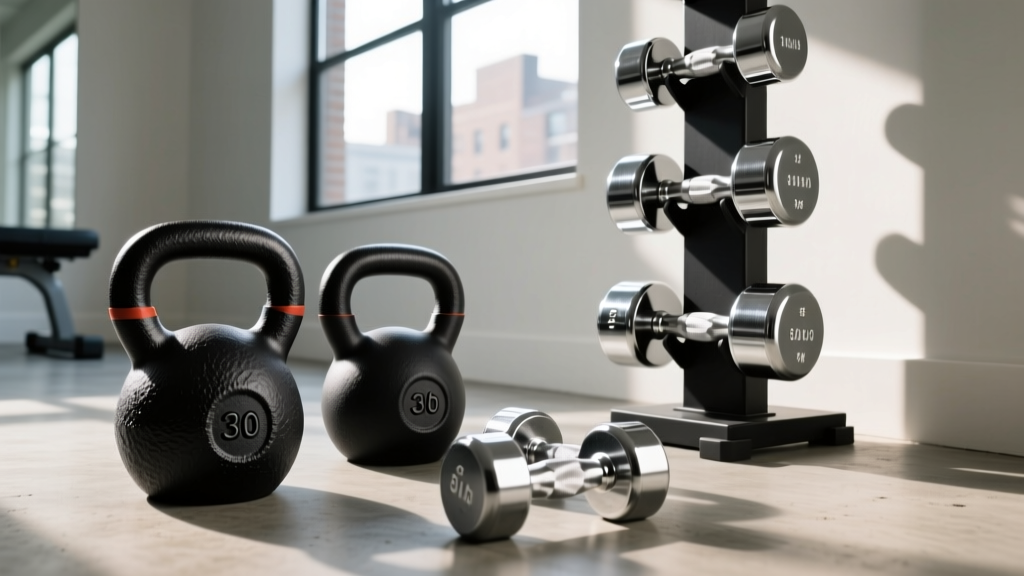
Cast Iron vs Competition Kettlebells & Dumbbell Exercises for Back of Arms
Optimize your home gym layout with our guide to cast iron vs competition kettlebells, plus space-saving dumbbell exercises for back of arms.

Designing a high-performance home gym in 2026 requires a ruthless approach to spatial efficiency. Whether you are converting a 10x10 spare bedroom or carving out a corner of your garage, every square inch must justify its footprint. Two of the most common dilemmas in compact gym design involve selecting the right free weight profiles and ensuring you have the clearance for targeted isolation work. In this guide, we break down the spatial and functional differences between cast iron and competition kettlebells, and demonstrate how to seamlessly integrate space-saving dumbbell exercises for back of arms into a high-density training layout.
The Geometry of Iron: Cast Iron vs. Competition Kettlebells
When optimizing a floor plan, the physical dimensions of your equipment dictate your storage and movement clearance. The debate between cast iron and competition kettlebells is often framed around durability or grip, but from a space optimization perspective, it is entirely about geometry and predictability.
Competition kettlebells are standardized by the International Union of Kettlebell Lifting (IUKL). Regardless of whether you are holding an 8kg or a 32kg bell, the dimensions remain identical: 280mm in height, 210mm in width, and a 35mm handle diameter. This uniformity allows for hyper-precise storage planning and consistent biomechanical clearance during high-repetition snatches or jerks in tight spaces. Conversely, traditional cast iron kettlebells scale in size with their weight. A 16kg cast iron bell might be compact enough to tuck under a bench, while a 32kg cast iron bell becomes a massive, unwieldy sphere that demands significant floor space and alters your swing arc clearance.
| Metric | Competition Bell (e.g., Rogue) | Standard Cast Iron Bell |
|---|---|---|
| Height | 280 mm (Fixed) | ~230 mm (Variable) |
| Width (Bell Diameter) | 210 mm (Fixed) | ~215 mm (Variable) |
| Handle Diameter | 35 mm | 30 mm - 33 mm |
| Storage Predictability | High (Uniform stacking) | Low (Requires custom spacing) |
| Swing Arc Clearance | Consistent across all weights | Increases with heavier loads |
Vertical Storage: Reclaiming Your Floor Plan
To maximize your active training area, kettlebells must be stored vertically. According to Rogue Fitness equipment specifications, a standard 3-tier kettlebell rack occupies a mere 23" x 23" footprint (roughly 3.7 square feet) while holding up to six bells. Because competition bells share identical widths, they slide into these vertical tiered racks with zero spatial friction. Cast iron bells, particularly those with wider, flatter bases or powder-coated finishes that increase friction, often require staggered or single-tier floor racks, which can consume upwards of 8 to 10 square feet of prime mat space.
Layout Tip: Place your vertical kettlebell rack in a "dead corner"—the 90-degree angle furthest from your primary entry point. This keeps the heavy, dense iron out of your primary swing and snatch lanes, ensuring a minimum of 48 inches of unobstructed clearance in your central training zone.
Integrating Adjustable Dumbbells for Isolation Work
While kettlebells are unparalleled for ballistic, full-body movements (swings, cleans, Turkish get-ups), they are suboptimal for strict, single-joint hypertrophy work. In a space-optimized gym, you cannot justify a full 5-to-50lb dumbbell rack that consumes an entire wall. Instead, a pair of high-end adjustable dumbbells (like the Nuobell 80s or PowerBlock Elite) is mandatory. These units replace 15 pairs of fixed dumbbells, condensing 1,200 lbs of iron into a footprint smaller than a standard shoebox.
When designing a tight layout, you must carefully select your dumbbell exercises for back of arms to ensure you don't strike walls, racks, or storage bins during overhead or lying movements. The triceps brachii make up roughly two-thirds of your upper arm mass, and targeting them effectively in a confined space requires specific exercise selection and spatial awareness.
The Compact Triceps Protocol (No Bench Required)
To train the back of the arms without dragging a 4-foot utility bench into your limited footprint, utilize these three floor-based and seated movements. Biomechanical data sourced from the ExRx Triceps Directory confirms that manipulating shoulder flexion angles allows for complete triceps development without requiring expansive equipment.
-
Floor-Based Skull Crushers (Lying Triceps Extensions)
Space Required: 2 ft x 5 ft floor mat space.
Execution: Lie flat on your 3/4" horse stall mat. With adjustable dumbbells set to 25-40 lbs, extend your arms directly over your chest. Hinge only at the elbow, lowering the dumbbells toward your ears until your forearms touch the floor. The floor acts as a natural depth stop, protecting your elbow joints while eliminating the need for a bench. Keep your elbows pinned inward to isolate the lateral and medial heads. -
Seated Overhead Triceps Extensions
Space Required: 2 ft x 2 ft seated clearance (requires 36" vertical overhead clearance).
Execution: The long head of the triceps crosses the shoulder joint, meaning it is only fully stretched and activated when the arm is raised overhead. Sit cross-legged or on a low 12" plyo box. Grasp a single heavy adjustable dumbbell (50-80 lbs) with both hands. Lower it behind your head, keeping your biceps flush against your ears. This movement requires strict vertical clearance but zero lateral footprint. -
Close-Grip Floor Presses
Space Required: 2 ft x 5 ft floor mat space.
Execution: A staple for powerlifters and space-constrained athletes. Lie on the floor, knees bent, feet flat. Grip the dumbbells with your hands just 6 to 8 inches apart. Press upward, focusing entirely on locking out the elbow joint. The floor limits your range of motion at the bottom, protecting the shoulders while heavily overloading the triceps at the point of peak contraction.
2026 Equipment Cost & Spatial ROI Matrix
Investing in space-saving equipment carries a premium upfront cost, but the "Return on Space" (ROS) is undeniable when calculating the cost per square foot of your home gym real estate.
| Equipment Category | 2026 Avg. Cost | Floor Footprint | Space Optimization Value |
|---|---|---|---|
| Set of 5 Competition Kettlebells (8-24kg) | $650 - $800 | 3.7 sq ft (on 3-tier rack) | High (Uniform, stackable) |
| Set of 5 Cast Iron Kettlebells (8-24kg) | $350 - $500 | 6.0+ sq ft (floor/staggered) | Moderate (Variable sizing) |
| Adjustable Dumbbells (5-80 lbs, Pair) | $400 - $450 | 1.2 sq ft (in cradle) | Extreme (Replaces full rack) |
Final Layout Blueprint: The 48-Square-Foot Power Zone
To synthesize the National Strength and Conditioning Association (NSCA) guidelines for home training environments with modern spatial constraints, here is the ultimate 6x8 foot layout blueprint:
- Zone 1 (The Anchor): Place a 4x6 ft, 3/4" thick rubber horse stall mat in the center. This is your primary ballistic and floor-press zone.
- Zone 2 (Vertical Storage): Position a 3-tier steel kettlebell rack in the back-left corner, loaded with competition bells for predictable spatial clearance during snatches.
- Zone 3 (The Isolation Station): Place your adjustable dumbbell cradle in the front-right corner, adjacent to a wall-mounted mirror. This allows you to transition instantly from heavy kettlebell swings to targeted dumbbell exercises for back of arms without crossing the room or tripping over stray iron.
By prioritizing uniform competition kettlebells for your ballistic work and relying on adjustable dumbbells for strict, floor-based triceps isolation, you eliminate the need for bulky benches and sprawling iron racks. The result is a dense, highly functional training environment that refuses to compromise on muscle development or safety, proving that in 2026, the smartest gyms are not the biggest—they are the most meticulously designed.
More gear to consider
All reviews
Power Rack vs Squat Rack vs Stand: Reverse Rows Dumbbells Guide

Standard vs Olympic Plates & The Thomas Inch Dumbbell Diameter
Best Racks for a 30 Minute Workout with Dumbbells: 2026 Budget Guide

Bicep and Tricep Workout with Dumbbells: Urethane vs Rubber Hex 2026

Cast Iron vs Competition Kettlebells for 5 Day Dumbbell Only Workout
