Cast Iron vs Competition Kettlebells: Dumbbell Squat to Shoulder Press
Analyze the 2026 budget ROI of cast iron vs competition kettlebells compared to adjustable dumbbells for the dumbbell squat to shoulder press.

The 2026 Home Gym Budget Dilemma: Free Weights Allocation
When outfitting a home gym, budget allocation dictates your training ceiling. A common crossroads for lifters is deciding whether to invest $350 to $450 in a pair of high-end adjustable dumbbells to perform staple compound movements like the dumbbell squat to shoulder press, or to pivot that budget toward a curated set of kettlebells. While adjustable dumbbells offer incremental weight jumps, kettlebells unlock unique ballistic and grind movement patterns that dumbbells simply cannot replicate safely.
But if you choose the kettlebell route, you immediately face a secondary market divide: cast iron vs. competition kettlebells. This guide breaks down the true cost-per-use, manufacturing nuances, and biomechanical ROI of both kettlebell styles, specifically contrasting them against the traditional dumbbell squat to shoulder press to help you maximize your equipment budget.
Cast Iron vs. Competition Kettlebells: A Value Analysis
To understand where your money goes, you must look past the paint and examine the metallurgy and tolerances of modern kettlebells.
Cast Iron Kettlebells: The Budget Workhorse
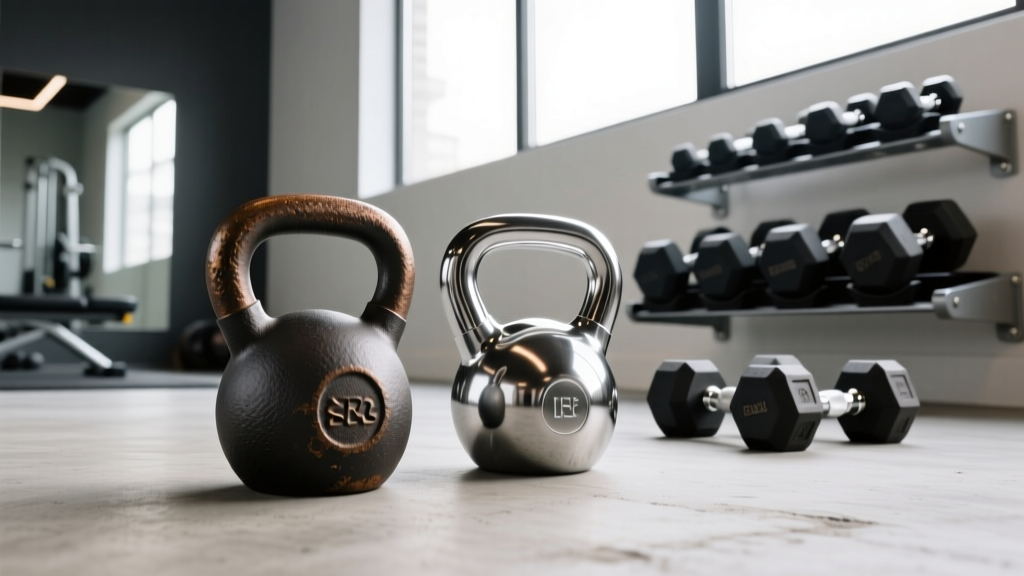
Cast iron kettlebells are gravity-poured into molds as a single solid piece of iron. Because they are solid, their physical dimensions scale with their weight. A 12kg cast iron bell is significantly smaller than a 32kg bell.
- Coating Options: In 2026, the market standard for premium cast iron is an e-coat (electrophoretic deposition) or a textured powder coat. E-coats, like those found on the Rogue E-Coat Kettlebells (~$85 for 16kg), preserve the machined feel of the handle and resist rust exceptionally well without adding thick layers of paint that can chip during drops.
- Handle Geometry: Handle thickness varies by weight. Lighter bells may feature 32mm handles, while heavy bells push 35mm or thicker. This variance forces your grip to adapt as you progress in weight.
- The Value Proposition: You are paying strictly for the raw material and basic finishing. Cost per kilogram hovers around $4.50 to $6.00.
Competition Kettlebells: The Premium Standard
Competition kettlebells are engineered for uniformity. Whether you are lifting 8kg or 48kg, the bell's physical dimensions, handle diameter (strictly 33mm), and horn spacing remain identical.
- Manufacturing: They feature a hollow steel outer shell. To achieve the target weight, manufacturers fill the core with a dense composite of iron filings, sand, and sometimes lead or steel shot. High-end models like the Kettlebell Kings Competition Series (~$115 for 16kg) use precision welding to ensure the base is perfectly flat and the shell will never rattle.
- Biomechanical Consistency: Because the dimensions never change, your muscle memory, rack position, and clean technique remain perfectly consistent regardless of the load.
- The Value Proposition: You are paying for machining precision, steel shell durability, and standardized ergonomics. Cost per kilogram jumps to $7.00 to $9.00.
Movement ROI: Kettlebell Thrusters vs. the Dumbbell Squat to Shoulder Press
To evaluate true value, we must analyze how this equipment performs during high-yield, full-body movements. The dumbbell squat to shoulder press (often called a dumbbell thruster) is a cornerstone of hypertrophy and conditioning. However, executing this movement with adjustable dumbbells introduces mechanical friction that kettlebells eliminate.
⚠️ The Adjustable Dumbbell Rack ProblemDuring the 'clean' phase of a dumbbell squat to shoulder press, adjustable dumbbells (like Nuobells or PowerBlocks) feature bulky, rectangular heads. When brought to the shoulder rack position, these oversized ends frequently clash with your collarbone or force your wrists into severe ulnar deviation. Kettlebells, conversely, are designed to rest securely in the 'rack'—tucked between the forearm and bicep, offloading the weight directly through the skeletal structure rather than taxing the wrist flexors.
According to ExRx.net's biomechanical breakdown of the shoulder press, optimal force transfer requires the wrist to remain stacked directly over the elbow. When performing the dumbbell squat to shoulder press, the transition from the deep squat hole to the overhead lockout demands immense core stability. If the dumbbell heads interfere with your shoulder mobility at the bottom of the squat, you lose power in the drive phase.
A kettlebell thruster (the kettlebell equivalent of the squat to press) allows the bell to sit flush against the forearm. As noted by the National Academy of Sports Medicine (NASM), the offset center of mass in a kettlebell demands greater recruitment of the rotator cuff and deep core stabilizers during the overhead lockout compared to a balanced dumbbell. Therefore, for athletic conditioning and functional core integration, the competition kettlebell offers a higher neurological ROI per dollar spent than a set of adjustable dumbbells.
Cost-Per-Use Matrix: Dumbbells vs. Kettlebells
Let us break down the financial reality of building a versatile home gym arsenal in 2026. The table below compares a standard adjustable dumbbell setup against a minimal but highly effective kettlebell pairing.
| Equipment Setup | Approx. 2026 Cost | Weight Range | Durability & Failure Modes |
|---|---|---|---|
| Pair of Adjustable Dumbbells (5-50 lbs) | $375 - $450 | 10 lbs - 100 lbs total | High failure rate if dropped. Internal dial mechanisms and plastic trays are prone to cracking. |
| Cast Iron KB Pair (16kg & 24kg) | $180 - $220 | 35 lbs & 53 lbs (Fixed) | Virtually indestructible. E-coat may scuff concrete, but structural failure is impossible. |
| Competition KB Pair (16kg & 24kg) | $230 - $260 | 35 lbs & 53 lbs (Fixed) | Steel shell can dent if dropped on steel plates, but handles will never snap or loosen. |
The Verdict on Value
If your primary goal is strict bodybuilding isolation and incremental progressive overload (e.g., lateral raises, strict curls, and slow-tempo presses), adjustable dumbbells win. However, if your programming heavily features the dumbbell squat to shoulder press, swings, snatches, and Turkish get-ups, spending $400 on fragile adjustable dumbbells is a poor allocation of funds. A $230 investment in two competition kettlebells provides a safer rack position, superior ballistic durability, and standardized movement mechanics.
The 2026 Buyer's Decision Framework
Use this step-by-step framework to finalize your free weights purchase:
- Assess Your Flooring: If you train in a garage on raw concrete or over standard garage tiles, buy Cast Iron (specifically rubber-bottomed or e-coat). Dropping a steel competition bell on concrete will dent the shell and chip your floor.
- Evaluate Your Wrist Mobility: If you lack the thoracic and wrist mobility to achieve a deep front rack, stick to the dumbbell squat to shoulder press using hex-head fixed dumbbells (avoiding adjustable models with bulky ends). If you are willing to drill mobility work, invest in Competition Kettlebells to enforce proper 33mm handle mechanics.
- Determine Your Progression Style: Kettlebells require 'volume progression' (adding reps or density) before 'load progression' (jumping from 16kg to 24kg is a massive 50% load increase). Dumbbells allow micro-loading. Choose based on your patience for load jumps.
Expert Insight: 'Never buy a vinyl-coated cast iron kettlebell. The thick vinyl alters the handle dimensions, making the horns too wide for a proper clean, and the handle becomes dangerously slippery once you start sweating during high-rep thrusters. Always opt for bare machined iron, e-coat, or powder coat.'
Frequently Asked Questions
Can I use kettlebells for strict shoulder presses?
Yes, but the offset center of mass requires more stabilizer engagement. For pure anterior deltoid hypertrophy, the balanced load of a dumbbell is superior. For functional, athletic shoulder health, the kettlebell press is unmatched.
Why do competition kettlebells cost more if they are hollow?
You are paying for the precision manufacturing required to create a uniform steel shell, the labor-intensive process of calibrating the internal core fill to exact gram tolerances, and the premium 33mm machined handles that protect your wrists during high-volume cleans and presses.
More gear to consider
All reviews
Top Adjustable Floor Press Dumbbells: 2026 Buying Guide

EZ vs Straight Bar: 2026 Dumbbell Training for Women Trends
Dumbbell Training Program Stalled? Olympic vs Standard Plate Fixes

Setup Guide: Olympic vs Standard Plates & Single Dumbbell Exercises
EZ Curl Bar vs Straight Bar: Beyond Light Dumbbell Exercises