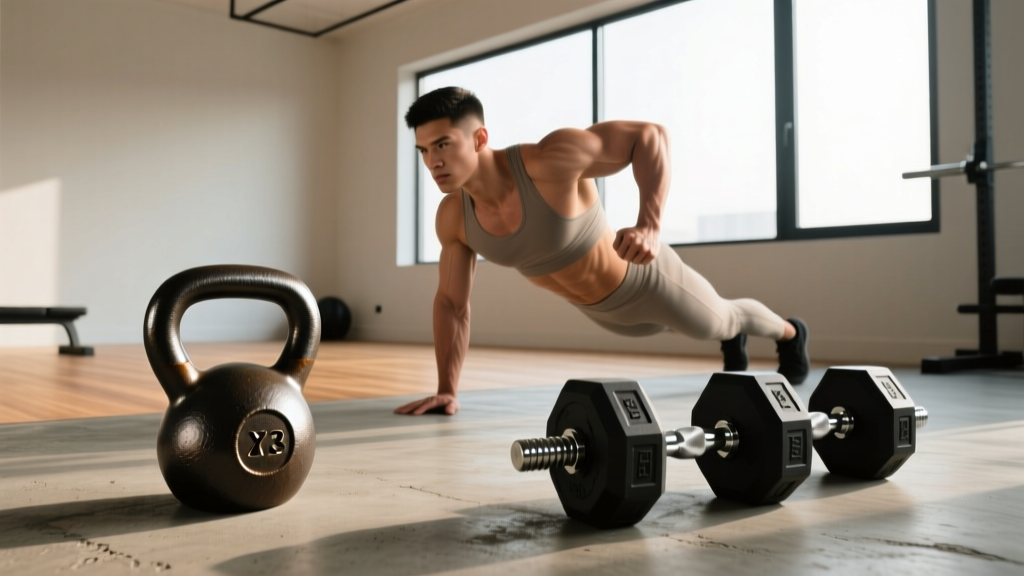
Cast Iron vs Competition Kettlebells & Dumbbell One Arm Push Press
Optimize your home gym layout. Compare cast iron vs competition kettlebells and use the dumbbell one arm push press for space-saving overhead strength.

The Spatial Footprint: Designing Your Free Weight Zone
Designing a high-performance home gym in 2026 requires ruthless spatial efficiency. When outfitting your free weight zone, the choice between cast iron and competition kettlebells dictates your storage footprint, racking hardware, and movement clearance. But what happens when your budget or floor plan prevents buying a full set of kettlebells for overhead work? This is where integrating adjustable dumbbells and mastering the dumbbell one arm push press becomes a masterclass in space optimization, allowing you to bridge strength gaps without sacrificing valuable square footage.
Layout Rule of Thumb: Always allocate a minimum 4x6 foot rubber-matted clearance zone for ballistic kettlebell movements. Never place your storage rack within the swing arc of your primary training space.Geometry and Storage: Cast Iron vs. Competition Bells
To optimize your layout, you must first understand the physical geometry of the tools. The spatial footprint of your kettlebell rack depends entirely on whether you choose cast iron or competition-style bells.
Cast Iron Kettlebells: The Variable Footprint
Cast iron kettlebells (like those from Rogue or Rep Fitness) scale in physical size as the weight increases. A 12kg bell is significantly smaller in diameter and height than a 32kg bell. While this means lighter bells take up less floor space, it creates a nightmare for racking. You cannot use a single-tier horizontal rack for a full set; you must invest in a multi-tiered A-frame or staggered wall-mounted rack to accommodate the varying handle heights and bell diameters. Furthermore, handle thickness varies from roughly 32mm on lighter bells to over 40mm on heavier ones, which alters the biomechanics of the rack position.
Competition Kettlebells: The Uniform Advantage
Competition kettlebells are manufactured to exact, uniform dimensions regardless of weight: 280mm in height, 203mm in width, and a 33mm handle diameter. From a space optimization and layout design perspective, this uniformity is a massive advantage. You can store an entire set of competition bells on a single-tier, 48-inch wide horizontal rack. This frees up vertical wall space for mirrors, whiteboards, or wall-mounted medicine ball storage. According to the equipment standards outlined by StrongFirst, the uniform 33mm handle also ensures that your muscle memory for cleans and presses remains consistent across all loads.
Comparative Matrix: Space, Cost, and Utility
| Feature | Cast Iron Kettlebells | Competition Kettlebells | Adjustable Dumbbells |
|---|---|---|---|
| Rack Footprint | Large (Requires multi-tier) | Compact (Single-tier capable) | Minimal (Fits on single shelf) |
| 2026 Avg. Cost (16kg/35lb) | $45 - $60 | $95 - $130 | $350 - $450 (per pair) |
| Overhead Clearance Needed | High (Strict press arc) | High (Strict press arc) | Moderate (Dip-and-drive path) |
| Micro-loading Capability | No (Jumps 4kg-8kg) | No (Jumps 4kg-8kg) | Yes (2.5lb - 5lb increments) |
Bridging the Overhead Gap: The Dumbbell One Arm Push Press
Here is the reality of home gym layouts: most garage gyms and basement spaces suffer from low ceiling heights (often 7 to 8 feet). When you combine a low ceiling with the strict overhead arc required for a heavy kettlebell military press, you risk striking the ceiling joists or drywall. Furthermore, buying a full set of competition kettlebells just to have the right micro-progression for overhead pressing is financially and spatially inefficient.
This is where the dumbbell one arm push press becomes your ultimate spatial and programming hack. By utilizing a pair of high-quality adjustable dumbbells (such as the Nuobell 80s or PowerBlock Elite USA), you eliminate the need to store six different heavy kettlebells strictly for overhead work.
Biomechanics and Ceiling Clearance
According to the exercise biomechanics data cataloged by ExRx.net, the push press utilizes a dip-and-drive mechanism originating from the lower body. Unlike a strict press, where the bell must travel a long, strict vertical line from the shoulder, the push press allows you to start the dumbbell slightly lower and use leg drive to propel the weight upward. This alters the spatial requirement of the movement:
- Lower Starting Position: The dumbbell is racked at the shoulder, requiring less initial vertical clearance than a kettlebell clean-and-press sequence.
- Wider Elbow Path: The dumbbell allows for a slightly more natural, flared elbow path during the drive phase, which is highly forgiving in narrow, constrained layout zones.
- Micro-Loading for Progressive Overload: Kettlebells typically jump in 4kg (8.8 lb) increments. If you fail a 20kg kettlebell press, you are stuck. With adjustable dumbbells, you can execute the dumbbell one arm push press at 42.5 lbs, then 45 lbs, then 47.5 lbs, ensuring continuous strength adaptation without buying intermediate bells.
2026 Buyer's Framework: What to Actually Purchase
To build a space-optimized layout that covers all bases without cluttering your floor, follow this targeted purchasing framework:
- The Ballistic Core (Cast Iron): Purchase two cast iron kettlebells for swings, goblet squats, and carries. A 16kg and 24kg (or 20kg and 28kg) set from Rogue Fitness will cost roughly $120 combined and can be stored on a compact, wall-mounted two-hook hanger, entirely eliminating floor rack footprint.
- The Overhead Solution (Adjustable Dumbbells): Invest $350-$400 in a pair of adjustable dumbbells that go up to 50-80 lbs. Store these on a single, low-profile shelf or the floor near your bench. Use these exclusively for the dumbbell one arm push press, strict presses, and unilateral rows.
- The Skill Work (Single Competition Bell): If you practice kettlebell sport or technical clean-and-jerk work, buy exactly one 16kg or 20kg competition bell. Its uniform 33mm handle will allow you to practice technique safely, and it can be stored on the floor or a single-bell pedestal.
Final Layout Verdict
Space optimization is not just about buying smaller equipment; it is about selecting tools that offer the highest utility-to-footprint ratio. Cast iron kettlebells win for budget-friendly ballistic loading but lose on racking efficiency. Competition kettlebells offer beautiful uniformity for single-tier racks but demand a massive financial investment for a complete set. By strategically pairing a minimal cast iron set with adjustable dumbbells—and leveraging the dumbbell one arm push press for your overhead strength work—you create a 2026 home gym layout that is financially lean, spatially dominant, and biomechanically complete.
More gear to consider
All reviews
Barbell Collar Clamps Compared: Squats to Rotating Dumbbell Curls

Barbell Collar vs Clamp Types & Box Squats with Dumbbells Safety

Olympic Barbell Knurling Guide & Alternating Dumbbell Press
Power Rack vs Squat Rack vs Stand: Dumbbells for Love Handles Setups
Slight Incline Dumbbell Press Mistakes & Olympic vs Standard Plates
