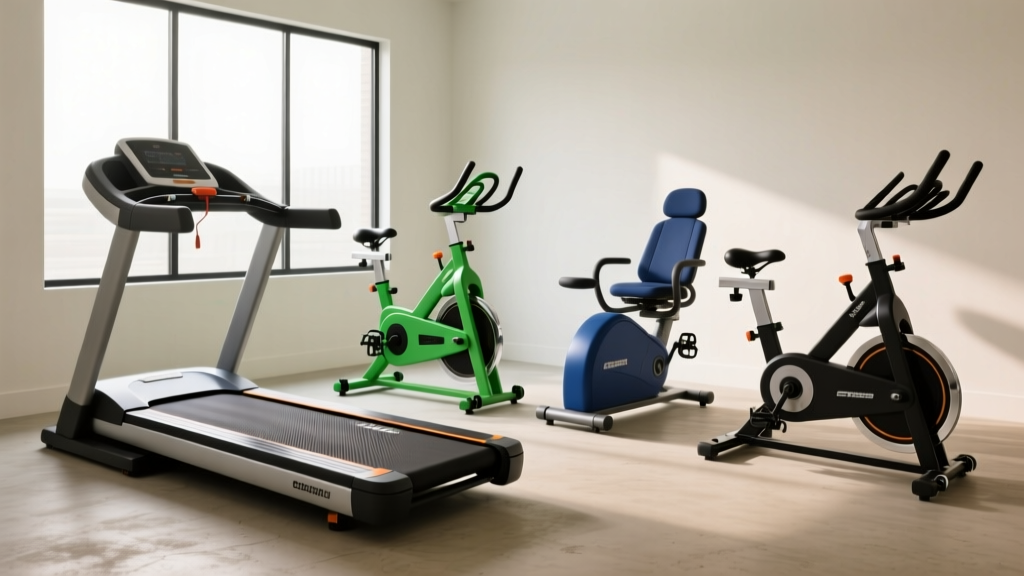
How Many Calories Burned on Treadmill vs Bikes: Space Layout Guide
Compare how many calories burned on treadmill vs upright, recumbent, and spin bikes. Discover the best space-saving layouts for your 2026 home gym.

The Spatial Dilemma: Caloric ROI vs. Square Footage
Designing a home gym in 2026 requires balancing two competing priorities: maximum metabolic output and minimal spatial intrusion. Whether you are converting a cramped 8x10 guest bedroom or optimizing a corner of your living space, the concept of 'Caloric Density per Square Foot' (CD/SF) is the ultimate metric for equipment selection. While treadmills are traditionally viewed as the gold standard for cardiovascular conditioning, their massive operational footprints often make them impractical for space-constrained environments. This guide breaks down the exact spatial requirements and metabolic returns of treadmills versus the three primary stationary bike types—upright, recumbent, and spin—to help you design a highly efficient home gym layout.
How Many Calories Burned on Treadmill vs. Stationary Bikes?
Before mapping out your floor plan, we must address the fundamental metabolic question: how many calories burned on treadmill machines compared to stationary bikes? According to data from Harvard Health Publishing, calorie expenditure is heavily dependent on intensity, body weight, and the mechanical efficiency of the machine. Running on a treadmill generally yields the highest raw calorie burn, but when we factor in the physical space the machine occupies—including mandatory safety clearances—the efficiency metric shifts dramatically.
| Equipment Type (2026 Reference Models) | Machine Footprint (L x W) | 30-Min Calorie Burn (155 lb user, Vigorous) | Caloric Density (Cal/Sq Ft) |
|---|---|---|---|
| Treadmill (Sole F80) | 82' x 37' (21.0 sq ft) | ~372 kcal | 17.7 cal/sq ft |
| Spin Bike (Peloton Bike+) | 59' x 22' (9.0 sq ft) | ~278 kcal | 30.8 cal/sq ft |
| Upright Bike (Schwinn IC4) | 48.7' x 21.2' (7.1 sq ft) | ~252 kcal | 35.4 cal/sq ft |
| Recumbent Bike (NordicTrack R30i) | 64' x 26' (11.5 sq ft) | ~210 kcal | 18.2 cal/sq ft |
Note: Calorie estimates are based on MET (Metabolic Equivalent of Task) values for vigorous effort. Actual results vary based on user biomechanics and resistance/incline settings.
Stationary Bike Types: Space Profiles & Layout Nuances
When a treadmill's 21-square-foot base is simply too large for your designated zone, stationary bikes offer compelling alternatives. However, not all bikes are created equal from a spatial design perspective. Here is how the three main types impact your room layout.
1. Spin Bikes (Indoor Cycles)
Spin bikes, characterized by their aggressive, forward-leaning geometry and heavy perimeter-weighted flywheels, are the closest spatial equivalent to a treadmill in terms of workout intensity. Models like the Peloton Bike+ or the Keiser M3i feature a narrow, elongated footprint. Layout Insight: Spin bikes generate a significant 'sweat radius.' When planning your layout, you must account for a 3-foot forward splash zone to protect drywall and electronics. Positioning a spin bike facing a window or an easily wipeable glass wall is a staple of modern 2026 gym design.
2. Upright Bikes
Upright bikes mimic traditional bicycles but with a more compact frame and a magnetic resistance wheel housed beneath the console. They boast the smallest physical footprint of any cardio machine. Layout Insight: Because they lack the elongated frame of a spin bike or recumbent, upright bikes can easily be tucked into alcoves or placed diagonally in tight corners. Many modern upright bikes also feature transport wheels that allow them to be rolled into a closet post-workout, effectively reducing their spatial footprint to zero when not in use.
3. Recumbent Bikes
Recumbent bikes feature a bucket seat with a backrest and forward-mounted pedals. While they are exceptional for users with lumbar issues or limited mobility, they are notorious space hogs. The elongated chassis required to support the reclined position often rivals a treadmill in length, though they are much narrower. Layout Insight: Recumbent bikes fail in square rooms but excel in long, narrow spaces like sunrooms, enclosed hallways, or the foot of a bed. Their low profile (usually under 45 inches in height) allows them to be placed directly beneath windows or wall-mounted televisions without obstructing sightlines.
Operational Clearances: The Hidden Space Hogs
The most common mistake in home gym layout design is measuring only the machine's physical dimensions while ignoring operational clearances. The American Council on Exercise (ACE) and general safety standards dictate specific buffer zones to prevent injury and ensure proper ventilation.
The Fall-Zone Rule vs. The Pedal-Zone Rule
Treadmills: Require a minimum of 20 inches of clearance on both sides and a critical 30-inch to 36-inch fall zone directly behind the machine. If a user slips, they will be ejected backward. This pushes the total operational footprint of a standard treadmill to over 70 square feet.
Stationary Bikes: Operate on a fixed axis. There is no rear ejection risk. Bikes only require 10 to 15 inches of lateral clearance for mounting, dismounting, and arm movement. The total operational footprint of a spin or upright bike rarely exceeds 32 square feet.
Environmental & Acoustic Footprints
Space optimization is not purely visual; it is also environmental. The layout of your cardio equipment must account for HVAC flow, ceiling height, and acoustic transmission to rooms below.
- Ceiling Height Requirements: A treadmill deck sits 8 to 10 inches off the ground. When a 6-foot user is running, their head clearance requires a minimum ceiling height of 8 feet. If you plan to use the treadmill's incline feature (which can raise the front deck by another 6-8 inches), you need 8.5-foot ceilings. Spin and upright bikes keep the user's head well below 7 feet, making them ideal for basement gyms with low drop-ceilings.
- Acoustic and Impact Loading: Treadmills generate severe dynamic impact loading. A 180-pound runner striking a treadmill deck generates up to 500 pounds of downward force per stride. This requires a dense 3/8-inch rubber mat and can cause structural vibration in second-floor rooms. Bikes generate zero impact loading. The only acoustic footprint is the low-frequency hum of the magnetic flywheel and the user's breathing, making them vastly superior for multi-family homes or apartment layouts.
- Thermal Output: Running on a treadmill generates massive amounts of body heat. According to the CDC's physical activity guidelines, maintaining core temperature during vigorous aerobic activity is crucial. Treadmills must be placed directly in the path of an HVAC vent or a dedicated high-velocity floor fan. Bikes generate less systemic heat and can be placed in poorly ventilated corners without causing user overheating.
Real-World Room Scenarios for 2026
To illustrate how these metrics apply to actual home layouts, consider these three common spatial scenarios:
Scenario A: The 8x10 Guest Bedroom (80 Sq Ft)
The Challenge: Limited floor space, standard 8-foot ceilings, and a need to retain a walkway to the closet. The Solution: An upright bike like the Schwinn IC4. Its 7.1 sq ft physical footprint and minimal lateral clearance requirements allow it to sit flush in the corner. A treadmill in this room would consume the entire walkway and violate the rear fall-zone safety rule, creating a severe tripping hazard.
Scenario B: The Narrow Sunroom (6x15 / 90 Sq Ft)
The Challenge: Plenty of length, but very narrow width. Large windows limit wall placement. The Solution: A recumbent bike. Its 26-inch width leaves ample space for a walking path, while its low profile ensures it does not block the natural light from the windows or the view of the backyard. Placing a treadmill here would create a claustrophobic 'tunnel' effect and block the room's primary architectural feature.
Scenario C: The Garage Corner (10x10 Zone)
The Challenge: Ample space, but prone to temperature fluctuations and concrete dust. The Solution: A treadmill. The garage easily accommodates the 70 sq ft operational footprint and the high ceilings required for incline running. Furthermore, the heavy impact noise of the treadmill is entirely isolated from the main living areas of the house.
Final Verdict: Designing for Maximum Efficiency
When deciding between a treadmill and a stationary bike, the answer lies in your spatial constraints and your intensity goals. If your primary question is simply how many calories burned on treadmill equipment versus a bike, the treadmill wins by a margin of roughly 90 to 120 calories per hour of vigorous effort. However, when you calculate the Caloric Density per Square Foot, upright and spin bikes offer nearly double the spatial efficiency of a treadmill. For urban dwellers, apartment renters, or anyone designing a multi-purpose room in 2026, the stationary bike—particularly the magnetic upright or indoor cycle—remains the undisputed champion of space-optimized cardiovascular design.
More gear to consider
All reviews
Is DeerRun a Good Treadmill Brand? Cardio Noise Compared
Elliptical vs Treadmill: Testing the Serene Life Treadmill

Folding Treadmill Small Space Review: Post-October 2025 Recall Trends

ProForm Pro Treadmill vs Curved Manual: 2026 Showdown

Walking Pad vs Treadmill Setup Guide for Using the Treadmill Safely
