
Bumper vs Iron Plates & the Seated Dumbbell Arnold Press Rack Guide
We compare bumper plate vs iron plate options, analyzing rack clearance, drop tests, and setups for the seated dumbbell arnold press in 2026.

The Great Plate Debate: Bumpers vs. Cast Iron in 2026
Outfitting a home gym or commercial facility requires making a definitive choice on weight plates. The decision between vulcanized rubber bumper plates and traditional cast iron plates extends far beyond aesthetics. It impacts your floor integrity, acoustic footprint, barbell whip, and—surprisingly—your rack geometry for accessory movements. As of 2026, the price gap between high-quality urethane-coated iron and virgin rubber bumpers has narrowed, making this decision entirely dependent on your specific training modalities and spatial constraints.
In this hands-on review, we break down the material science, real-world failure modes, and exact pricing of our top picks. Furthermore, we will explore a highly specific, often-overlooked spatial dynamic: how plate thickness dictates rack clearance for wide-stance accessory movements like the seated dumbbell arnold press.
Material Science & Bounce: What the Durometer Tells Us
The primary differentiator between a premium bumper and a cheap one is the Shore A Durometer rating, which measures rubber hardness. According to the International Weightlifting Federation (IWF), competition bumpers must meet strict dimensional and bounce-test standards. However, for general strength and conditioning, a durometer rating between 80 and 90 Shore A is the sweet spot. Anything lower (like crumb rubber) results in excessive bounce and a wobbly barbell during heavy deadlifts; anything higher approaches the hardness of hard plastic, defeating the purpose of a shock-absorbing drop.
Expert Insight: Never judge a bumper plate solely by its weight. A 10lb bumper plate must maintain the same 450mm (17.7-inch) diameter as a 45lb plate to protect the barbell during drops. This results in 10lb and 15lb bumpers being exceptionally thick and prone to warping if stored improperly on vertical trees.Hands-On Review: Top Bumper Plate Pick
Rogue Echo V2 Color Bumpers
The Rogue Echo V2 series remains the gold standard for mixed-use gyms. Featuring a virgin rubber compound with a Shore A rating of 85, these plates exhibit minimal bounce even when dropped from overhead. The V2 iteration introduced a refined stainless steel insert that drastically reduces the common failure mode of center hub tearing.
- Price: ~$3.75 per pound (sold in pairs)
- 45lb Plate Thickness: 3.25 inches
- Pros: IWF-standard diameter, low bounce, color-coded for rapid loading, highly durable insert.
- Cons: Thick profile eats up barbell sleeve space; strong initial rubber odor that takes 2-3 weeks to off-gas in a garage environment.
Hands-On Review: Top Iron Plate Pick
Rogue Deep Dish Machined Iron Plates
For powerlifters and bodybuilders who rarely drop weights from overhead, cast iron is unbeatable for spatial efficiency. The Rogue Deep Dish plates are machined to precise tolerances, ensuring a 45lb plate weighs exactly 45lbs (unlike cheaper commercial plates which can vary by up to 5%). The deep-dish lip provides an excellent grip for loading and unloading, while the baked enamel finish resists corrosion far better than traditional painted iron.
- Price: ~$1.95 per pound
- 45lb Plate Thickness: 1.30 inches
- Pros: Ultra-slim profile allows for massive weight on standard sleeves; classic aesthetic; zero off-gassing; superior acoustic feedback.
- Cons: Will destroy unprotected concrete floors if dropped; prone to chipping if slammed against metal racks; no shock absorption for the barbell whip.
Rack Geometry: Plate Thickness and the Seated Dumbbell Arnold Press
One of the most glaring edge cases in home gym design is how your primary plate choice impacts your secondary rack workflows. Consider the interior dimensions of a standard power rack, such as the REP PR-4000 or Titan T3, which offers roughly 49 inches of clear interior width.
When transitioning from heavy barbell squats to hypertrophy work, many lifters prefer to leave their loaded barbell in the J-cups to save time. However, if you are setting up an adjustable bench inside the rack to perform the seated dumbbell arnold press, plate thickness becomes a critical spatial constraint.
The Biomechanical Clearance Problem
The seated dumbbell arnold press requires a deep stretch at the bottom of the movement, with the elbows flaring wide and the wrists supinating. If you are using large hex dumbbells (e.g., 50lb rubber hexes that are 14 inches long), your lateral clearance requirements are substantial.
- With Iron Plates (1.3" thick per side): You retain approximately 46.4 inches of interior clearance. This provides ample room for wide elbow tracking and dumbbell bells without clipping the barbell sleeves.
- With Bumper Plates (3.25" thick per side): Your interior clearance shrinks to roughly 42.5 inches. While this sounds sufficient, the bulky rubber edges of the bumpers protrude inward. During the rotational phase of the arnold press, taller lifters with long wingspans frequently find their elbows or the dumbbell heads grazing the rubber bumpers, forcing an unnatural, restricted range of motion.
Head-to-Head Comparison Matrix
| Feature | Virgin Rubber Bumpers | Machined Cast Iron |
|---|---|---|
| Primary Use Case | Olympic lifting, CrossFit, drops | Powerlifting, bodybuilding, controlled eccentrics |
| 45lb Thickness | ~3.25 inches | ~1.30 inches |
| Cost per Pound (2026) | $3.00 - $4.50 | $1.50 - $2.50 |
| Floor Impact | Low (requires 3/4" rubber mats) | High (requires heavy-duty drop pads or platform) |
| Barbell Sleeve Space | Max ~400 lbs on standard 16" sleeve | Max ~600+ lbs on standard 16" sleeve |
Durability & Real-World Failure Modes
According to extensive longevity testing reviewed by experts at Garage Gym Reviews, both plate types have distinct failure modes that buyers must anticipate.
Bumper Plate Failure Modes
- Center Hub Separation: The metal insert pulling away from the vulcanized rubber. This is usually caused by dropping a barbell loaded only with light bumpers (e.g., two 10lb plates), which concentrates all the shear force on the thin rubber edges and the insert. Always use a pair of 45lb bumpers on the collars to distribute the impact.
- Edge Warping: Storing 10lb and 15lb bumpers vertically on a tree for long periods causes the thin rubber to fold and permanently warp, meaning they will never sit flush on the floor again.
Iron Plate Failure Modes
- Enamel Chipping & Rust: If the baked enamel is chipped during a rough loading session, the exposed cast iron will rapidly oxidize in humid environments (like an uninsulated garage). A quick touch-up with Rust-Oleum is required to prevent structural degradation.
- Calibration Drift: Cheap, un-machined iron plates can be off by 2-3 pounds per plate. Over a 6-plate spread, this means your 405lb squat might actually be 390lbs or 420lbs. Always invest in machined or calibrated iron for accurate progressive overload tracking.
Final Verdict: Which Should You Buy?
The choice between bumper plates and iron plates ultimately hinges on your training style and spatial awareness. If your programming involves Olympic lifts, high-rep touch-and-go deadlifts, or you train in a shared living space where noise mitigation is paramount, the Rogue Echo V2 Bumpers are a non-negotiable investment.
However, if you are strictly focused on powerlifting, hypertrophy, and maximizing the interior clearance of your power rack for complex accessory movements—ensuring you never clip a plate during a heavy set of the seated dumbbell arnold press—machined cast iron is the superior, more cost-effective choice. For the ultimate hybrid gym in 2026, consider purchasing a set of 45lb and 25lb bumpers for your dynamic barbell work, and filling the rest of your tree with slim iron change plates (10s, 5s, and 2.5s) to optimize both sleeve space and rack geometry.
For further reading on equipment safety and rack clearances, refer to the National Strength and Conditioning Association (NSCA) guidelines on facility layout and resistance training biomechanics.
More gear to consider
All reviews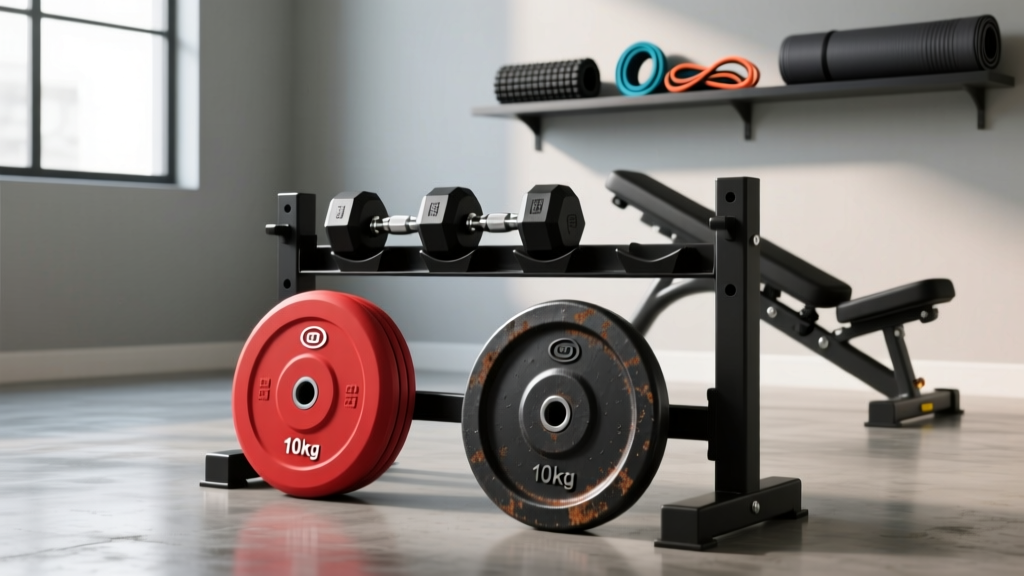
Bumper Plate vs Iron Plate: Budgeting for Incline Dumbbell Chest Flys

Olympic vs Standard Plates: Incline Dumbbell Curl Guide
Best Neoprene Dumbbells for a Dumbbell Bench Press at Home 2026

Compact Home Gym: Tricep Dumbbell Workout With Loadable Plates
EZ Curl Bar vs Straight Bar Care & Target 8 lb Dumbbells Maintenance
