
Bumper vs Iron Plates: Space Design & Two Handed Single Dumbbell Curl
Compare bumper vs iron plates for home gym space optimization. Learn layout strategies for deadlift zones and two handed single dumbbell curl areas.

The Spatial Economics of the Modern Home Gym
Designing a high-performance home gym in a limited footprint—whether it is a standard two-car garage, a basement, or a spare bedroom—requires strict attention to spatial economics. In 2026, fitness enthusiasts are no longer just buying equipment; they are engineering multi-use training zones. Every square foot of floor space and every inch of wall clearance dictates the functionality of your daily programming. One of the most critical decisions that impacts your gym's layout is the choice between bumper plates and cast iron or calibrated steel plates.
While the debate often centers on noise reduction and drop-safety, the dimensional footprint of your weight plates fundamentally alters your storage requirements, floor zoning, and accessory corners. According to equipment analysts at Garage Gym Reviews, the physical thickness of urethane bumpers versus machined iron drastically changes the lateral clearance needed for plate trees and barbell sleeves, which in turn dictates where you can safely place your dumbbell racks and isolation zones.
Dimensional Deep Dive: Bumper vs. Iron Plate Footprints
To understand how plate selection impacts your layout, we must look at the exact measurements of standard 45-pound plates. While both plate types share a standard 450mm (17.7-inch) diameter to comply with International Weightlifting Federation (IWF) standards, their thickness and sleeve-space requirements vary wildly.
| Feature | Rogue Echo Bumper (45lb) | Rogue Calibrated Iron (45lb) |
|---|---|---|
| Diameter | 450mm (Standard) | 450mm (Standard) |
| Thickness per Plate | ~3.25 inches | ~1.15 inches |
| Sleeve Space (1 Pair) | 6.5 inches | 2.3 inches |
| Storage Rack Width (3 Pairs) | 36-inch Heavy-Duty Tree | 24-inch Standard Tree |
| Average Cost per Pound | $2.00 - $2.50 | $1.50 - $1.80 |
The Layout Takeaway: If you load three pairs of 45lb bumper plates onto a standard barbell, you will consume over 19 inches of sleeve space, which can exceed the capacity of standard Olympic bars and force you to upgrade to specialty deadlift bars. Furthermore, storing those same three pairs on a wall-mounted rack or a freestanding tree requires a heavy-duty, wider base to prevent tipping, consuming an additional 12 inches of lateral wall space compared to calibrated iron.
Zoning the Multi-Use Home Gym
Proper gym design relies on distinct zoning: the 'Drop Zone' for heavy barbell compounds, and the 'Accessory Corner' for isolation and hypertrophy work. The American Council on Exercise (ACE) recommends a minimum of 36 inches of clearance around all equipment to ensure safe biomechanical execution and prevent trip hazards.
The Heavy Drop Zone (Barbell Work)
If your programming heavily features Olympic lifts, CrossFit-style WODs, or heavy deadlift drops, bumper plates are non-negotiable. However, this mandates a dedicated 8x8 foot drop zone equipped with a 3/4-inch vulcanized rubber mat over a plywood subfloor. This zone becomes a permanent, immovable fixture in your layout, anchoring your power rack or squat stands.
The Accessory Isolation Corner
When you save 12 to 18 inches of lateral wall space by opting for calibrated iron plates on your storage tree, you unlock enough floor area to build a dedicated accessory corner. This is crucial for isolation movements that require a focused, uncluttered 4x4 foot footprint.
Consider the biomechanics of executing a heavy two handed single dumbbell curl. As detailed in the ExRx Biomechanics Directory, gripping a heavy dumbbell (e.g., 60 to 80+ pounds) with both hands for a concentrated curl requires a wide, staggered stance for strict torso stabilization. If your plate tree protrudes 36 inches from the wall into your designated accessory corner, you risk clipping the iron or urethane during the eccentric phase of the curl. By choosing thinner iron plates for your barbell storage, you push the storage footprint flush against the wall, creating the necessary safety zone for these demanding two-handed isolation movements without compromising your gym's walkways.
Expert Layout Tip: Never place your dumbbell rack directly adjacent to your plate tree. The combined protrusion of a 3-tier dumbbell rack (approx. 22 inches deep) and a loaded bumper plate tree (approx. 28 inches deep) creates a 50-inch dead zone that chokes the flow of a standard 20-foot wide garage gym. Separate them by at least 4 feet to maintain an open central training floor.
Storage Matrices: Reclaiming Wall Space
How you store your plates dictates your remaining square footage. Here is a breakdown of storage solutions based on your plate choice:
- For Bumper Plate Users (The Vertical Approach): Because bumpers are thick and heavy, freestanding A-frame trees are common but eat up floor space. Opt for a Wall-Mounted Vertical Plate Dispenser (like the Rogue Monster Wall Mount Plate Dispenser). This holds bumpers vertically by their center holes, keeping them off the floor and reclaiming the ground space below for kettlebell storage or plyo boxes.
- For Iron Plate Users (The Horizontal Approach): Calibrated iron plates are thin and feature raised lips. A standard 6-Peg Wall Mount Rack is ideal. Because the plates are thin, they sit flush against the pegs, protruding only about 14 inches from the wall. This ultra-low profile allows you to place a weight bench or a plyometric box directly beneath the rack, effectively double-dipping your spatial footprint.
Flooring Transitions and Acoustic Footprints
Space optimization is not just about horizontal square footage; it is also about vertical transitions and acoustic management. Bumper plates allow you to use standard 3/4-inch horse stall mats directly over concrete. Iron plates, however, will crack unprotected concrete if dropped.
If you choose iron plates, you must build a specialized lifting platform (typically 8x8 feet) consisting of a 3/4-inch plywood base, a second layer of 3/4-inch plywood, and 3/4-inch rubber mats on the drop zones. This creates a raised platform that is 1.5 to 2.25 inches higher than the rest of your gym floor. From a layout perspective, this raised lip creates a trip hazard and dictates that your accessory corners (where you perform movements like the two handed single dumbbell curl) must be strictly confined to the flat, non-platform areas of the gym to ensure ankle stability and even footing.
Real-World Layout Blueprints
Scenario A: The 2-Car Garage (Bumper Heavy)
Profile: Functional fitness, Olympic lifting, high-volume deadlifts.
Plate Choice: Urethane Bumper Plates.
Layout Strategy: Center the power rack on a flush 8x8 rubber mat zone. Store bumpers on a heavy-duty, 36-inch wide A-frame tree in the back corner. Dedicate the opposite corner to a 3-tier dumbbell rack, ensuring a clear 5x5 foot rubber-matted zone for accessory work, lunges, and heavy curls.
Scenario B: The Basement / Spare Room (Iron Heavy)
Profile: Powerlifting, bodybuilding, strict isolation.
Plate Choice: Calibrated Steel / Cast Iron.
Layout Strategy: Utilize wall-mounted 6-peg storage to keep plates flush against the drywall. This saves 18 inches of floor depth. Use this reclaimed depth to install a wall-mounted folding squat rack and a cable pulley system, maximizing the utility of a room that may only be 12x14 feet in total dimension.
Frequently Asked Questions
Can I mix bumper and iron plates in a small home gym?
Yes, but it requires strategic zoning. Keep a set of 10lb and 25lb urethane bumpers for barbell complex warm-ups and lighter drops, while using calibrated iron for your heavy working sets. Store the bumpers vertically and the irons horizontally to optimize wall space.
Do I need a platform if I only do controlled reps with iron plates?
If you are strictly doing controlled eccentrics and never dropping the bar, 3/4-inch rubber mats over concrete are sufficient. However, if fatigue leads to occasional drops, the acoustic shockwave in a basement or garage can damage both the floor and your hearing. Always use a platform for heavy iron barbell work.
How much space does a dedicated accessory corner actually require?
For most standing isolation movements, a 4x4 foot clear zone is the absolute minimum. This allows for a staggered stance, lateral stepping, and the full range of motion required for exercises like lateral raises, walking lunges, or the two handed single dumbbell curl without striking nearby equipment.
More gear to consider
All reviews
EZ Curl Bar vs Straight Bar: Is a Hexagonal Dumbbell Better Value?

Dumbbell to Barbell Bench Conversion: Squat vs Power Rack

Power Rack vs Squat Rack vs Stand: Push Press With Dumbbells
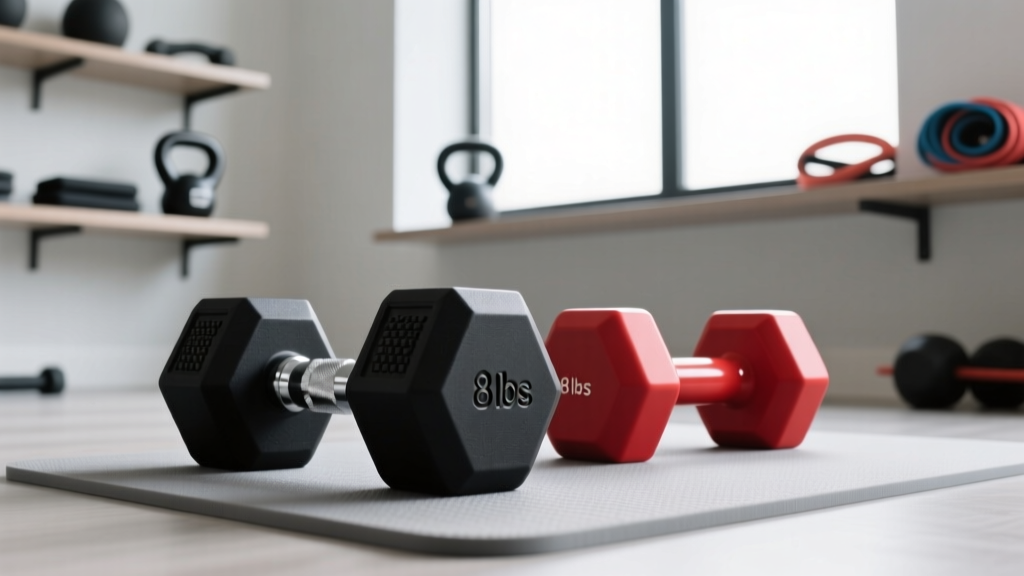
8 lbs Dumbbell Value: Rubber Hex vs Urethane Cost Breakdown

Bumper vs Iron Plates: Gym Layouts for Good Tricep Dumbbell Workouts
