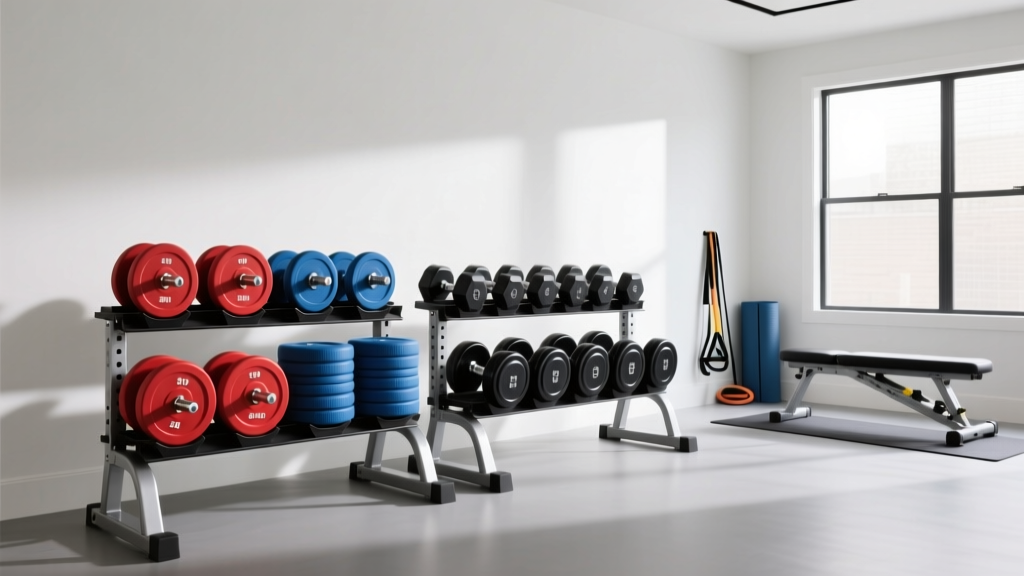
Bumper vs Iron Plates: Space Layouts for a 30 Day Dumbbell Workout
Optimize your home gym layout for a 30 day dumbbell workout. Compare bumper vs iron plates for space efficiency, storage, and progressive overload.

When committing to an intensive 30 day dumbbell workout program, progressive overload is the non-negotiable driver of muscle hypertrophy and strength gains. However, most home gym owners quickly hit a ceiling: fixed hex dumbbells max out, and buying a full 5-to-100lb dumbbell rack requires an impractical 40-square-foot footprint. The space-optimized solution? Transitioning to plate-loaded adjustable dumbbell handles or a compact Olympic barbell setup. But this immediately introduces a critical spatial dilemma: should you buy bumper plates or cast iron plates?
As of 2026, the home fitness equipment market offers highly specialized options for both, but their physical geometries dictate entirely different storage layouts, sleeve capacities, and floor space requirements. In this guide, we break down the exact dimensional differences between bumper and iron plates, providing actionable layout designs to maximize your training space.
The Space-to-Weight Ratio RealityBumper plates maintain a uniform 450mm diameter regardless of weight, creating a massive spatial footprint for lighter increments. Iron plates feature graduated diameters, allowing for dense, nested storage configurations that can reduce your equipment footprint by up to 60%.
Dimensional Analysis: How Plate Geometry Dictates Layout
To design an efficient home gym, you must understand the exact physical dimensions of your equipment. According to BarBend's comprehensive plate guide, the International Weightlifting Federation (IWF) mandates that all bumper plates, from 10lbs to 55lbs, share a uniform diameter of 450mm (17.7 inches). This ensures the barbell is always at the correct starting height for Olympic lifts.
Cast iron plates, conversely, scale in diameter relative to their mass. A standard 45lb cast iron plate measures roughly 445mm in diameter, but a 25lb plate shrinks to about 340mm, and a 10lb plate drops to roughly 230mm. This geometric variance is the cornerstone of space optimization.
The Vertical Storage Problem
If your layout relies on a vertical plate tree, iron plates are vastly superior. A standard 10-peg vertical tree holding a full set of iron plates (two 45s, two 35s, two 25s, two 10s) occupies a floor footprint of just 24x24 inches. The smaller plates nest neatly inside the larger ones. If you attempt to store a full set of bumper plates on a vertical tree, every single peg extends out to a 17.7-inch radius, creating a massive 4-foot-wide cylinder of dead space that severely limits your gym's walkable clearance.
Sleeve Capacity: The Adjustable Dumbbell Bottleneck
When executing a 30 day dumbbell workout, you will frequently need to micro-load or jump weights in 5lb to 10lb increments. If you are using traditional spinlock dumbbell handles (which typically feature 10 to 12 inches of loadable sleeve space), plate thickness becomes your primary constraint.
- Bumper Plate Thickness: A 45lb Rogue HG 2.0 Bumper Plate is 3.25 inches thick. A 25lb bumper is 2.15 inches thick.
- Iron Plate Thickness: A 45lb Rogue Machined Iron Plate is roughly 1.5 inches thick. A 25lb iron plate is about 1.1 inches thick.
If you attempt to load 45lb bumper plates onto a standard 10-inch spinlock dumbbell sleeve, you will only fit one plate per side before running out of room for the locking collar. This caps your dumbbell weight prematurely. With machined iron plates, you can easily slide three 45lb plates onto a 10-inch sleeve, allowing you to build heavy, space-efficient dumbbells capable of supporting advanced hypertrophy phases late into your 30-day program.
Head-to-Head Comparison Matrix
Below is a data-driven comparison of standard competition-grade bumpers versus machined iron plates, focusing on metrics that impact spatial layout and budget.
| Metric | Rogue HG 2.0 Bumper (45lb) | Rogue Machined Iron (45lb) |
|---|---|---|
| Diameter | 450mm (Uniform) | 445mm (Graduated) |
| Thickness | 3.25 inches | 1.5 inches |
| Avg. Cost per Lb (2026) | $3.50 - $4.50 | $1.80 - $2.50 |
| Drop Tolerance | High (Deadlifts, Cleans) | Low (Controlled lowering) |
| Optimal Storage | Horizontal Wall Rack | Vertical Tree / A-Frame |
Designing the Layout: 3 Space-Optimized Configurations
Choosing your plate type is only half the battle; integrating them into your room's architecture is where space optimization truly happens. Here are three distinct layout configurations based on your equipment choice.
Configuration 1: The Flush-Mount Wall Rack (Best for Bumpers)
If your 30 day dumbbell workout incorporates high-intensity interval training (HIIT) or metabolic conditioning where you drop weights from the shoulder or overhead, bumpers are mandatory. Because bumpers share a uniform 17.7-inch diameter, they are perfectly suited for horizontal wall-mounted plate racks.
- Dimensions Required: 48 inches of horizontal wall space, 6 inches of depth.
- Layout Strategy: Mount a Titan Fitness Wall Plate Rack at 24 inches off the floor. This allows the bottom of the 450mm plates to hover exactly 1 inch above the floor, preventing moisture trapping and rubber degradation while keeping your floor entirely clear for lunges and dumbbell floor presses.
Configuration 2: The Corner Vertical Tree (Best for Iron)
If your program focuses on strict, controlled hypertrophy (e.g., slow-eccentric dumbbell chest presses and heavy goblet squats), iron plates are the superior, budget-friendly choice. Iron plates thrive in corners.
- Dimensions Required: 24x24 inch corner footprint.
- Layout Strategy: Place a REP Fitness Vertical Plate Tree in a 90-degree corner. Because the 10lb and 25lb iron plates have small diameters, they tuck tightly against the center pole. This configuration reclaims up to 8 square feet of floor space compared to a horizontal rack, leaving ample room for an adjustable bench.
Configuration 3: The Under-Bench Slide-Out (Hybrid Micro-Plates)
For advanced lifters who need fractional loading to sustain progressive overload through the final 10 days of their 30-day program, consider a hybrid approach. Store your heavy 45lb and 35lb iron plates on a vertical tree, but utilize fractional bumper plates (1.25lb to 5lb) stored in a slide-out drawer mounted directly beneath your adjustable weight bench. This eliminates the need to walk across the gym to change weights, keeping your workout density high and your footprint tight.
Noise, Drop Zones, and Flooring Preservation
Space optimization also means optimizing your acoustic and structural environment. Dropping cast iron plates in a garage or apartment gym will transmit severe low-frequency vibrations through the concrete or subfloor, potentially cracking your foundation or angering neighbors. As noted by Garage Gym Reviews, the vulcanized rubber matrix of high-quality bumpers absorbs kinetic energy upon impact.
If your layout does not allow for a dedicated 4x8 foot, 3/4-inch thick horse-stall mat drop zone, you must use bumper plates for any exercise where the weight leaves the chest or shoulders. Conversely, if your gym is located in a space with strict noise ordinances, iron plates paired with 2-inch thick EVA foam or rubber puzzle mats are your only viable option, provided you strictly control the eccentric phase of every lift.
Final Verdict for Your 30-Day Program
The decision between bumper and iron plates ultimately hinges on your specific training modalities and spatial constraints. If your 30 day dumbbell workout relies on heavy, controlled, space-efficient adjustable dumbbells and you have a tight corner for a vertical tree, machined iron plates offer unmatched sleeve capacity and a lower cost-per-pound. However, if your layout demands horizontal wall storage, incorporates explosive movements, or requires strict noise mitigation, the uniform geometry and shock absorption of bumper plates are non-negotiable. Map your floor plan, measure your sleeve lengths, and choose the geometry that serves your space.
More gear to consider
All reviews
Chest Supported Dumbbell Lateral Raise: Rubber vs Urethane
Best Dumbbell Workouts to Barbells: Knurl & Weight Buying Mistakes

Beyond Rogue Rubber Hex Dumbbells: Barbell Weight & Knurling Errors
Lower Back Dumbbell Guide: Top Neoprene Weights Compared
How to Use Dumbbells Effectively: Loadable Dumbbell Maintenance
