Bumper Plate vs Iron Plate Cost: Cable Fly vs Dumbbell Fly Value
Analyze the 2026 home gym budget: bumper plate vs iron plate costs, plus a biomechanical and financial breakdown of the cable fly vs dumbbell fly.

The 2026 Home Gym Capital Allocation Problem
Building a high-performance home gym in 2026 requires ruthless capital allocation. With fitness equipment manufacturing costs stabilizing but premium retail prices holding firm, lifters are facing a critical budgeting dilemma: where do you deploy your limited funds for maximum hypertrophy and strength ROI? Two of the most fiercely debated equipment choices center around your primary loading mechanisms and your isolation tools. Specifically, the bumper plate vs iron plate comparison dictates the foundation of your lifting, while the decision between investing in a functional trainer for a cable fly vs dumbbell fly setup determines the quality of your isolation work.
This comprehensive budget breakdown dissects the exact cost-per-pound metrics, material failure modes, and biomechanical advantages of these equipment categories. By understanding the financial and physiological trade-offs, you can optimize a $1,500 to $3,000 equipment budget without sacrificing training quality.
Bumper Plate vs Iron Plate Comparison: The Heavy Lifting Budget
The majority of your home gym budget will be consumed by weight plates. In 2026, the price gap between high-quality cast iron and virgin rubber bumpers remains substantial, often forcing lifters to choose between drop-safety and sheer loading capacity.
Material Science and Failure Modes
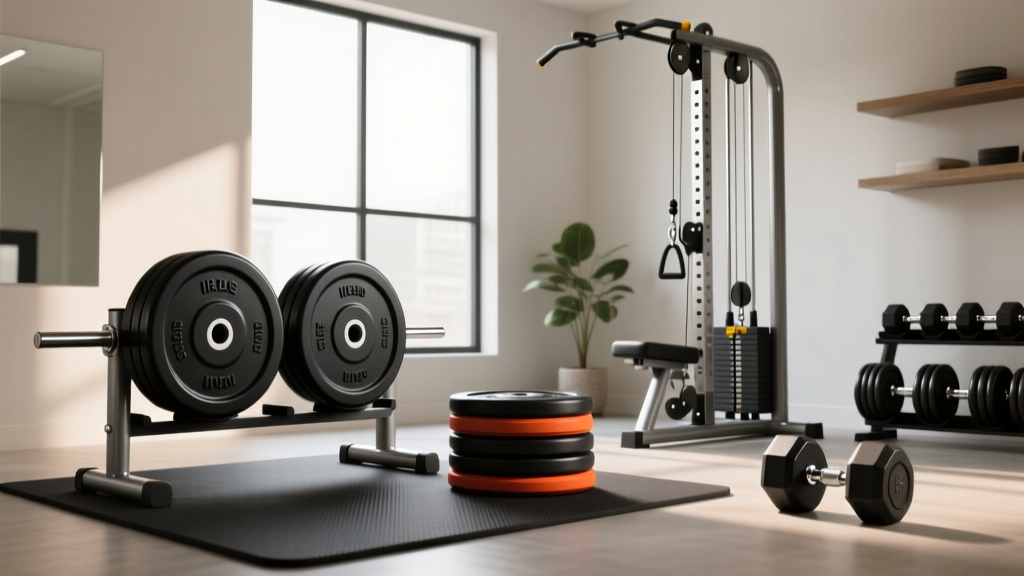
Not all plates are created equal. When evaluating Rogue Echo Bumper Plates versus standard cast iron options like the REP Fitness Equalizer Iron Plates, you must consider the durometer (hardness) rating and insert construction.
- Virgin Rubber Bumpers (70-75 Shore A): Offer a 'dead bounce,' minimizing the risk of the barbell bouncing back and injuring the lifter during Olympic lifts. However, the stainless steel center insert can eventually loosen if subjected to thousands of overhead drops, leading to a rattling noise and compromised structural integrity.
- Crumb Rubber Bumpers (80+ Shore A): Cheaper to produce but highly bouncy. They are prone to delamination and edge tearing when dropped on uneven surfaces.
- Machined Cast Iron: Features a precise center hole that grips the barbell sleeve tightly. The primary failure mode is cosmetic (rust and chipped enamel), but structurally, iron plates will outlast the lifter. The critical caveat: dropping iron plates from shoulder height or higher will shatter the plates, destroy your lifting platform, and potentially bend your barbell.
Cost-Per-Pound Analysis (2026 Market Rates)
| Metric | REP Equalizer Iron Plates | Rogue Echo Bumper Plates |
|---|---|---|
| Average Cost Per Pound | $1.60 - $1.80 / lb | $3.80 - $4.50 / lb |
| Cost for 260 lbs (Standard Set) | ~$440 | ~$1,100 |
| Thickness (45lb/20kg Plate) | 1.35 inches | 3.25 inches |
| Drop Safety (Overhead) | Zero (Catastrophic Failure) | High (Designed for Impact) |
| Barbell Sleeve Capacity | High (Fits 5+ plates per side) | Low (Maxes out around 3-4 plates) |
Isolation Investments: Cable Fly vs Dumbbell Fly Value
Assuming you saved $650 by opting for iron plates (and committing to controlled eccentrics rather than dropping the bar), you now have capital to address chest isolation. The cable fly vs dumbbell fly debate is not just about preference; it is a clash between biomechanical efficiency and financial accessibility.
The Biomechanics of Tension Curves
To understand the value proposition, we must look at the physics of the pectoralis major. The primary function of the pecs during a fly is horizontal adduction of the humerus. According to electromyography (EMG) analyses cataloged in peer-reviewed biomechanical literature on PubMed, the resistance profile of the implement drastically alters muscle fiber recruitment.
- The Dumbbell Fly Tension Curve: When lying supine on a flat bench, gravity pulls the dumbbells straight down. At the bottom of the movement (maximum stretch), the moment arm is longest, creating massive tension on the pecs. However, as you bring the dumbbells together at the top of the movement, the moment arm approaches zero. The weight is supported entirely by the skeletal structure of the arm, resulting in zero muscular tension on the chest at peak contraction.
- The Cable Fly Tension Curve: A cable system pulls horizontally (or at a customized angle). Because the resistance vector remains perpendicular to the lever arm throughout the entire range of motion, the pectoralis major experiences constant, unyielding tension from the stretched position all the way through the peak contraction. Furthermore, cables allow for a natural crossover, extending the range of motion past the midline of the body.
'If your goal is pure hypertrophy and maximizing time-under-tension in the shortened position, the cable fly is biomechanically superior. The dumbbell fly is essentially a loaded stretch exercise with a useless top half.' — Biomechanics consensus in modern sports science.
The Financial Reality: Functional Trainers vs. Adjustable Dumbbells
While cables win on paper, the budget breakdown tells a different story. Executing a proper cable fly requires a dual-pulley system.
- The Cable Route: A commercial-grade functional trainer like the Titan Fitness Functional Trainer or REP PR-4000 with cable attachments will cost between $1,200 and $1,800 in 2026. This requires a massive upfront capital expenditure and significant floor space (roughly 6x4 feet).
- The Dumbbell Route: A high-quality pair of adjustable dumbbells, such as the PowerBlock Elite USA or Nuobell 80s, costs between $350 and $450. Combined with a $150 adjustable bench, your total isolation station is under $600.
The 2026 Ultimate Budget Matrix
How do you synthesize the bumper vs. iron decision with the cable vs. dumbbell dilemma? Use this decision matrix based on your primary training modality and total budget.
Scenario A: The Olympic Lifter & CrossFit Athlete
Budget Allocation: Heavy on Bumpers, Light on Isolation.
Strategy: You must buy bumper plates. Dropping the barbell from overhead is non-negotiable for snatches and clean-and-jerks. Allocate $1,100+ for a set of Rogue Echo or Hi-Temp bumpers. For chest isolation, rely on dumbbell flies using a basic pair of fixed hex dumbbells or rings for deficit push-ups. The cable fly is a luxury you cannot afford if you need 300+ lbs of drop-safe rubber.
Scenario B: The Hypertrophy Purist (Bodybuilding Focus)
Budget Allocation: Heavy on Iron, Heavy on Cables.
Strategy: Buy iron plates. You are doing controlled squats and bench presses; you will never drop a barbell from overhead. Spend $450 on 300 lbs of REP Equalizer iron plates. Take the $650 you saved and put it toward a plate-loaded cable crossover attachment for your power rack, or save up for a dedicated functional trainer. The cable fly is mandatory for your chest development, providing the constant tension required for maximum sarcoplasmic hypertrophy.
Scenario C: The Hybrid Athlete on a Strict $1,500 Budget
Budget Allocation: The Compromise.
Strategy: Purchase a 'mixed set.' Buy 110 lbs of bumper plates (two 45s, two 10s) for your dynamic Olympic lifts and WODs, and fill out the rest of your barbell weight with cheap cast iron plates for heavy, slow squats and deadlifts. For isolation, utilize resistance bands anchored to your power rack to simulate the horizontal pull of a cable fly, bridging the biomechanical gap without the $1,500 functional trainer price tag.
Final Verdict: Where Should Your Money Go?
The bumper plate vs iron plate comparison ultimately comes down to your relationship with gravity and floor impact. If you drop weights, bumpers are a mandatory insurance policy for your equipment and your subfloor. If you control your eccentrics, iron plates offer vastly superior cost-per-pound value and sleeve capacity.
Similarly, the cable fly vs dumbbell fly debate is settled by biomechanics but constrained by wallets. Cables provide a mathematically superior tension curve for chest hypertrophy, but dumbbells offer 80% of the benefit at 20% of the cost. In 2026, the smartest home gym builders aren't just buying the most expensive gear; they are exploiting the price gaps between commercial-grade rubber and raw iron to fund the biomechanical advantages of cable isolation systems.
More gear to consider
All reviews
Single Dumbbell Floor Press: Budget Guide to Loadable Handles

Low Angle Dumbbell Incline: Troubleshooting Neoprene Weight Slips

Rubber Hex vs Urethane: Gym Layouts and the Dumbbell Pullover for Lats
Dumbbell Lateral Pull Down & EZ vs Straight Bar Market Trends 2026
Space-Saving Dumbbell Racks to Elevate Your Dumbbell Glutes Workout
