
Bumper vs Iron Plate Costs: Budgeting for Dumbbell Wrist Rotations
Compare bumper vs iron plate costs in 2026. Learn how to budget your home gym build to afford essential prehab gear for dumbbell wrist rotations.

The 2026 Home Gym Economy: Rethinking Your Plate Purchase
As we navigate the fitness equipment market in 2026, the debate between bumper plates and cast iron plates remains one of the most critical financial decisions for home gym builders. While the sticker price of a 300-pound plate set is the most obvious metric, true value analysis requires looking at the 'opportunity cost' of your purchase. Every dollar spent on premium urethane bumpers is a dollar diverted from essential accessories, recovery tools, and joint prehab gear.
For serious lifters, longevity is just as important as the weight on the bar. Heavy pressing cycles and Olympic lifts place immense compressive and shear forces on the radiocarpal joints. To mitigate this, sports medicine professionals heavily advocate for targeted forearm and wrist prehab. However, executing proper dumbbell wrist rotations requires a dedicated set of light, fractional dumbbells (typically 3 to 10 lbs). If you blow your entire free-weight budget on high-end bumper plates, you may find yourself unable to afford the very tools required to keep your wrists healthy enough to lift those plates. Let us break down the true cost-per-pound, the spatial economics of barbell sleeves, and how to strategically allocate your budget for maximum physical ROI.
Bumper vs. Iron Plates: The True Cost-Per-Pound Breakdown
The price gap between iron and bumper plates has shifted over the last few years due to fluctuations in raw material costs and overseas shipping. In 2026, cast iron remains the undisputed king of budget-friendly mass, while virgin rubber and urethane bumpers command a premium for their drop-absorption and noise-dampening qualities.
| Plate Type | Brand / Model Example | Avg. Cost Per Pound (2026) | 45lb Plate Thickness | Best Use Case |
|---|---|---|---|---|
| Cast Iron (Standard) | Titan Fitness Cast Iron | $1.25 - $1.50 | ~1.3 inches | Powerlifting, Bodybuilding |
| Cast Iron (Machined) | Rogue Deep Dish | $2.50 - $2.80 | ~1.2 inches | Precision Loading, Aesthetics |
| Crumb Rubber Bumper | Hi-Temp Crumb Bumpers | $2.75 - $3.25 | ~3.4 inches | Garage Gyms, CrossFit |
| Virgin Rubber Bumper | Rogue Echo Bumpers | $3.50 - $4.00 | ~3.2 inches | Olympic Weightlifting |
| Urethane Bumper | Rogue Urethane Plates | $6.00 - $8.00+ | ~2.8 inches | Commercial Gyms, High-End |
As highlighted in comprehensive equipment analyses by BarBend, the functional difference lies in the 'dead bounce' of crumb rubber versus the rigid durability of iron. But financially, outfitting a 300lb set of Rogue Echo Bumpers will cost roughly $1,200, whereas a 300lb set of Titan Cast Iron will cost around $450. That $750 delta is where your prehab and accessory budget is born or destroyed.
The Opportunity Cost: Funding Prehab and Dumbbell Wrist Rotations
💡 The Prehab Reallocation Strategy
By choosing cast iron plates for your primary barbell loading, you can reallocate the $700+ savings toward a comprehensive joint-care station. This includes fractional plates, resistance bands, wrist wraps, and the micro-dumbbells required for vital isolation work like dumbbell wrist rotations.
When building a bulletproof upper body, ignoring the distal radioulnar joint and the TFCC (triangular fibrocartilage complex) is a rookie mistake. Heavy bench pressing, front squats, and clean catches compress the wrist and force it into extreme extension. According to orthopedic guidelines on wrist sprains and repetitive loading from the American Academy of Orthopaedic Surgeons (AAOS), maintaining the balance between wrist flexors and extensors is critical to preventing chronic tendinopathy.
This is where dumbbell wrist rotations become non-negotiable. By holding a light dumbbell (5 to 10 lbs) and performing slow, controlled pronation and supination movements, you strengthen the rotational stabilizers of the forearm that barbells completely ignore. However, you cannot perform these effectively with a 45lb iron plate or a 35lb bumper plate. You need dedicated neoprene or urethane hex dumbbells in the 3lb, 5lb, and 8lb ranges. A high-quality pair of 5lb CAP Barbell neoprene dumbbells costs about $25. A full prehab set (3, 5, 8, 10 lbs) costs roughly $120. If your plate purchase drains your bank account, this vital $120 investment is often the first thing cut from the budget, leading to preventable injuries down the line.
Barbell Sleeve Capacity and Spatial Economics
Budgeting is not just about dollars; it is also about physical space and equipment limitations. The thickness of your plates directly impacts how much weight you can load onto a standard Olympic barbell sleeve (which typically offers 16.3 inches of usable loadable length).
- Cast Iron Plates (45 lbs): At roughly 1.3 inches thick, you can fit six 45lb plates per side, plus a collar. This allows for 545 lbs of total loading capacity.
- Bumper Plates (45 lbs): At roughly 3.2 to 3.4 inches thick, you can only fit four 45lb bumpers per side before running out of sleeve space. This caps your barbell at 365 lbs to 405 lbs.
If your 2026 training goals include pulling a 500lb deadlift, buying bumper plates is not just a financial misstep; it is a functional one. You would be forced to buy expensive, ultra-thin calibrated steel powerlifting plates (which cost upwards of $10 per pound) just to fit the weight on the bar. Iron plates offer the best spatial economy for heavy strength athletes.
Value Analysis: Which Plate Type Fits Your Lifting Style?
To maximize your free weight ROI, you must align your plate purchase with your actual training modalities. Here is a decision framework to help you allocate your $1,000 free-weight budget.
Scenario A: The Powerlifter & Bodybuilder (The Iron Route)
The Build: 400 lbs of Titan Fitness Cast Iron ($600).
The Reinvestment ($400): You use the remaining budget to buy an adjustable FID bench, a pair of high-quality wrist wraps, and a complete set of light dumbbells (5-15 lbs) to execute dumbbell wrist rotations, tricep kickbacks, and lateral raises. Your joints are protected, and your barbell sleeve has plenty of room for heavy 5x5 squat cycles.
Scenario B: The Olympic Weightlifter & CrossFit Athlete (The Bumper Route)
The Build: 260 lbs of Rogue Echo Bumpers ($950).
The Reinvestment ($50): You have almost no budget left. You must rely on cheap resistance bands for wrist prehab and forego the micro-dumbbells needed for targeted joint rotations. Furthermore, if you ever want to deadlift heavy, you will have to save up for a secondary set of thin iron plates.
Scenario C: The Hybrid Athlete (The Split Budget)
The Build: Buy a pair of 45lb and 25lb bumpers for Olympic cleans and snatches ($300). Buy 200 lbs of cast iron plates for heavy deadlifts and squats ($300).
The Reinvestment ($400): Use the remaining funds for a landmine attachment, fractional change plates, and your prehab dumbbell set for wrist and shoulder health. This is the ultimate 2026 home gym value hack.
Frequently Asked Questions
Can I drop cast iron plates on my garage floor?
No. Dropping cast iron plates will crack concrete slabs, damage the barbell sleeves, and ruin the plates themselves. If your training involves dropping weights from overhead or the shoulder (like snatches or high-rep cleans), you must invest in bumper plates and proper horse-stall mats, regardless of the higher cost per pound.
Are dumbbell wrist rotations necessary if I wear wrist wraps?
Wrist wraps provide passive, external compression to stabilize the joint under heavy axial loads (like a heavy bench press). However, they do not strengthen the intrinsic muscles of the forearm. Dumbbell wrist rotations provide active, internal strengthening through the full range of pronation and supination, addressing the root cause of many lifting-related forearm imbalances rather than just masking the symptom.
Do crumb rubber bumpers smell worse than virgin rubber?
Yes. Crumb rubber (made from recycled tires) off-gasses significantly more volatile organic compounds (VOCs) than virgin rubber. If your home gym is in a poorly ventilated basement or attached garage, the $100 you save on crumb bumpers might not be worth the persistent rubber odor. Virgin rubber (like Rogue Echo) or urethane are much better investments for indoor air quality.
Ultimately, building a home gym in 2026 requires looking beyond the barbell. By understanding the true cost-per-pound of free weight plates and recognizing the financial space needed for joint longevity, you can build a setup that is as resilient as your body.
More gear to consider
All reviews
How to Train Shoulders With Dumbbells: Hex vs Urethane for Small Gyms

Women's Dumbbell Workout Routine PDF Free Download: Time for a Rack?
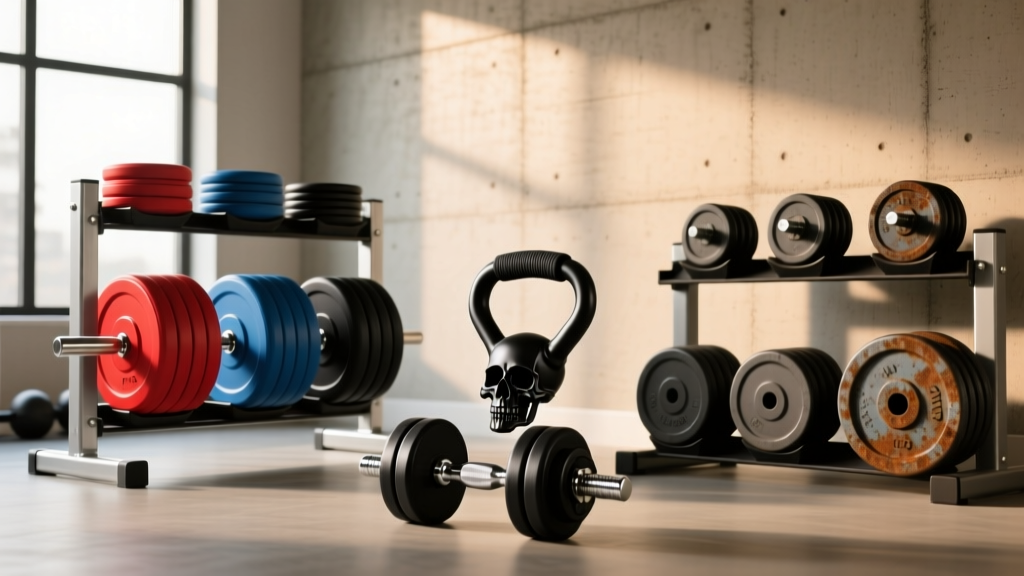
2026 Market Trends: Bumper vs Iron Plates & Skull Crusher Dumbbell

2026 Market Trends: EZ Curl vs Straight Bar & Ignite Dumbbells

Beginners Home Workout With Dumbbells: Power Rack vs Squat Rack vs Stand
