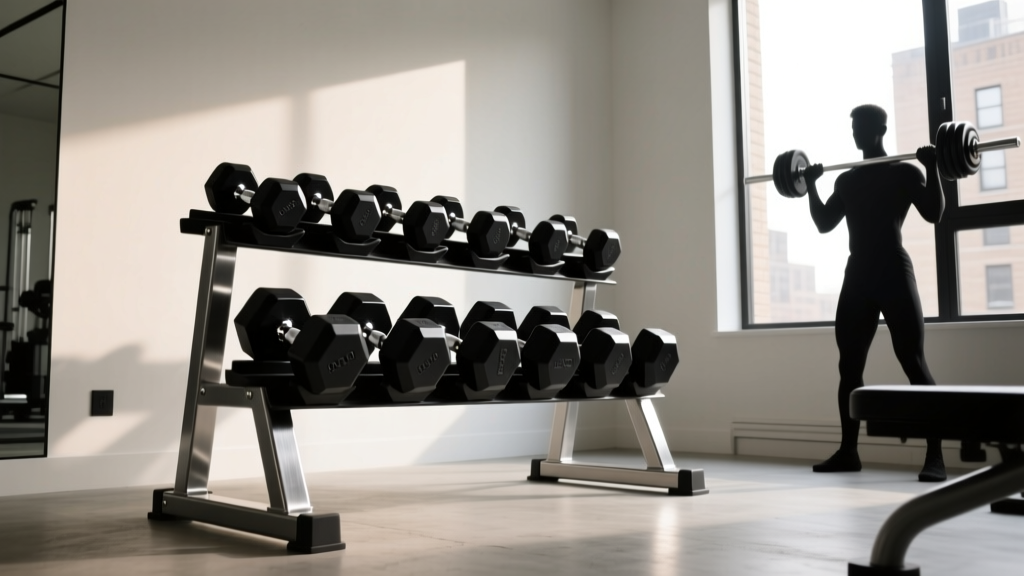
Best Budget Dumbbell Racks for Standing Dumbbell Rows in 2026
Discover the best budget dumbbell racks in 2026 optimized for standing dumbbell rows. We break down cost, tier clearance, and true value for your home gym.

The Biomechanical Cost of Cheap Storage
When building a home gym on a budget, lifters often allocate 90% of their funds to the weights themselves and treat the storage solution as an afterthought. This is a critical error, particularly if your programming relies heavily on hinge-based movements like standing dumbbell rows. The hip hinge required to initiate a standing dumbbell row places immense shear force on the lumbar spine. According to OSHA's ergonomics guidelines on material handling, lifting heavy loads from below knee height drastically increases the compressive forces on the lower back discs.
If your budget dumbbell rack features a bottom tier that sits a mere four inches off the floor with narrow saddle spacing, you are forced into a compromised, rounded-back position just to pick up and re-rack your 60-pound bells. Over time, this 'ergonomic penalty' leads to lumbar strain and ruins the workflow of your superset. In this 2026 value analysis, we evaluate budget-friendly dumbbell racks (under $160) not just by their price tag, but by their functional clearance, weight capacity, and structural longevity.
💡 The 'Row Pickup' Rule: For safe execution and racking of standing dumbbell rows, your rack's bottom tier must sit at least 9 to 11 inches off the floor. This allows you to hinge at the hips with a neutral spine rather than squatting deeply or rounding your back to clear the steel frame.2026 Budget Rack Value Matrix
To determine true value, we must look beyond the sticker price. The table below breaks down three popular budget racks available in 2026, analyzing their cost relative to safe lifting capacity and ergonomic design.
| Rack Model | Avg. Price (2026) | Bottom Tier Height | Total Capacity | Saddle Material |
|---|---|---|---|---|
| CAP Barbell 3-Tier A-Frame | $89.99 | 8.5 inches | 600 lbs | Molded Rubber |
| Yes4All Heavy-Duty Jumbo | $139.99 | 11.0 inches | 800 lbs | UHMW Plastic |
| Marcy 3-Tier Chrome | $74.50 | 6.0 inches | 300 lbs | Hard PVC |
Top Budget Racks Evaluated for Functional Clearance
1. Yes4All Heavy-Duty Jumbo 3-Tier Rack (Best Overall Value)
Priced around $139.99, the Yes4All Jumbo model bridges the gap between budget and premium commercial racks. Constructed from 12-gauge steel, it offers an 800-pound total capacity. More importantly for lifters performing standing dumbbell rows, the bottom tier sits at an optimal 11 inches off the ground.
- Pros: UHMW plastic saddles protect dumbbell knurling and won't degrade into a sticky mess over time. The 11-inch base clearance allows for a safe, neutral-spine hip hinge when picking up heavy bells. Wide 10-inch saddle spacing accommodates large hex dumbbells without them touching.
- Cons: Heavier footprint (32 lbs) makes it slightly harder to move for floor cleaning. Assembly requires a 19mm wrench, which is not included.
- Value Verdict: At $0.17 per pound of capacity, this is the smartest investment for intermediate lifters progressing past 50-pound rows.
2. CAP Barbell 3-Tier A-Frame Rack (Best for Tight Spaces)
The CAP Barbell A-Frame (Model FM-300F) retails for roughly $89.99. Its triangular footprint (22 x 15 inches) is ideal for cramped apartment gyms. The bottom tier sits at 8.5 inches, which is passable for hinge movements, though lifters with long femurs may still need to bend their knees slightly to maintain a flat back during the pickup phase.
- Pros: Excellent spatial efficiency. The A-frame design naturally lowers the center of gravity, preventing forward-tipping when loading only one side of the rack.
- Cons: The molded rubber saddles are prone to tearing if you drop hex dumbbells onto them aggressively. Total capacity is limited to 600 lbs, meaning it will max out if you own a full set from 5 to 50 lbs.
- Value Verdict: A solid entry-level choice, but the rubber saddle degradation is a known failure mode that may require DIY replacements (like pool noodles or adhesive UHMW tape) within two years.
3. Marcy 3-Tier Chrome Dumbbell Rack (The False Economy)
At $74.50, the Marcy Chrome rack is the cheapest option on the market, but it represents a 'false economy' for serious lifters. The bottom tier is a mere 6 inches off the floor. According to biomechanical analyses of back exercises, lifting from this depth without a deep squat guarantees lumbar flexion, directly sabotaging the core bracing required for heavy standing dumbbell rows.
- Pros: Very affordable. The chrome finish resists rust in humid environments like unclimate-controlled garages.
- Cons: 16-gauge steel tubing flexes visibly when loaded with 200+ lbs. The 6-inch bottom tier is an ergonomic hazard for heavy hinging. Narrow saddle spacing causes rubber hex dumbbells to stack on top of one another.
- Value Verdict: Only recommended for light neoprene or adjustable dumbbell sets under 25 lbs. Avoid for heavy free-weight routines.
The 'Price-Per-Pound' Value Framework
When analyzing budget gym equipment, never look at the sticker price in isolation. Use the Price-Per-Pound (PPP) Framework to determine true value. Divide the total cost of the rack by its maximum safe weight capacity.
Example Calculation:
Yes4All Jumbo: $139.99 / 800 lbs = $0.17 PPP
Marcy Chrome: $74.50 / 300 lbs = $0.24 PPP
Insight: The 'cheaper' Marcy rack actually costs 41% more per pound of supported weight, while simultaneously offering inferior ergonomic clearance.
Furthermore, you must factor in the 'Ergonomic Multiplier.' If a rack forces you to modify your lifting technique (e.g., squatting to pick up weights instead of hinging), the physical cost of potential chiropractic or physical therapy visits far outweighs the $50 saved on the initial purchase.
Common Failure Modes in Budget Racks
Budget racks cut costs in specific manufacturing areas. Being aware of these edge cases will help you inspect your gear and maintain safety:
- Spot-Weld Shearing: Premium racks use continuous TIG or MIG welds along the saddle brackets. Budget racks often use 4-point spot welds. If you consistently drop heavy dumbbells onto the top tier from a height of 3+ inches, the shockwave can fracture these spot welds over 12-18 months. Fix: Always place the weights gently onto the tier.
- Hardware Loosening: Budget racks ship with low-grade zinc-plated bolts that lack nylon-insert lock nuts. The vibration from dropping weights onto the rack will back these bolts out. Fix: Apply blue Loctite (threadlocker) to all structural bolts during initial assembly and re-torque them every 6 months.
- Saddle Compression: Cheap PVC or low-density rubber saddles will compress and permanently deform under 50+ lb dumbbells, eventually causing the bells to roll off the tier. Fix: Upgrade to UHMW (Ultra-High Molecular Weight) plastic saddle liners, which offer zero compression and protect your dumbbell knurling.
Final Verdict: Maximizing Your Home Gym Budget
Storage is not just about keeping your floor clear; it is the starting and ending point of every single rep you perform. For lifters prioritizing functional, hinge-based movements like standing dumbbell rows, the geometry of your rack dictates the safety of your setup.
In 2026, the Yes4All Heavy-Duty Jumbo 3-Tier remains the undisputed champion of the budget category. Its $139.99 price point is justified by commercial-grade 12-gauge steel, UHMW saddles, and an 11-inch bottom tier that respects your lumbar spine. Skip the false economy of sub-$80 racks with 6-inch clearances, and invest in a storage solution that supports your biomechanics as reliably as it supports your iron.
More gear to consider
All reviews
Power Rack vs Squat Stand: The 50 Pound Dumbbell Curl Clearance Test

EZ Curl Bar vs Straight Bar: Budget Guide & Dumbbell Rows on Bench

Incline Dumbbell Row Muscles Worked: Home Setup & Neoprene Guide

Power Rack vs Squat Stand: Beyond Planet Fitness Dumbbell Weights
Best Neoprene Dumbbells for Leg Lifts With Dumbbells (2026)
