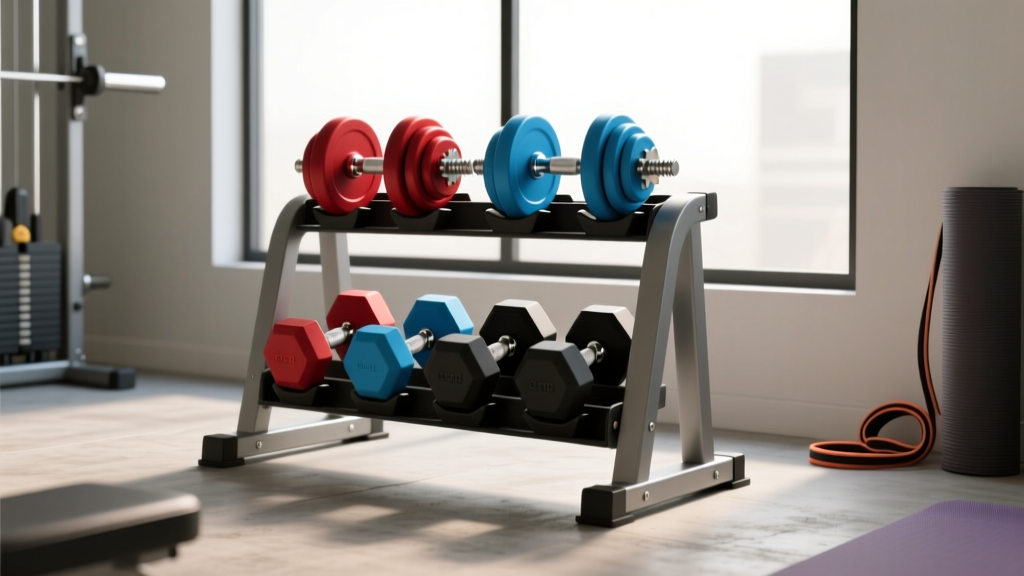
Budget Racks for Your Dumbbell Pullover Chest Workout Weights
Discover the best budget dumbbell racks for your home gym. We analyze storage value, footprint, and safety for your dumbbell pullover chest workout.

The Hidden Cost of Poor Storage in Chest Workouts
When programming a dumbbell pullover chest workout, lifters typically obsess over bench angles, grip width, and progressive overload. Yet, one of the most critical—and frequently overlooked—components of a sustainable home gym is how those heavy hex or urethane dumbbells are stored between sets. Dropping a 60-pound dumbbell onto the floor after a grueling set of pullovers doesn't just risk damaging your subfloor; it micro-fractures the dumbbell's internal steel handle and degrades the outer urethane coating over time.
As of 2026, the home fitness equipment market has stabilized, meaning you no longer need to pay premium commercial-gym prices to secure heavy-duty storage. However, the budget rack category (defined as sub-$200) is riddled with structural compromises. In this value analysis, we break down the exact spatial demands of the pullover movement, evaluate the top budget-friendly dumbbell racks on the market, and expose the failure modes of cheap steel so you can invest your money wisely.
The Spatial Demands: Why Pullovers Require Specific Clearances
The dumbbell pullover is unique among chest exercises because of its extreme sagittal plane arc. According to the American Council on Exercise (ACE), the movement requires the lifter to lower the weight until the upper arms are parallel to or slightly below the torso, demanding significant overhead clearance.
The 36-Inch Rule for Rack Placement
Standard flat benches are roughly 48 inches long. When executing a pullover, the dumbbell extends approximately 24 to 30 inches past the top of the bench. If your dumbbell rack is placed directly behind your bench, you will inevitably strike the steel uprights during the eccentric phase of the lift. Minimum Requirement: You must maintain a 36-inch clearance radius behind the head of the bench. This dictates that A-frame racks must be positioned laterally to the bench, not directly behind it.
2026 Budget Rack Market Breakdown: A-Frame vs. 3-Tier vs. Wall-Mount
The budget storage sector is dominated by three primary designs. Understanding the structural engineering behind each is vital for determining long-term value. Based on current ExRx dumbbell standards for intermediate to advanced lifters, a standard home gym requires storage for weights ranging from 15 lbs to 70 lbs per hand.
| Rack Type | Avg. Cost (2026) | Floor Footprint | Max Capacity | Best Application |
|---|---|---|---|---|
| A-Frame (Vertical) | $70 - $110 | ~24' x 24' | 300 - 500 lbs | Tight spaces, lighter sets (under 40 lbs) |
| 3-Tier Horizontal | $130 - $180 | ~48' x 24' | 800 - 1,200 lbs | Full 5-50 lb sets, heavy commercial-style use |
| Wall-Mount Shelves | $140 - $170 (pair) | 0 sq ft (Floor) | Varies by stud | Garage gyms with exposed wooden studs |
Top Budget-Friendly Dumbbell Racks Reviewed
1. Yes4All 3-Tier Jumbo Dumbbell Rack (The Value Champion)
Current Price: ~$149.99
Steel Gauge: 14-gauge steel frame with 12-gauge crossbars
The Yes4All 3-Tier remains the undisputed king of budget horizontal storage. It comfortably holds up to 10 pairs of dumbbells (typically the 5 lb to 50 lb range). The angled tray design prevents the dumbbells from rolling, a crucial safety feature when you are fatigued after a heavy chest superset.
- Pros: Exceptional weight distribution; rubberized feet protect epoxy garage floors; holds a complete starter set.
- Cons: Assembly takes roughly 45 minutes due to the high bolt count (24+ hex bolts).
- Failure Mode to Watch: Do not store 60+ lb dumbbells on the top tier. The 12-gauge crossbars can experience slight deflection (sagging) over time under concentrated heavy loads.
2. CAP Barbell A-Frame Dumbbell Rack (The Space Saver)
Current Price: ~$89.00
Steel Gauge: 14-gauge tubular steel
If your home gym is a converted bedroom or a tight apartment corner, the CAP Barbell A-Frame is the go-to solution. Its vertical design minimizes the footprint to just 24x24 inches. It holds five pairs of dumbbells, making it ideal for lifters who use a limited weight range for their dumbbell pullover chest workout (e.g., 25, 30, 35, 40, and 45 lbs).
- Pros: Highly affordable; minimal floor space required; easy to assemble in under 15 minutes.
- Cons: Only accommodates hex or rubber-coated dumbbells with specific handle clearances; neoprene dumbbells often do not fit the cradles.
- Failure Mode to Watch: The Tipping Hazard. Because the base is narrow, pulling a heavy 50 lb dumbbell from the top tier shifts the center of gravity. The National Strength and Conditioning Association (NSCA) emphasizes equipment stability; you must anchor this rack or always pull from the bottom tier first to maintain a low center of mass.
3. Rogue Fitness Wall-Mount Dumbbell Shelves (The Premium Budget)
Current Price: ~$155.00 per pair
Steel Gauge: 11-gauge steel brackets with UHMW plastic liners
While slightly more expensive, Rogue's wall-mounted shelves offer unmatched value by entirely eliminating floor footprint. Designed to mount directly to wooden studs (16 inches on center), these shelves hold up to three pairs of heavy dumbbells per tier. The UHMW (Ultra-High-Molecular-Weight) plastic liners protect the knurling and steel handles of your premium dumbbells from scratching.
- Pros: Zero floor footprint; commercial-grade 11-gauge steel; eliminates the tipping hazard entirely.
- Cons: Requires a stud finder, a heavy-duty drill, and lag screws; not suitable for drywall-only or masonry walls without specialized anchors.
Failure Modes: Where Sub-$100 Racks Break Down
When analyzing budget equipment, it is critical to understand how and why cheap racks fail. The most common failure point in budget A-frames and 2-tier racks is weld shearing at the gusset plates. Manufacturers of sub-$80 racks often use spot-welding rather than continuous MIG welds at the joints where the weight-bearing trays meet the vertical uprights.
Expert Warning: If you are buying a budget rack, inspect the welds upon delivery. Look for 'porosity' (tiny holes in the weld bead) or 'undercutting' (a groove melted into the base metal). If the welds look like messy, uneven blobs rather than smooth, uniform 'dimes', return the rack. It will not survive the dynamic loading of dropping heavy dumbbells back into the cradle.
Another critical failure point is the rubber foot degradation. Cheap PVC feet harden and crack after 12 to 18 months of exposure to UV light and temperature fluctuations in a garage gym, eventually leading to the steel frame scratching your concrete or rubber mat flooring.
Step-by-Step Layout Framework for the Pullover
To optimize your space for a dumbbell pullover chest workout while maintaining safe storage, follow this exact layout framework:
- Place the Bench: Position the flat bench parallel to the longest wall of your gym space.
- Establish the Drop Zone: Measure 36 inches directly behind the head of the bench. This is your 'no-storage zone' to allow for the pullover arc and a safe drop if you fail a rep.
- Position the Rack Laterally: Place your 3-Tier or A-Frame rack exactly 18 inches to the left or right of the bench. This allows you to sit on the edge of the bench, reach over, and grab the dumbbells for your pullovers without twisting your lumbar spine.
- Secure the Perimeter: If using an A-Frame, ensure it is pushed into a corner or against a wall to prevent backward tipping when extracting heavy weights.
Final Value Verdict
For lifters executing a dedicated dumbbell pullover chest workout, the storage solution is just as vital as the weights themselves. If you are working with a strict sub-$100 budget and have limited space, the CAP Barbell A-Frame is acceptable, provided you strictly manage the center of gravity when loading and unloading. However, for the best long-term value and structural integrity in 2026, the Yes4All 3-Tier Jumbo Rack at $149.99 offers the safest, most ergonomic storage for a complete set of hex dumbbells, ensuring your equipment—and your floors—survive the rigors of heavy chest training.
More gear to consider
All reviews
Olympic vs Standard Plates for Incline Seated Dumbbell Curls

Loadable Dumbbell Setups for Every Biceps Exercise Using Dumbbells
Free Weight Setup: Barbell Collar Types & Alternate Dumbbell Press
Best Adjustable Dumbbells for Arm and Shoulder Exercises

Best Neoprene Coated & Neutral Grip Dumbbell Guide 2026
