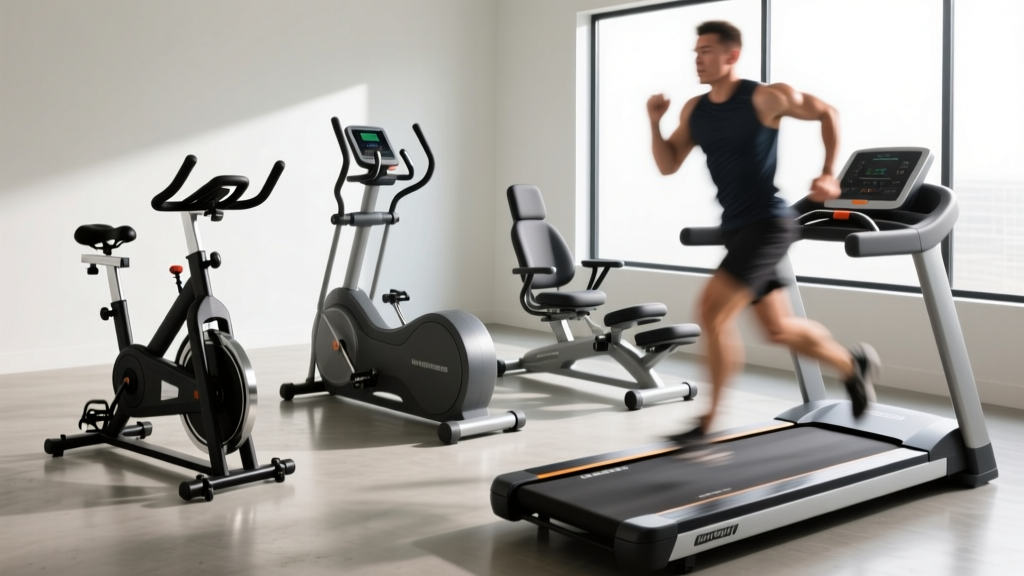
Budget Bikes vs Interval Sprints on Treadmill: Spin & Upright Value
Compare the budget and value of spin, upright, and recumbent bikes against the cost of doing interval sprints on treadmill machines for home HIIT.

The Baseline: The True Cost of Interval Sprints on Treadmill Machines
High-Intensity Interval Training (HIIT) is a cornerstone of modern cardiovascular conditioning. According to Harvard Health Publishing, HIIT routines that push your heart rate to 80-95% of its maximum capacity yield superior metabolic adaptations in a fraction of the time compared to steady-state cardio. For many home gym owners, the gold standard for this is performing interval sprints on treadmill machines. However, the financial and spatial footprint of a treadmill capable of handling daily, high-impact sprint intervals is substantial.
To safely execute rapid acceleration and deceleration without belt slip or motor burnout, you need a treadmill with a minimum of a 3.0 Continuous Horsepower (CHP) motor and a high-torque drive system. Entry-level models with 2.0 CHP motors will overheat and degrade within months of sprint intervals. In 2026, a reliable HIIT-capable treadmill like the Sole F80 (3.5 CHP) retails around $1,199, while premium smart models like the NordicTrack Commercial 2450 (4.0 CHP) push $2,799. Furthermore, treadmills demand roughly 30 square feet of floor space and require annual deck lubrication and belt tensioning.
⚠️ Failure Mode Alert: Treadmill Motor BurnoutWhen performing interval sprints on treadmill machines, the motor experiences massive current spikes during rapid acceleration. If the user exceeds the machine's weight limit or the motor is underpowered (sub-2.5 CHP), the internal thermal sensor will trip, or the drive belt will slip, causing dangerous deceleration stumbles.
This begs a critical budget question: Can you achieve the same cardiovascular ROI and metabolic output using stationary bikes—specifically spin, upright, or recumbent models—for a fraction of the cost? Let us break down the value proposition of each bike type for HIIT.
Spin Bikes: The Heavy Flywheel HIIT Contenders
Spin bikes (indoor cycles) are the closest biomechanical and metabolic match to treadmill sprinting. They allow for out-of-the-saddle climbing, aggressive aero-posture sprints, and virtually unlimited resistance ceilings. The value of a spin bike for HIIT hinges entirely on its resistance mechanism and flywheel mass.
Friction vs. Magnetic Resistance for Sprints
Older or ultra-budget spin bikes (under $400) use felt-pad friction resistance. While they offer infinite resistance, they suffer from pad degradation, sweat-induced slipping, and require frequent calibration. For sprint intervals, a magnetic resistance system is mandatory. Magnetic systems use eddy currents to create drag, meaning zero physical contact, zero maintenance, and instantaneous resistance shifts when you transition from a recovery jog to an all-out sprint.
Budget vs. Premium Spin Bike Breakdown
- The Budget Champion: Sunny Health & Fitness SF-B1002 ($350 - $400). Features a 40lb steel flywheel and friction resistance. It survives HIIT, but the friction pad will need replacing every 6-12 months if you sprint daily. The Q-factor (pedal width) is overly wide, which can cause knee strain during high-cadence sprints.
- The Value Sweet Spot: Schwinn IC4 ($1,099). This 2026 staple features a magnetic resistance system, a 40lb flywheel, and dual-sided pedals (SPD clips and toe cages). It connects via Bluetooth to Zwift and Peloton. It delivers 90% of the premium sprint experience for 40% of the cost of high-end smart bikes.
- The Premium Standard: Keiser M3i ($2,295). Uses a lightweight 8lb flywheel but achieves massive inertia through a 1:10 gear ratio and rear-wheel drive. It is the only bike that accurately measures wattage output (essential for tracking sprint power decay over a 20-minute HIIT session).
Upright Bikes: The Space-Saving Compromise
Upright bikes mimic the geometry of a traditional outdoor road bike but feature a wider, plush saddle and a step-through frame. They utilize smaller, enclosed flywheels (usually 10 to 20 lbs) and belt-drive systems.
The HIIT Limitation: Ergonomics and Power Transfer
While upright bikes like the Nautilus U618 ($799) or ProForm 235 CSX ($549) are excellent for moderate-intensity intervals (e.g., 3 minutes hard, 2 minutes easy), they fail during max-effort, 30-second all-out sprints. The wide, plush saddles cause severe chafing and soft-tissue compression when you attempt to pedal above 100 RPM. Additionally, the upright frame geometry does not allow you to stand up and mash the pedals; you are forced to remain seated, limiting your peak wattage output and glute recruitment compared to a spin bike or treadmill sprint.
However, from a pure budget and spatial perspective, upright bikes win. They occupy less than 8 square feet, weigh under 70 lbs (making them easy to move), and cost roughly half as much as a comparable magnetic spin bike.
Recumbent Bikes: Why They Fail the Sprint Test
Recumbent bikes, such as the Schwinn 270 ($899), feature a bucket seat with a backrest and forward-facing pedals. They are unparalleled for rehabilitation, spinal support, and steady-state Zone 2 cardio. According to the Mayo Clinic, low-impact aerobic options are vital for joint preservation, making recumbents ideal for aging populations or those recovering from lower-body injuries.
However, for HIIT and sprint intervals, recumbent bikes are a poor investment. The seated, reclined position prevents the use of gravity and body weight to drive the pedals. You cannot stand up, and your maximum cadence is physically bottlenecked by the bucket seat. Attempting 110+ RPM sprints on a recumbent bike usually results in the user bouncing out of the seat rather than transferring power to the drivetrain. If your primary goal is high-intensity sprint intervals, a recumbent bike will leave you frustrated and under-stimulated.
Head-to-Head Value Matrix (2026 Market)
| Machine Type | Avg. Cost (HIIT Capable) | Sprint Suitability | Footprint | Maintenance Risk |
|---|---|---|---|---|
| Treadmill (3.5+ CHP) | $1,200 - $2,800 | Excellent (Gold Standard) | ~30 sq ft | High (Belt/Deck/Motor) |
| Magnetic Spin Bike | $900 - $2,300 | Excellent (Stand/Sit Sprints) | ~12 sq ft | Very Low |
| Upright Bike | $500 - $800 | Moderate (Seated Only) | ~8 sq ft | Low |
| Recumbent Bike | $700 - $1,200 | Poor (Cadence Bottleneck) | ~15 sq ft | Low |
The 2026 Buyer's Decision Framework
When allocating your home gym budget, you must align your equipment choice with the specific physiological demands of your workout programming. The CDC Physical Activity Guidelines recommend at least 75 minutes of vigorous-intensity aerobic activity per week. How you achieve those 75 minutes dictates your purchase.
Scenario A: The Pure HIIT & Power Athlete
If your programming involves Tabata protocols, 30-second max-wattage sprints, and out-of-the-saddle climbs, skip the treadmill and buy a magnetic spin bike. The Schwinn IC4 or Bowflex C6 provides the necessary flywheel inertia and structural rigidity to handle violent pedal strokes without the $2,000+ price tag or motor-burnout anxiety of a budget treadmill. You save money, save 18 square feet of floor space, and eliminate impact-related shin splints.
Scenario B: The Mixed-Modal Cardio Enthusiast
If you prefer longer intervals (e.g., 3 minutes at threshold pace) mixed with steady-state reading or watching TV, an upright bike offers the best financial value. Models in the $600 range provide excellent magnetic resistance, heart-rate telemetry via chest straps, and a comfortable seat for 45-minute sessions, though they will frustrate you if you attempt true 100% max-effort sprints.
Scenario C: The Joint-Conscious Steady-State Rider
If your interest in HIIT is waning due to lower back pain or knee tendinitis, do not force interval sprints on treadmill machines or aggressive spin bikes. Invest in a recumbent bike. While it fails the sprint test, its value lies in enabling you to consistently hit your weekly cardiovascular volume without injury, which ultimately yields better long-term health outcomes than sporadic, painful sprint sessions.
Final Verdict on Budget Allocation
Interval sprints on treadmill machines remain the king of full-body, weight-bearing HIIT, but the barrier to entry is steep. A high-quality treadmill requires a massive upfront investment, dedicated spatial real estate, and ongoing mechanical maintenance. By pivoting to a magnetic spin bike, home gym owners can replicate 95% of the cardiovascular stimulus of treadmill sprinting for roughly 40% of the cost, with virtually zero maintenance overhead. Evaluate your sprint mechanics, measure your available floor space, and allocate your budget toward the drivetrain and resistance mechanism that best supports your peak power output.
More gear to consider
All reviews
Treadmill Abuse Death Risks: Safety Features & Buying Guide

Walking Pad vs Ironman Treadmill: Review & Troubleshooting

Stationary Bike Types & Sunny Treadmill SF-T4400 Manual Guide
Air Bike vs Assault Bike: Value Beyond iFIT Treadmill Workouts

Curved Manual vs Motorized Treadmill: How to Fix a Slipping Belt
