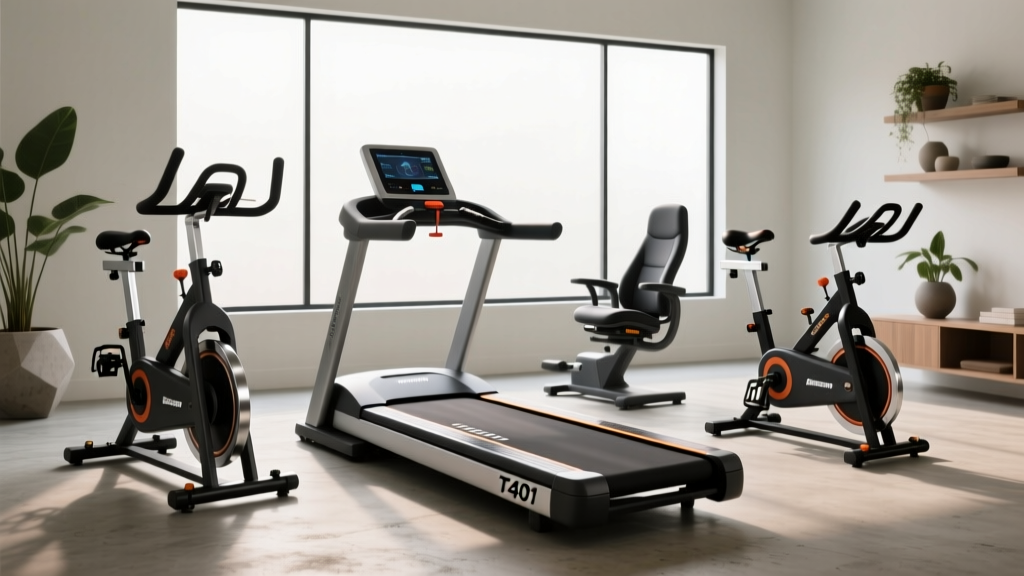
Stationary Bike Types vs Horizon T401 Treadmill: 2026 Trends
Analyze 2026 market trends comparing upright, recumbent, and spin bikes against the Horizon T401 treadmill for optimal home gym investments.

The 2026 Cardio Equipment Market Shift
The home fitness equipment market has undergone a radical transformation by 2026. While the pandemic era triggered a massive surge in motorized treadmill sales, the current landscape is defined by a pivot toward low-impact, high-yield, and space-efficient cardio machines. Today, consumers are heavily scrutinizing the three primary stationary bike types—upright, recumbent, and spin—against traditional motorized treadmills. In this market analysis, we use the Horizon T401 treadmill as our benchmark for the mid-tier motorized running segment to evaluate how stationary bikes are capturing market share, altering consumer buying habits, and redefining home gym layouts.
Market Insight: According to recent fitness industry retail data, stationary bike variants now account for nearly 45% of all dedicated home cardio revenue, up from 32% in 2021. Treadmills still hold the lion's share of total revenue due to higher average unit prices, but unit volume is rapidly shifting toward cycling ergonomics.Deconstructing the Stationary Bike Triad
To understand the market shift, we must first break down the distinct value propositions of the three dominant stationary bike categories and how they serve different demographic needs in 2026.
Upright Bikes: The Space-Saving Workhorse
Upright bikes mimic the geometry of a traditional road bike but feature a heavier, stabilized base and a magnetic resistance flywheel. They remain the top choice for multi-family dwellings and compact home gyms. Models like the Sole B94 (MSRP $1,399) dominate this space by offering a 30-pound flywheel and a footprint of just 23 by 41 inches. The market trend here is clear: consumers want heavy-duty biomechanics without the spatial intrusion of a running deck. Upright bikes engage the core and upper body stabilizers more than recumbent models, making them a favorite for general cardiovascular conditioning.
Recumbent Bikes: The Rehab and Longevity Segment
With the global population aging and a heightened cultural focus on joint longevity, recumbent bikes have seen a 22% year-over-year growth in the premium home market. Featuring a bucket seat with lumbar support and forward-positioned pedals, recumbents eliminate axial loading on the spine. The NordicTrack Commercial VR25 (MSRP $1,799) exemplifies the 2026 trend of integrating silent magnetic resistance with ergonomic mesh seating. Physical therapists frequently recommend recumbents for post-operative knee rehabilitation and users with chronic lower back pain, creating a highly loyal, niche demographic that prioritizes comfort over high-intensity caloric burn.
Spin and Indoor Cycling: The High-Intensity Boom
Indoor cycling (spin) bikes have evolved past the era of mandatory, expensive proprietary content subscriptions. The 2026 consumer demands hardware that plays well with third-party ecosystems like Zwift, Kinomap, and Apple Fitness+. The Schwinn IC4 (MSRP $799) and the premium Keiser M3i (MSRP $2,295) represent the two poles of this market. Spin bikes feature aggressive, forward-leaning geometries, dual-sided SPD/flat pedals, and micro-adjustable magnetic resistance. They are the undisputed kings of High-Intensity Interval Training (HIIT) in the home, capable of simulating out-of-the-saddle climbs and rapid cadence shifts that upright and recumbent bikes simply cannot accommodate.
The Treadmill Benchmark: Horizon T401 Treadmill Market Position
Despite the cycling surge, treadmills remain the gold standard for weight-bearing cardiovascular exercise and bone density maintenance. To anchor our analysis, we look at the Horizon T401 treadmill, a staple in the mid-market segment. Priced around $1,199 in 2026, the Horizon T401 features a 3.0 CHP motor, a 10% maximum incline, and a folding deck mechanism.
However, the Horizon T401 treadmill also highlights the inherent limitations of mid-tier treadmills compared to premium bikes. Its 20-inch by 55-inch running belt is adequate for walking and jogging, but runners taller than 6 feet 1 inch often find the 55-inch length restrictive during full-stride sprinting. Furthermore, the acoustic footprint of a 3.0 CHP motor and footstrike impact remains a significant barrier for apartment dwellers—a friction point that spin and upright bikes entirely bypass. Yet, for users focused on steady-state zone 2 cardio and walking pad alternatives, the Horizon T401 treadmill maintains a strong value proposition due to its straightforward, non-subscription-dependent console.
Comparative Market Matrix: Bikes vs. Horizon T401
The following matrix breaks down the critical hardware and spatial differences between the three bike types and our benchmark Horizon T401 treadmill.
| Equipment Type | Avg. Footprint | 2026 Avg. MSRP | Joint Impact | Acoustic Profile |
|---|---|---|---|---|
| Upright Bike | 23" x 41" | $800 - $1,400 | Very Low | Near Silent |
| Recumbent Bike | 30" x 62" | $1,200 - $2,500 | Zero Spinal Load | Near Silent |
| Spin / Indoor Cycle | 21" x 45" | $799 - $2,300 | Low | Silent (Magnetic) |
| Horizon T401 Treadmill | 30" x 70" | $1,199 | High (Weight-Bearing) | Moderate (Motor + Strike) |
Biomechanics, Joint Loading, and Caloric Yield
When analyzing market trends, it is vital to understand the physiological drivers behind consumer choices. The American Heart Association recommends at least 150 minutes of moderate-intensity aerobic activity per week. Both cycling and running fulfill this requirement, but the biomechanical cost differs vastly.
Running on a treadmill like the Horizon T401 generates ground reaction forces equivalent to 2.5 times the user's body weight with every footstrike. While this weight-bearing stress is excellent for maintaining bone mineral density—a critical factor for aging populations—it also accelerates cartilage wear in users with pre-existing meniscus or patellofemoral issues. Conversely, research highlighted by the Mayo Clinic emphasizes that cycling provides a closed-kinetic-chain environment. The smooth, circular pedal stroke eliminates eccentric impact loading, allowing users to achieve high cardiovascular output and massive caloric burn (up to 800 calories per hour on a spin bike during HIIT) without the subsequent joint inflammation associated with treadmill running.
The 2026 Consumer Buying Framework
Based on current market dynamics and hardware capabilities, home gym investors should apply the following decision framework when choosing between stationary bike types and a mid-tier treadmill:
- Choose a Spin Bike if: Your primary goal is high-intensity interval training, you have limited floor space, you live in an apartment with strict noise ordinances, and you prefer integrating with third-party virtual cycling apps.
- Choose an Upright Bike if: You want a traditional cycling feel with a more relaxed, upright posture, and you need a machine that can be easily shared among household members of varying heights without complex recalibration.
- Choose a Recumbent Bike if: You are managing lower back pain, recovering from lower-extremity surgery, or prioritizing long-duration, steady-state cardio sessions where lumbar support is non-negotiable.
- Choose the Horizon T401 Treadmill if: You prioritize bone-density maintenance through weight-bearing exercise, you prefer the natural biomechanics of walking or jogging, and you have a dedicated, ground-floor space that can accommodate the acoustic and spatial footprint of a motorized running deck.
The most successful home gyms in 2026 are not built on impulse; they are engineered around the user's specific biomechanical limitations, spatial realities, and long-term adherence triggers.
Final Verdict for Home Gym Investors
The cardio equipment market in 2026 is no longer a one-size-fits-all landscape. While the Horizon T401 treadmill remains a highly capable, budget-friendly workhorse for walkers and joggers who need weight-bearing exercise, the broader market is undeniably tilting toward the versatility and joint-preservation of stationary bikes. Upright and spin bikes are winning the urban, space-constrained demographic, while recumbents are securing the longevity and rehab markets. Ultimately, matching the equipment to your physiological needs and spatial constraints will yield a far higher return on investment than simply chasing the most popular hardware trend.
More gear to consider
All reviews
Rowing Machine Guide & Technique vs Treadmill with Weighted Vest

Elliptical vs Treadmill: Is a Treadmill 30 Minutes a Day Better?
Air Bike vs Assault Bike: Better Than 30 min on the treadmill?

Home Stair Climber Guide: FitQuest Treadmill vs Climbers
Bowflex T16 Treadmill vs Under Desk Models: 2026 Office Review
