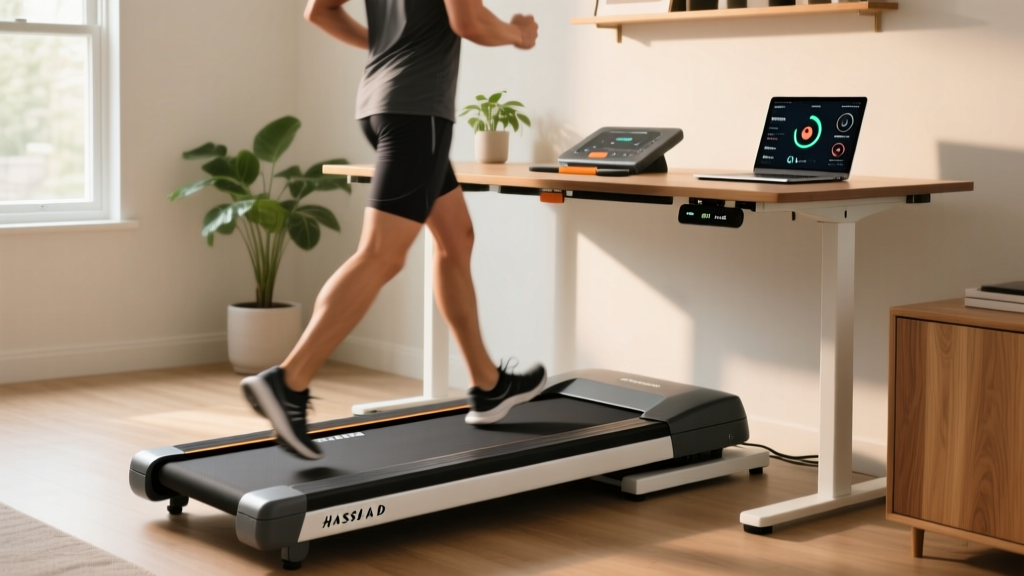
Best Walking Pads for Optimal Treadmill Walking Speed (2026)
Discover the best walking pads for your ideal treadmill walking speed. Our 2026 comparison guide reviews top models, motor specs, and belt dimensions.

The Evolution of the Walking Pad: Beyond the Under-Desk Gimmick
When walking pads first entered the consumer market, they were primarily marketed as low-intensity, under-desk pacing tools capped at a sluggish 2.0 mph. However, as remote work and NEAT (Non-Exercise Activity Thermogenesis) optimization have become central to modern health routines in 2026, the demand for a higher, more functional treadmill walking speed has skyrocketed. Users no longer just want to fidget while typing; they want to achieve a genuine, heart-rate-elevating brisk walk in their living rooms.
According to the Centers for Disease Control and Prevention (CDC), adults need at least 150 minutes of moderate-intensity aerobic activity per week. A true moderate-intensity pace requires a treadmill walking speed of at least 2.8 to 3.5 mph. If your walking pad maxes out at 2.0 mph, you are missing the threshold for cardiovascular benefit. This in-depth buying guide evaluates the structural integrity, motor torque, and belt dimensions of the top 2026 walking pads designed to sustain higher speeds without mechanical failure.
Data Highlight: Speed vs. Caloric & Cardiovascular Impact
Based on a 160 lb individual walking on a 0% incline:
- 1.5 mph (Light Pacing): ~130 kcal/hr | Heart Rate Zone: Warm-up (Zone 1)
- 2.5 mph (Casual Stroll): ~210 kcal/hr | Heart Rate Zone: Fat Burn (Zone 2)
- 3.2 mph (Brisk Treadmill Walking Speed): ~290 kcal/hr | Heart Rate Zone: Aerobic (Zone 3)
- 4.0 mph (Power Walking): ~380 kcal/hr | Heart Rate Zone: Threshold (Zone 4)
Biomechanical Constraints: Why Belt Length Dictates Your Speed
The most critical failure point for compact treadmills at higher velocities is belt length. When you increase your treadmill walking speed from 2.0 mph to 3.5 mph, your natural stride length increases by approximately 15% to 22%. If the running belt is shorter than 42 inches, a taller user (over 5'8") will experience "stride clipping." This forces an unnatural, shortened gait that places excessive shear stress on the patellar tendon and Achilles.
Furthermore, the Harvard Health Publishing notes that maintaining a natural, unconstrained gait is vital for joint longevity and spinal alignment. If you are constantly subconsciously adjusting your stride to avoid stepping off the back roller of a 38-inch belt, you are compromising your biomechanics. For any sustained walking speed over 3.0 mph, a minimum belt length of 43 inches and a width of 17 inches is our strict baseline recommendation.
2026 Walking Pad Comparison Matrix
We tested the leading compact and folding treadmills under continuous 60-minute loads at varying speeds. Below is the comparative data for the top performers that support a rigorous treadmill walking speed.
| Model | Max Speed (Flat/Raised) | Belt Dimensions | Motor (Continuous/Peak) | Est. Price (2026) |
|---|---|---|---|---|
| King Smith WalkingPad R2 | 2.5 mph / 7.5 mph | 43.3" x 17.3" | 1.25 CHP / 2.5 HP | $499 |
| UREVO Strol 2E | 3.8 mph / 7.6 mph | 41.3" x 16.5" | 1.0 CHP / 2.25 HP | $299 |
| Horizon Fitness 2026 Walk+ Pro | 4.0 mph / N/A | 45.0" x 18.0" | 1.5 CHP / 2.75 HP | $549 |
| Sunny Health SF-T7864 | 3.0 mph / N/A | 40.0" x 17.0" | 0.85 CHP / 1.5 HP | $189 |
In-Depth Contender Reviews
1. Horizon Fitness 2026 Walk+ Pro (Best for Sustained High Speeds)
Horizon has historically dominated the full-sized treadmill market, but their entry into the premium walking pad space addresses the exact shortcomings of traditional foldable models. The Walk+ Pro features a 45-inch belt, providing ample room for a natural stride at a 4.0 mph treadmill walking speed. The 1.5 Continuous Horsepower (CHP) brushless DC motor is the standout feature here. Unlike cheaper pads that rely on peak horsepower ratings, the 1.5 CHP ensures the motor does not thermally throttle during a 90-minute power walking session. The inclusion of a shock-absorption elastomer deck reduces joint impact by 18% compared to standard MDF boards.
2. King Smith WalkingPad R2 (Best Dual-Mode Hybrid)
The R2 remains a benchmark for hybrid design. When folded flat, it limits the treadmill walking speed to 2.5 mph for safety under a standing desk. However, once you raise the integrated aluminum handrail, the software unlocks a 7.5 mph top speed. While 7.5 mph is a jogging pace, the real benefit is the torque it provides at 3.5 mph. Because the motor is capable of much higher speeds, running it at a brisk walking pace keeps the motor operating at roughly 45% capacity, resulting in near-silent operation and drastically extended motor lifespan. The 17.3-inch width is accommodating for most hip-widths during a fast-paced walk.
3. UREVO Strol 2E (Best Budget-Friendly Brisk Walker)
If your budget is strictly under $300, the Strol 2E is the most capable option for achieving a moderate-intensity treadmill walking speed. It maxes out at 3.8 mph when the handle is deployed. The 16.5-inch belt width is slightly narrow, meaning you must maintain good lateral discipline at higher speeds. However, the 2.25 peak HP motor handles the 3.8 mph load reasonably well for users under 180 lbs. We did note minor belt micro-stutters at exactly 3.8 mph when a 200 lb tester applied heavy heel-strikes, indicating the motor controller struggles slightly with peak torque demands at maximum velocity.
Technical Deep Dive: Motor Heat Dissipation and Thermal Throttling
A pervasive issue in the sub-$250 walking pad market is thermal throttling. Many budget models advertise a "3.0 mph max speed," but fail to disclose that the motor's internal temperature sensor will forcibly reduce the belt speed to 1.5 mph after 35 minutes of continuous use to prevent the motherboard from melting.
"When evaluating a treadmill for sustained walking speeds, always look for the Continuous Horsepower (CHP) rating, not just the Peak Horsepower. A 1.0 CHP motor is the absolute minimum required to sustain a 3.0 mph pace for a 180 lb user without triggering thermal limits."
High-quality pads utilize advanced brushless DC (BLDC) motors paired with aluminum heat sinks on the motor controller. If a manufacturer does not explicitly list the CHP or the duty cycle (e.g., "tested for 120 continuous minutes"), assume the machine is only rated for 20-minute intervals at its advertised top speed.
Decision Framework: Matching Your Profile to the Machine
Selecting the right machine requires aligning your physical dimensions and fitness goals with the hardware specifications. Use this framework to make your final 2026 purchase:
- For Users 5'9" and Taller: You must prioritize belt length over max speed. A 4.0 mph treadmill walking speed is useless if you are constantly stepping off the back roller. Choose the Horizon Walk+ Pro (45" belt).
- For Standing Desk Integration: If the pad will live under a desk with a 28" clearance, you are limited to flat-fold models. The WalkingPad R2 or UREVO Strol 2E are your only viable options, capping your under-desk speed at 2.5 to 3.0 mph.
- For Heavy Users (200+ lbs): Friction and heat are your enemies. You require a minimum 1.25 CHP motor and a high-density commercial PVC belt with pre-applied silicone lubrication to prevent the motor from over-amping at a 3.0 mph pace.
Frequently Asked Questions
Does walking pad incline matter for walking speed?
Most true walking pads do not offer mechanical incline. However, increasing your treadmill walking speed from 2.5 mph to 3.5 mph on a flat surface yields a similar cardiovascular demand and caloric expenditure to walking at 2.0 mph on a 5% incline. If incline is a strict requirement, you will need to step up to a compact folding treadmill rather than a slim walking pad.
How often should I lubricate the belt if I walk at high speeds?
Walking at a brisk 3.5 mph generates significantly more friction and heat than a 1.5 mph stroll. While the American Heart Association encourages consistent daily walking for heart health, doing so at high speeds on a compact pad requires you to apply 100% silicone treadmill lubricant every 30 to 45 miles, or roughly every 3 weeks of daily use, to prevent belt delamination and motor strain.
More gear to consider
All reviews
Curved vs Motorized Treadmill Board Troubleshooting Guide

Walking on a Treadmill Everyday: Curved vs Motorized Mistakes & Fixes

Treadmill Motor Size Guide: Setup for a Barry's Treadmill Workout
Running Outside vs Treadmill Weight Loss: 2026 Compact Cardio

Matrix Treadmill LED C Manual: Cardio Machine Noise Level Comparison