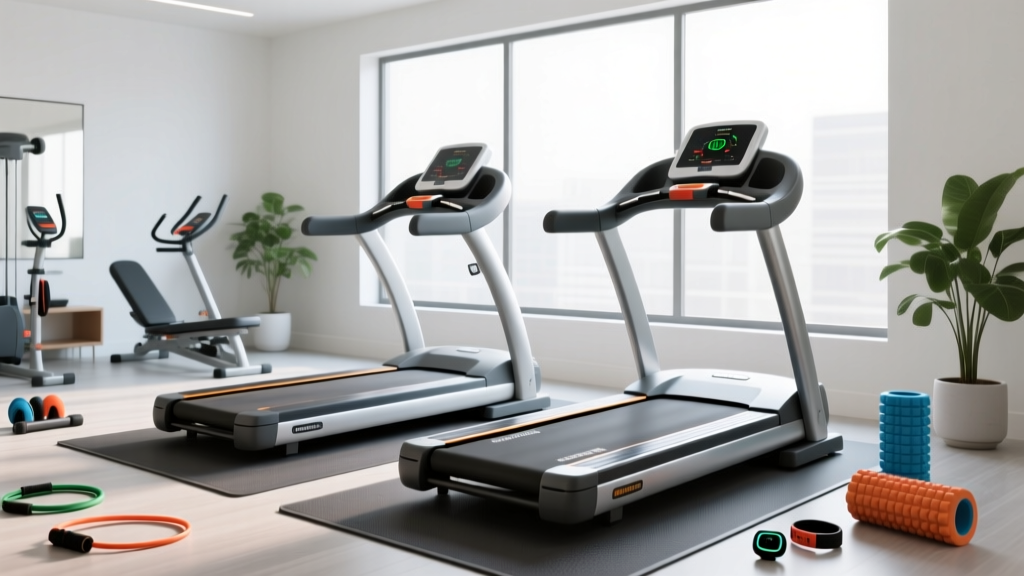
Treadmill Motor Size Guide: Setup for a Barry's Treadmill Workout
Learn how to choose the right treadmill motor size and complete the setup to safely replicate an intense Barry's treadmill workout at home.

The Physics of a Barry's Treadmill Workout: Why Motor Size Matters
Replicating a boutique studio experience in your home gym requires more than just clearing out space; it demands commercial-grade engineering. The signature barry's treadmill workout is built on a foundation of extreme high-intensity interval training (HIIT). You are transitioning from all-out 10 MPH sprints to heavy 10% incline recovery walks in a matter of seconds. According to the Mayo Clinic, this specific style of HIIT places massive metabolic demands on the body, but it also places catastrophic electrical and mechanical demands on your treadmill's motor.
When you jump onto a moving belt at 9 MPH, the sudden introduction of your body weight causes an immediate 'amp spike' in the motor controller. If your treadmill is equipped with a standard 2.5 HP peak motor commonly found in budget models, this spike will overheat the internal windings, trigger a thermal safety shutoff, and stop the belt mid-sprint. This guide walks you through selecting the correct Continuous Horsepower (CHP) and provides a complete installation and calibration walkthrough to ensure your machine survives the studio-level punishment of a Barry's routine.
Decoding Treadmill Motors: HP vs. CHP for HIIT
The fitness equipment industry is notorious for misleading marketing. Many manufacturers advertise 'Peak HP,' which is the maximum power the motor can generate for a few seconds before failing. For a barry's treadmill workout, Peak HP is irrelevant. You must look exclusively at Continuous Horsepower (CHP), which measures the power the motor can sustain indefinitely during a workout.
As noted in the Consumer Reports treadmill buying guide, a higher CHP rating ensures the motor operates at a lower percentage of its total capacity, reducing heat buildup and extending the lifespan of the belt and deck.
Motor Sizing Matrix: CHP vs. User Weight for HIIT
| User Weight | Walking/Light Jog (Standard Use) | Barry's HIIT Sprints (High Impact) | Recommended 2026 Models | Average Price Range |
|---|---|---|---|---|
| Under 150 lbs | 2.5 CHP | 3.0 CHP Minimum | Horizon Fitness 7.4 | $1,099 - $1,299 |
| 150 - 200 lbs | 3.0 CHP | 3.5 CHP Minimum | Sole F80 / NordicTrack 1750 | $1,499 - $1,999 |
| 200 - 250 lbs | 3.5 CHP | 4.0 CHP Minimum | Sole F85 / Precor TRM 731 | $1,999 - $3,499 |
| 250+ lbs | 4.0 CHP | 4.25+ CHP or Curved Non-Motorized | Woodway 4Front / AssaultRunner | $3,999 - $7,500+ |
Pre-Installation Walkthrough: Electrical and Spatial Prep
High-CHP motors require serious electrical current. The most common installation failure for home HIIT setups is tripping the household breaker mid-workout because the treadmill shares a circuit with an air conditioner, space heater, or even a refrigerator.
Step 1: Verify Your Circuit Amperage
- Locate the Breaker Panel: Identify the circuit that powers your chosen gym room.
- Check the Amperage: Treadmills with 3.5 CHP to 4.0 CHP motors require a dedicated 15-amp or 20-amp circuit. If your motor is 4.0 CHP or higher (like the Precor TRM series), a 20-amp dedicated circuit is mandatory.
- Inspect the Outlet: Ensure the outlet is a standard 3-prong grounded NEMA 5-15R or 5-20R. Never use a 2-prong adapter or an extension cord. Extension cords introduce voltage drops that cause the motor controller to overcompensate, generating excess heat.
Step 2: Spatial Clearance for Safety
A proper barry's treadmill workout involves pushing your heart rate to near-maximum capacity. Fatigue leads to form breakdown. You must leave a minimum of 6 feet of clear fall space directly behind the treadmill and 2 feet of clearance on both sides. This is a non-negotiable safety standard to prevent severe friction burns if you are thrown off the back of the belt during a high-speed transition.
Step-by-Step Assembly & Calibration for Sprint Intervals
Once the unit is unboxed and placed on a level surface (use a spirit level to check side-to-side and front-to-back; an unlevel deck causes uneven belt wear and motor strain), follow this calibration sequence.
Phase 1: Belt Tension and Alignment
Factory-set belt tension is often too loose for HIIT. When you perform a sprint interval, a loose belt will slip over the front roller, causing a dangerous stutter.
- The Deflection Test: Reach under the center of the belt and lift. You should be able to lift it exactly 2 to 3 inches off the deck. If it lifts higher, it is too loose.
- Tightening: Using the provided Allen wrench, turn both the left and right rear roller adjustment bolts clockwise by exactly one-quarter (1/4) turn. Test the deflection again. Never turn one side more than the other, or the belt will track off-center.
Phase 2: Incline Motor Calibration
Barry's workouts heavily utilize incline walking (up to 10-15%) to spike the heart rate without the joint impact of running. The incline motor is separate from the drive motor and must be calibrated to ensure the console reading matches the actual deck angle.
- Enter the machine's engineering or calibration mode (refer to your specific model's manual; for Sole, this usually involves holding 'Start' and 'Speed Up' while inserting the safety key).
- Run the auto-calibration sequence. The deck will elevate to its maximum height (e.g., 15%) and lower to 0%.
- Pro-Tip: Place a digital angle finder on the side rail of the treadmill when it reaches max incline to verify the physical angle matches the console display. A miscalibrated incline motor will draw excess amps trying to reach a physical limit it cannot achieve.
Real-World Motor Failure Modes During Barry's Workouts
Understanding how your equipment fails is the hallmark of an informed home gym owner. When subjecting a treadmill to studio-style intervals, watch for these specific edge cases:
Thermal Cutoff vs. Controller Failure: If your treadmill abruptly stops and the console displays an 'E1' or 'Overcurrent' error, the motor controller has overheated. This is common in 3.0 CHP motors pushed by users over 180 lbs. The fix isn't just letting it cool down; you must check the belt lubrication. High friction between the belt and deck forces the motor to work 30% harder, transferring that heat directly to the controller.
According to commercial fitness equipment standards utilized by boutique studios featuring Woodway treadmills, the shift toward slat-belt and curved non-motorized designs is a direct response to the high maintenance and motor-burnout rates associated with traditional DC motors under HIIT conditions. If you plan on doing a barry's treadmill workout five or more times a week, investing in a commercial-grade AC motor or a curved manual treadmill (like the AssaultRunner Elite) eliminates the DC motor thermal failure point entirely.
Maintenance Protocol to Protect Your Motor Investment
To keep a 3.5+ CHP motor running cool during high-friction sprint intervals, implement this strict maintenance schedule:
- 100% Silicone Lubrication: Apply 1 oz of pure silicone treadmill lubricant under the belt every 130 miles or every 3 months (whichever comes first). HIIT generates more lateral friction than steady-state jogging.
- Vacuum the Motor Hood: Every 6 months, unplug the machine, remove the plastic motor hood (usually 4-6 Phillips screws), and use a vacuum with a brush attachment to remove dust from the motor fan and controller heat sink. Dust acts as an insulator, trapping heat during sprint intervals.
- Check Drive Belt Tension: The ribbed drive belt connecting the motor to the front roller stretches over time. If you hear a high-pitched squeal during rapid acceleration from 3 MPH to 8 MPH, the drive belt needs tightening or replacement.
Quick FAQ: Setup and Motor Sizing
Q: Can a 2.5 CHP motor handle a barry's treadmill workout if I am under 140 lbs?
A: It can survive it, but you will likely experience micro-stutters during rapid acceleration. For a true studio feel with seamless speed transitions, 3.0 CHP is the functional minimum for HIIT, regardless of weight.
Q: Do I need a curved non-motorized treadmill instead?
A: Curved treadmills are phenomenal for Barry's style workouts because they are self-powered, meaning there is no motor to overheat and no top speed limit. However, they require a much higher upfront investment and take significant practice to master the pacing compared to a traditional motorized setup.
By prioritizing Continuous Horsepower, ensuring a dedicated 20-amp electrical circuit, and rigorously calibrating your belt tension, your home treadmill will be fully equipped to handle the brutal, calorie-torching demands of a barry's treadmill workout for years to come.
More gear to consider
All reviews
Treadmill Heart Rate Errors: Curved vs Motorized Troubleshooting

Curved vs Motorized Treadmills: Converting Treadmill MPH to Pace

Folding Treadmill Review & Care: Sydney Sweeney Treadmill Video

Air Bike vs Assault Bike: Are Heart Rate Monitors on Treadmills Accurate?
Stair Climber Setup: Prep for a Treadmill Challenge for Beginners