
Barbell Knurling & Front Lateral Raises with Dumbbells Fixes
Avoid common gym mistakes. Learn Olympic barbell knurling buying tips and troubleshoot form errors for front lateral raises with dumbbells.

The Free Weight Paradox: Heavy Compounds vs. Precision Isolation
Building a comprehensive free weight arsenal in 2026 requires mastering two entirely different ends of the biomechanical spectrum. On one end, you have heavy axial loading—squatting, deadlifting, and pressing—which demands a high-quality Olympic barbell with the correct weight, whip, and knurling. On the other end, you have precision isolation movements, where joint health and muscle targeting are paramount.
Whether you are outfitting a new home gym or upgrading your commercial facility, making purchasing mistakes on your barbell or form errors on your isolation lifts will cost you both money and progress. This guide tackles the most common equipment buying mistakes regarding Olympic barbell weight and knurling, followed by a deep-dive troubleshooting matrix for one of the most misunderstood isolation movements: front lateral raises with dumbbells.
Olympic Barbell Buying Mistakes: Weight & Knurling Troubleshooting
The Olympic barbell is the centerpiece of any serious weight room. Yet, many buyers focus solely on the price tag, ignoring the tactile and mechanical nuances that dictate how the bar performs under heavy loads.
Mistake 1: Misinterpreting Knurl Aggressiveness and Profile
Knurling is the machined pattern on the bar shaft designed to increase friction. In 2026, manufacturers have refined knurling into three distinct profiles. Choosing the wrong profile for your training style is a primary cause of torn calluses and slipped grips.
| Knurl Profile | Geometry & Depth | Best Use Case | Notable 2026 Models |
|---|---|---|---|
| Hill | Shallow, rounded peaks (0.5mm - 0.8mm depth) | High-rep CrossFit, Olympic weightlifting, bare hands | Eleiko Olympic WL Bar |
| Volcano | Deep, sharp ridges with a flat top (1.0mm - 1.2mm depth) | Powerlifting, heavy deadlifts, mixed grip | REP Fitness Excalibur, Rogue Ohio Power Bar |
| Mountain | Sharp, pointed peaks without flat tops | Specialty deadlift bars, strongman | Rogue Deadlift Bar |
Troubleshooting Tip: If you are experiencing frequent skin tearing on your palms, you are likely using a "Mountain" or aggressive "Volcano" knurl for high-volume hypertrophy work. Switch to a moderate "Hill" knurl or use a bare steel/zinc finish rather than Cerakote, as ceramic coatings can slightly fill in the knurl valleys, altering the grip feel.
Mistake 2: Ignoring Barbell Weight, Diameter, and Whip
A standard men's Olympic barbell weighs exactly 20kg (44 lbs) with a 28mm or 29mm shaft diameter. However, buying a 29mm power bar for Olympic weightlifting is a critical error. The thicker shaft reduces "whip" (the elastic deformation of the bar during the pull), which transfers harsh kinetic energy directly into the lifter's joints.
Conversely, using a 25mm women's Olympic bar (15kg / 33 lbs) for heavy 500lb+ deadlifts results in excessive, unmanageable whip that can throw off your lockout timing. For a versatile home gym, a 28.5mm multi-purpose bar with a tensile strength of 190,000 PSI to 205,000 PSI remains the gold standard for balancing grip comfort and structural rigidity.
Expert Insight: According to comprehensive gear analyses by BarBend, the finish of the barbell shaft drastically alters knurl perception. A bare steel bar will feel significantly more aggressive than the exact same knurl pattern coated in black zinc or Cerakote.
Troubleshooting Front Lateral Raises with Dumbbells
Moving from the heavy barbell rack to the dumbbell zone, we encounter a different set of errors. The term "front lateral raises with dumbbells" is frequently used by lifters to describe a hybrid movement targeting both the anterior (front) and medial (side) deltoids. Biomechanically, this is best executed as a scapular plane raise (often called a Y-raise).
Performing strict frontal raises heavily biases the anterior deltoid (which is already overworked from bench pressing), while strict lateral raises bias the medial deltoid. The scapular plane—raising the arms roughly 30 to 45 degrees anterior to the frontal plane—is the optimal path for joint health and 3D shoulder development. Here is how to troubleshoot the most common errors.
Mistake 1: The "Pouring the Pitcher" Impingement Trap
Old-school bodybuilding advice often suggested internally rotating the shoulder at the top of a lateral raise ("pouring the pitcher"). Modern sports science has thoroughly debunked this for most lifters. Internal rotation under load narrows the subacromial space, grinding the supraspinatus tendon against the acromion process.
The Fix: Maintain a neutral grip or slightly externally rotate the dumbbells (thumb slightly higher than the pinky) at the top of the movement. This clears the subacromial space, allowing for pain-free hypertrophy.
Mistake 2: Ego Lifting and Momentum Hijacking
The medial and anterior deltoids are relatively small muscle groups. When lifters grab 40lb hex dumbbells and use a hip-hinge to swing the weight up, the trapezius and spinal erectors take over the load, rendering the isolation movement useless.
Troubleshooting Matrix: Shoulder Isolation Errors
| Symptom / Error | Biomechanical Cause | Immediate Fix |
|---|---|---|
| Sharp pain at the top of the raise | Internal rotation causing subacromial impingement | Switch to neutral grip; raise in the scapular plane (30° forward) |
| Upper traps burning out before delts | Excessive weight forcing scapular elevation (shrugging) | Drop weight by 30%; focus on depressing the scapulae before lifting |
| Lower back fatigue during sets | Using hip extension momentum to initiate the lift | Perform seated or lean against a 75° incline bench for strict isolation |
| Uneven shoulder development | Dominant side taking over during bilateral dumbbell raises | Switch to unilateral (one-arm) raises, bracing the non-working hand on a rack |
The Micro-Loading Problem with Fixed Hex Dumbbells
One of the most pervasive mistakes in commercial and home gyms is forcing progressive overload too quickly on isolation lifts. Standard rubber hex dumbbells jump in 5lb increments. Moving from 15lb to 20lb dumbbells represents a massive 33% increase in load. For a small muscle group like the lateral deltoid, this jump is neurologically and mechanically impossible to adapt to without breaking form.
Equipment Solution: Invest in high-quality adjustable dumbbells that offer 2.5lb micro-increments. Models like the Nuobell 80lb or PowerBlock Elite allow for seamless 2.5lb jumps, ensuring that your front lateral raises with dumbbells remain strict, controlled, and highly effective over a 12-week mesocycle.
Budget Allocation: Where to Spend Your Money in 2026
When outfitting a space for both heavy compounds and precision isolation, budget allocation is critical. Do not blow your entire budget on a $1,200+ elite weightlifting barbell if it means you are forced to buy cheap, poorly balanced fixed dumbbells.
A smart 2026 purchasing framework looks like this:
- The Barbell ($250 - $350): Target a 29mm multi-purpose power bar with a moderate volcano knurl and stainless steel shaft. (e.g., Rogue 29mm Ohio Bar variants or REP Fitness PR-1100 series bars).
- The Plates ($1.50 - $2.50/lb): Crumb rubber bumper plates for noise reduction and floor protection.
- The Dumbbells ($400 - $600): A premium pair of adjustable dumbbells (5lb to 50lb range) to facilitate the micro-loading required for safe, effective lateral and front raises.
Final Reps
Mastering the free weight room requires respecting the physics of your equipment and the anatomy of your joints. By selecting an Olympic barbell with a knurl profile that matches your specific lifting style, you ensure safety and grip security under maximal loads. Conversely, by stripping the ego away from your isolation work and executing front lateral raises with dumbbells in the scapular plane with micro-loaded weights, you guarantee long-term shoulder health and optimal hypertrophy. Train smart, buy precise, and let the equipment work for you.
More gear to consider
All reviews
Rubber Hex vs Urethane: The Best Reverse Pec Deck Dumbbell Setup
Space-Saving Layouts: Kettlebells & Pink Dumbbell Set With Rack
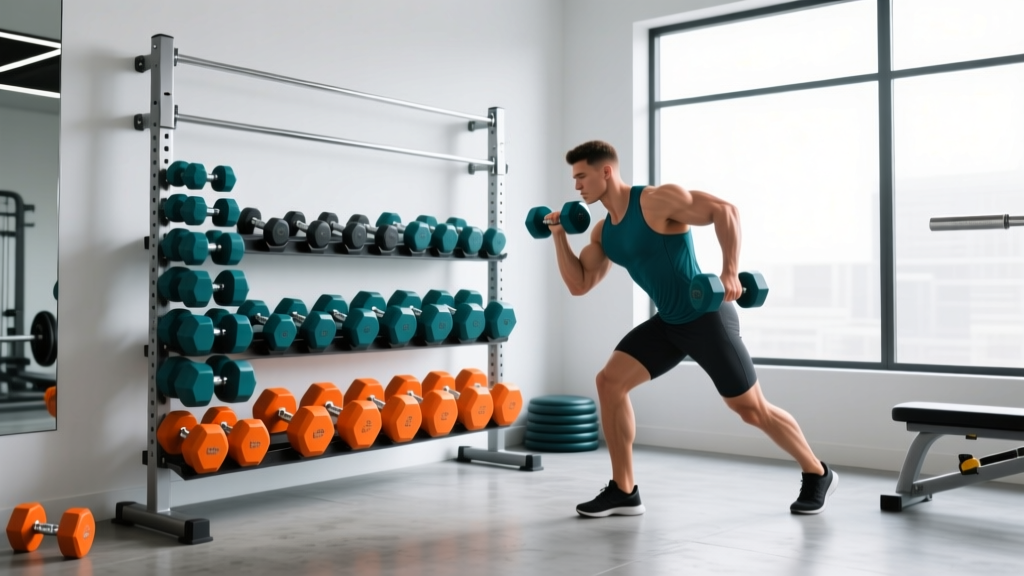
How to Build Lats With Dumbbells: Space-Saving Rack Layouts

EZ Curl Bar vs Straight Bar: Curls & Shoulder Shrug Dumbbells

Power Rack vs Squat Stand: Bench Dumbbell Workout Routine Setups
