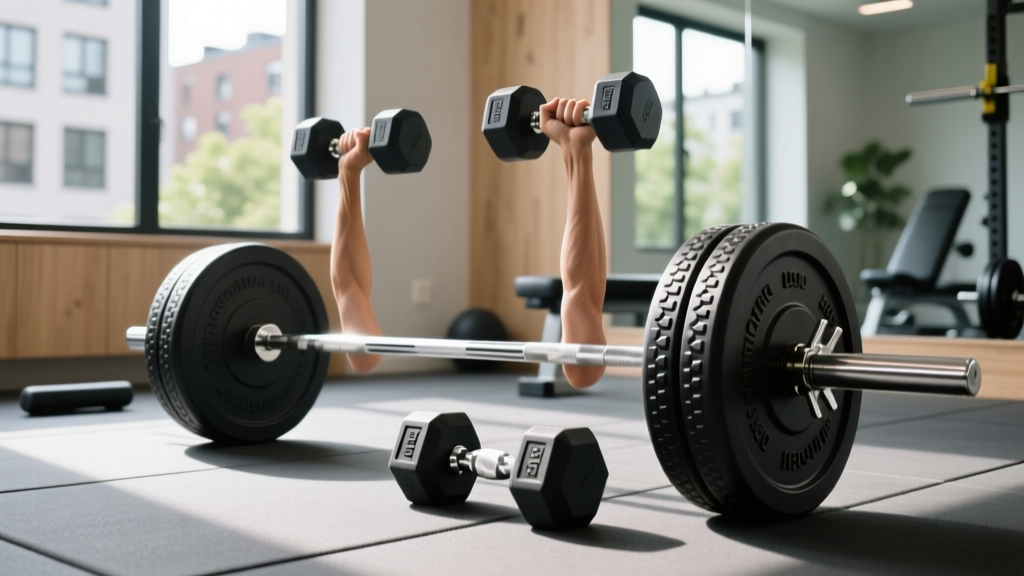
Barbell Knurling Guide & Dumbbell Bicep Curl to Shoulder Press Setup
Master your 2026 gym setup: compare Olympic barbell knurling and weight specs, then test your rack with a dumbbell bicep curl to shoulder press.

The Anatomy of a Perfect Free Weight Station
Building a commercial-grade home gym in 2026 requires more than just bolting steel uprights to a concrete floor. The true hallmark of an elite lifting environment lies in the micro-details: the tactile feedback of your Olympic barbell's knurling, the precise weight tolerances of your plates, and the spatial ergonomics of your dumbbell storage. In this complete setup and installation walkthrough, we will decode the critical buying metrics for Olympic barbells and then physically validate your rack's footprint using a complex, multi-planar movement: the dumbbell bicep curl to shoulder press.
Setup Objective: To select an Olympic barbell tailored to your specific tensile strength and grip needs, install a 4-post power rack with integrated dumbbell storage, and verify spatial clearance and biomechanical flow using a compound dumbbell complex.Olympic Barbell Buying Guide: Weight, Tolerances, and Knurling
The barbell is the single most important piece of equipment in your arsenal. When shopping for an Olympic barbell, you must look past the brand name and scrutinize the metallurgy and machining. According to comprehensive equipment analyses from BarBend's Barbell Knurling Guide, the knurl pattern dictates not just your grip security, but the long-term health of your calluses and central nervous system fatigue during high-volume blocks.
Decoding Knurl Profiles
Manufacturers use CNC machines to cut knurling into the steel shaft. The depth and shape of these cuts fall into three primary categories:
- Mountain Knurl: Sharp, jagged peaks that offer aggressive bite. Ideal for heavy, low-rep powerlifting deadlifts, but known to tear the hands during high-volume Olympic lifting or accessory work. Often found on older, traditional power bars.
- Volcano Knurl: The gold standard for modern powerlifting and multipurpose bars (e.g., the Rogue Ohio Power Bar). The machine cuts the peak off the mountain, creating a rim with a crater-like center. This provides maximum surface area contact for grip without the sharp tearing of a mountain knurl.
- Hill Knurl: Shallow, rounded grooves that feel smooth but secure when chalked. Mandatory for Olympic weightlifting, where the barbell must rotate rapidly in the hook grip and make contact with the clavicle during the clean.
Weight Tolerances and Tensile Strength
In 2026, top-tier manufacturers guarantee weight tolerances of ±10 grams (approx. 0.02 lbs) per 20kg barbell, aligning with strict International Weightlifting Federation (IWF) competition standards. Budget bars often carry a ±1% tolerance, meaning a 20kg bar could legally weigh 19.8kg or 20.2kg—a massive discrepancy for competitive lifters.
Furthermore, tensile strength (measured in PSI) dictates the bar's yield point. A quality multi-purpose bar should boast a minimum of 190,000 PSI, while elite power bars push past 215,000 PSI to prevent permanent deformation under heavy squat loads.
| Barbell Type | Shaft Diameter | Knurl Profile | Tensile Strength | Best Application |
|---|---|---|---|---|
| Olympic WL Bar | 28mm | Hill / Moderate Volcano | 190k - 200k PSI | Snatches, Cleans, Jerks |
| Powerlifting Bar | 29mm | Aggressive Volcano | 210k - 215k+ PSI | Squat, Bench, Deadlift |
| Multi-Purpose Bar | 28.5mm | Moderate Volcano | 190k - 205k PSI | General Fitness, CrossFit |
Complete Rack & Dumbbell Storage Installation Walkthrough
With your barbell selected, we move to the physical installation of the lifting station. For this walkthrough, we are utilizing a standard 4-post 3x3" upright power rack (such as the Titan T-3 or Rogue R-3 series) equipped with rear storage pegs for urethane hex dumbbells.
Step 1: Base Assembly and Upright Plumbness
Begin by assembling the base crossmembers on a level surface. Critical Edge Case: Garage concrete slabs often have a 1-2% grade for water runoff. If you bolt the rack directly into an unshimmed sloped floor, your uprights will lean, causing the safeties to sit unevenly and barbell collars to slide. Use stainless steel shims under the front base plates and verify plumbness with a 48-inch magnetic level before tightening the 5/8" hardware to 80 ft-lbs of torque.
Step 2: Integrating Dumbbell Storage Pegs
Install the dumbbell storage pegs on the rear uprights at a height of 36 inches from the platform surface. This specific height is biomechanically optimal; it allows you to hinge at the hips and retrieve heavy dumbbells without placing excessive shear force on the lumbar spine. Ensure the pegs are sleeved in UHMW plastic to protect the steel cores of your dumbbells from scratching.
Step 3: Platform Clearance and Matting
Lay down a 3/4-inch thick vulcanized rubber matting system. The mat must extend at least 24 inches beyond the front uprights to provide a stable landing zone for dropped weights and adequate standing room for accessory movements.
Spatial Validation: The Dumbbell Bicep Curl to Shoulder Press
Why test a brand-new barbell and rack setup with a dumbbell movement? The dumbbell bicep curl to shoulder press is the ultimate spatial and ergonomic stress test for your free weight zone. This compound flow requires vertical clearance, lateral stability, and tests the proximity of your dumbbell storage to your primary lifting platform. If your station is poorly laid out, this movement will immediately expose the flaws.
Biomechanical & Spatial Checklist:- Vertical Clearance: The transition from the curl peak to the overhead press lockout requires a minimum of 84 inches of clear vertical space. Verify that your rack's top crossmember or pull-up bar does not impede the dumbbell trajectory.
- Lateral Footprint: As you press overhead, the dumbbells will naturally drift slightly forward and outward. Ensure your barbell is racked safely behind you and that the j-cups are not protruding into your swing path.
- Retrieval Ergonomics: Pick up the dumbbells from the 36-inch storage pegs, step back two paces, and execute the set. If you have to navigate around a loaded barbell on the floor to get into position, your storage layout needs adjustment.
Executing the Test Movement
- The Retrieval: Hinge at the hips, grip a pair of 40lb urethane hex dumbbells from the rear pegs, and deadlift them to the waist. Step back exactly 36 inches from the rack uprights.
- The Curl Phase: Keep elbows pinned to your ribs. Supinate the wrists as you curl the weight up. This phase tests the floor grip of your vulcanized mats—your heels should not slip during the eccentric lowering phase.
- The Transition: At the top of the curl, rotate the wrists to a neutral or slightly pronated grip. This micro-adjustment requires spatial awareness to avoid clipping the uprights if you are standing too close.
- The Press Phase: Drive the dumbbells overhead to full lockout. Look straight ahead. If your ceiling height or rack pull-up bar forces you to press forward at an angle, the station is unsafe for overhead work.
Maintenance Protocols for 2026
A premium setup requires rigorous maintenance to preserve the knurling and urethane coatings. Sweat contains lactic acid and salts that will rapidly oxidize carbon steel shafts, even those with zinc or cerakote coatings.
After every session, use a stiff nylon brush (never wire, which damages the finish) to scrub chalk and dead skin out of the volcano knurl grooves. Follow up by wiping the shaft with a microfiber cloth lightly dampened with a 3-in-1 synthetic oil. For the dumbbells used in your bicep curl to shoulder press test, wipe down the urethane heads with a mild, non-abrasive antibacterial soap to prevent the rubber from drying out and cracking under UV exposure from garage windows.
By meticulously selecting your barbell's knurl profile, shimming your rack for absolute plumbness, and validating the spatial ergonomics with complex movements, you ensure your free weight station is not just a collection of steel, but a calibrated instrument for long-term strength development. For further reading on equipment specifications and biomechanics, consult the Rogue Fitness Barbell Catalog and the National Strength and Conditioning Association (NSCA) exercise libraries.
More gear to consider
All reviews
Olympic vs Standard Plates: Gear for a 1 Dumbbell Chest Workout

2026 Kettlebell Market: Beyond Walking Lunges With Dumbbells

Barbell Collar Comparison: Safe Setup for Heavy Lifts and Dumbbell Exercises
Power Rack vs Squat Stand for Your Women's Dumbbell Workout Plan

Space Layouts: Kettlebells & the Bent Over Single Arm Dumbbell Row
