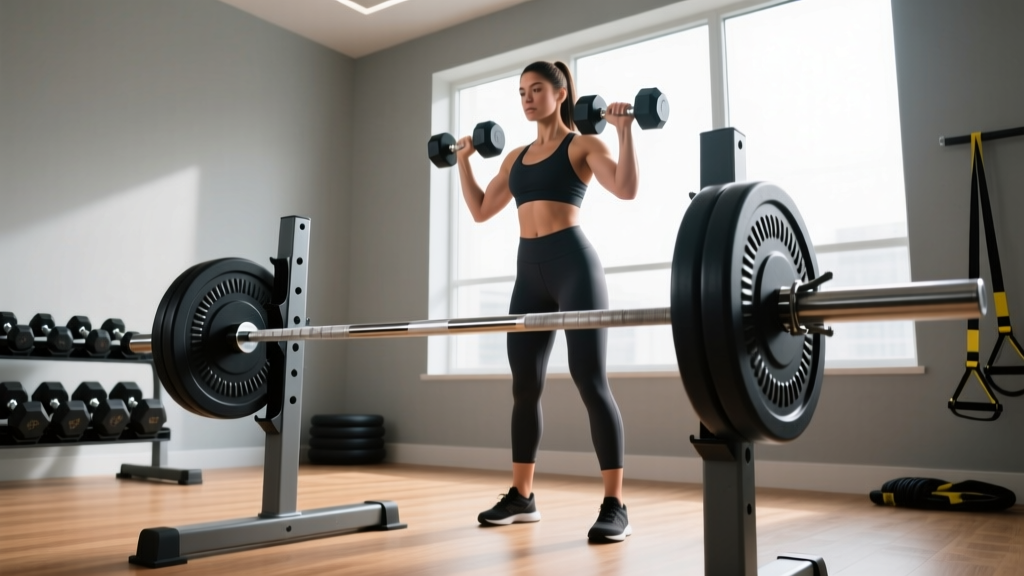
Barbell Collar Comparison for Total Body Dumbbell Exercises
Compare barbell collar and clamp types to secure heavy lifts and loadable handles for total body dumbbell exercises safely and efficiently in 2026.

The Hidden Bottleneck in Your Home Gym: Sleeve Space and Security
Most lifters spend upwards of $400 on a quality Olympic barbell and $600 on calibrated steel plates, only to secure their investment with a $12 pair of rusted spring clips. While this negligence might pass for a controlled bench press session, it becomes a catastrophic failure point when you transition to loadable dumbbell handles for total body dumbbell exercises. Whether you are executing heavy goblet squats, dumbbell thrusters, renegade rows, or walking lunges, the structural integrity of your collar dictates both your physical safety and your ability to progressively overload.
In 2026, the market is flooded with specialized clamping mechanisms, from aircraft-grade aluminum levers to glass-reinforced nylon snap-clamps. But which mechanism actually holds up to the violent off-axis torque generated during dynamic movements? This head-to-head comparison breaks down the exact metallurgy, clamping forces, and failure modes of modern barbell collars, specifically analyzing their viability for both traditional barbell lifts and high-demand total body dumbbell exercises.
The Biomechanics of Off-Center Loads
When performing total body dumbbell exercises like single-arm snatches or walking lunges using Olympic loadable handles, the implement is subjected to severe off-axis torque. Unlike a barbell resting on a rack, a dumbbell is frequently dropped, twisted, and swung. According to equipment safety guidelines discussed by the National Strength and Conditioning Association, uneven loading or shifting plates alter the moment arm of the implement, exponentially increasing shear force on the wrist and shoulder joints. If a collar slips even a quarter-inch during a dumbbell thruster, the sudden shift in the center of mass can result in a severe rotator cuff strain.
Furthermore, the International Weightlifting Federation mandates specific collar weights (exactly 2.5 kg for competition) and secure locking mechanisms to prevent plate dispersion during the violent extension of the snatch or clean. While home gym owners do not need to adhere to IWF weight tolerances, the underlying physics remain identical: your clamping mechanism must resist both lateral sliding and rotational spinning.
Head-to-Head: Barbell Clamp Mechanisms Compared
To understand which collar fits your training style, we must evaluate the four dominant clamping mechanisms on the market. Below is a comprehensive breakdown of their engineering, pricing, and real-world failure modes.
| Collar Type | Primary Material | Avg Clamping Force | Sleeve Footprint | Best Use Case | 2026 Price Range |
|---|---|---|---|---|---|
| Spring Clips | Galvanized Spring Steel | ~40 lbs | 0.5 inches | Light loadable dumbbells, accessory work | $12 - $18 |
| Lever Clamps | 6061 Aluminum / Nylon | ~150 lbs | 2.375 inches | Heavy barbell squats, deadlifts, presses | $30 - $45 |
| Snap-Clamps | Glass-Reinforced Nylon | ~120 lbs | 1.75 inches | CrossFit, dynamic total body dumbbell exercises | $35 - $50 |
| Spin-Lock / Threaded | Cast Iron / Steel | Variable | 1.5 inches | Standard 1-inch handles (Obsolete for Olympic) | $10 - $20 |
1. Spring Clips (The Budget Compromise)
Spring clips rely on the inherent tension of bent steel. While they boast an incredibly slim profile (taking up only 0.5 inches of sleeve space), their failure mode is inevitable: metal fatigue. After roughly 500 rep cycles of being squeezed and released, the steel yields, and clamping force can drop by up to 20%. They are acceptable for light isolation work but are highly dangerous for heavy, dynamic total body dumbbell exercises where the implement is dropped onto rubber flooring.
2. Lever Clamps (The Powerlifting Standard)
Models like the Rogue HG 2.0 utilize a cam-lever system lined with a high-friction nylon insert. According to product engineering specs from Rogue Fitness, these collars deliver massive clamping force, effectively welding the plates to the sleeve. However, their 2.375-inch width makes them virtually useless for loadable dumbbell handles, as they consume nearly half the available sleeve space. Furthermore, if you drop a barbell directly onto the lever arm during a failed lift, the aluminum housing can bend or snap.
3. Snap-Clamps (The Hybrid Solution)
Snap-clamps (popularized by brands like Lock-Jawz) use a dual-tooth mechanism that bites into the steel sleeve. They offer a brilliant middle ground: high clamping force with a much slimmer profile than lever clamps. The primary edge case and failure mode for snap-clamps is temperature sensitivity. In unheated garage gyms where temperatures drop below 40°F, the glass-reinforced nylon housing becomes brittle and is prone to cracking upon impact with the floor.
The Sleeve Space Dilemma: Barbells vs. Loadable Dumbbells
The primary reason lifters struggle with total body dumbbell exercises using Olympic loadable handles (such as the Titan Fitness or Rogue loadable handles) is a fundamental misunderstanding of sleeve geometry. A standard Olympic barbell features a 16.3-inch sleeve. A loadable dumbbell handle typically features a sleeve length of just 6.5 to 8 inches.
⚠️ The Math of Sleeve Real Estate:If you use a standard 2.4-inch lever collar on a 6.5-inch dumbbell sleeve, the collar consumes 2.4 inches. Add the 1-inch inner lip of the handle, and you are left with only 3.1 inches of usable space for weight plates. This severely limits your ability to load heavy bumpers for exercises like dumbbell sumo deadlifts or heavy goblet squats. Solution: You must use ultra-compact spring clips or specialized 1.75-inch dumbbell snap-clamps to maximize plate capacity.
2026 Buyer’s Matrix: Matching the Collar to the Movement
To optimize your home gym, you should not rely on a single pair of collars. Based on current training methodologies, here is the practical decision framework for outfitting your equipment:
- For Heavy Barbell Compounds (Squats, Deadlifts, Bench): Invest in 6061 Aluminum Lever Clamps. The massive clamping force prevents plate rattle and protects your barbell bearings from uneven shock loads.
- For High-Rep CrossFit & MetCons: Use Snap-Clamps. They can be applied and removed in under two seconds, saving crucial time during AMRAP workouts, while providing sufficient grip for kettlebell-style swings and cleans.
- For Total Body Dumbbell Exercises (Loadable Handles): Purchase specialized compact dumbbell collars or heavy-duty 1-inch spring clips. The reduced footprint allows you to load up to 45lbs of plates per side on standard loadable handles, enabling true progressive overload for lunges, thrusters, and renegade rows.
Expert Troubleshooting and Maintenance
"A collar is only as effective as the sleeve it grips. If you are experiencing slippage during total body dumbbell exercises, the fault often lies with the barbell or dumbbell handle, not the clamp."
Over time, Olympic sleeves accumulate chalk, sweat, and oxidized zinc, creating a slick surface that defeats even the most aggressive nylon inserts. To maintain maximum clamping force, wipe down your sleeves with a nylon-bristle brush and a light application of 3-in-1 oil once a month. Avoid using WD-40, as it leaves a residue that degrades the nylon and rubber components of lever and snap-clamps.
Additionally, inspect the teeth of your snap-clamps and the nylon inserts of your lever clamps every six months. If the insert shows deep grooves or the plastic teeth are rounded off, the clamping force has been compromised. Replacing a $35 pair of collars is infinitely cheaper than treating a torn rotator cuff caused by a shifting plate during a heavy dumbbell snatch.
Final Verdict
Securing your weights is not an afterthought; it is the critical link between your effort and the implement. For traditional barbell work, lever clamps remain the undisputed king of security. However, to truly unlock the potential of loadable handles for total body dumbbell exercises, you must prioritize sleeve space and off-axis torque resistance by utilizing compact snap-clamps or heavy-duty steel springs. Equip your gym with the right tools for the specific biomechanical demands of your training, and lift with absolute confidence.
More gear to consider
All reviews
Rack Mistakes: Power Rack vs Squat Stand & Lateral Squat Dumbbell Fit
Best Adjustable Dumbbells for the Narrow Dumbbell Press: 2026 Review

Dumbbell Y Raise Mistakes: Troubleshooting Neoprene Sets
EZ Curl vs Straight Bar Care & 1 1 2 Dumbbell Bench Press

Compact Gym Layouts: Loadable Dumbbells for the Dumbbell SLDL