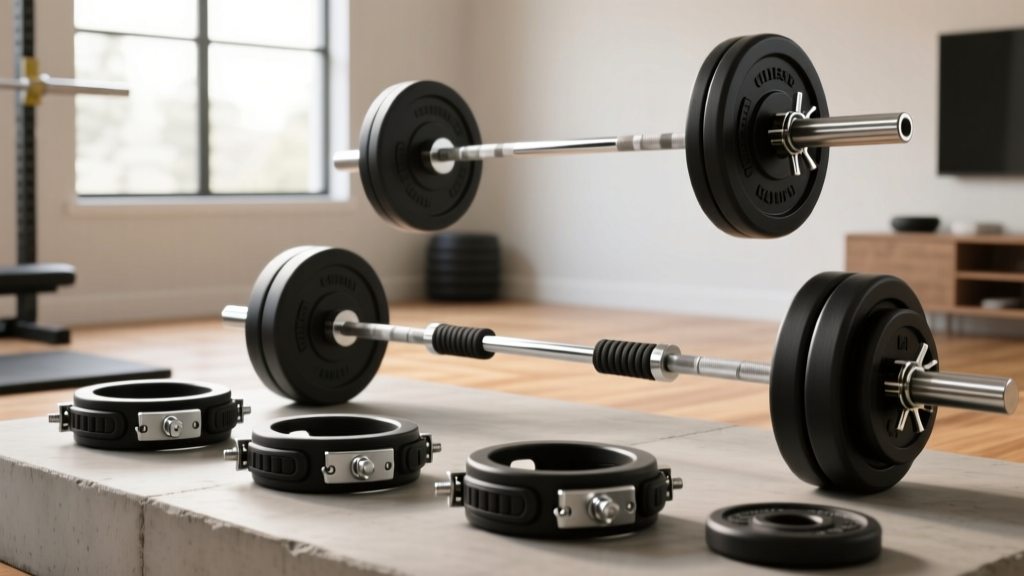
Barbell Collar Types: Securing Squats & Reverse Lunge Dumbbells
Compare barbell collar and clamp types for 2026. Learn which locks secure heavy squats and loadable reverse lunge dumbbells best with our in-depth matrix.

The Critical Role of Collars in Unilateral and Bilateral Lifts
In the hierarchy of gym equipment, barbell collars are often treated as an afterthought. Yet, as we move through 2026, the evolution of loadable implements and dynamic lifting techniques has made secure weight retention a paramount safety concern. Whether you are grinding through heavy bilateral squats or constructing specialized implements for unilateral movements, the collar you choose dictates the safety and mechanical integrity of your lift. A failing collar does not just result in a loud crash; it alters the biomechanics of the lift mid-rep, introducing dangerous asymmetrical loads to the spine and joints.
⚠️ Safety Warning: Never rely on standard spring collars for dynamic movements, drop sets, or Olympic lifts. The fatigue limit of standard steel springs degrades rapidly after 6 to 12 months of heavy use, leading to catastrophic plate shifts under axial load.The Physics of Plate Shift and Rotational Inertia
When weight plates shift on a barbell sleeve, they alter the system's center of mass. According to principles detailed in the ExRx Kinesiology Directory, even a minor lateral shift of a 45-pound plate changes the moment arm, forcing the lifter's stabilizing muscles to compensate instantaneously. During bilateral lifts like the deadlift, this causes a subtle but dangerous spinal twist. However, the implications are far more severe during unilateral exercises. When the load shifts unexpectedly, the asymmetrical torque can overwhelm the connective tissues of the wrist, elbow, and shoulder before the central nervous system can react to drop the weight.
Barbell Collar and Clamp Types Comparison Matrix
To help you navigate the 2026 market, we have broken down the primary collar mechanisms by their material composition, clamping force, sleeve footprint, and ideal use cases.
| Collar Type | Primary Material | Est. Clamping Force | Sleeve Space Used | Best Application |
|---|---|---|---|---|
| Spring Collar | Chrome Steel | Low (~50 lbs) | 0.5 inches | Light isolation, pressing |
| Clamp-Style | Aircraft Aluminum | High (~600+ lbs) | 2.0 - 2.5 inches | Heavy squats, deadlifts |
| Lever / Lock-Jaw | Glass-Filled Nylon | Medium-High (~400 lbs) | 1.0 - 1.5 inches | Olympic lifts, dumbbells |
| Competition | Steel / Rubber | Maximum (IWF Spec) | 2.16 inches (55mm) | Sanctioned meets |
Deep Dive: Top Collar Mechanisms Analyzed
Spring Collars (The Outdated Standard)
While still included in budget home gym packages, traditional spring collars are fundamentally flawed for heavy loading. They rely on the radial tension of coiled steel. Over time, the metal experiences fatigue, and the tension drops below the threshold required to overcome the kinetic energy of sliding iron plates. Furthermore, they struggle to grip knurled or cerakote-coated barbell sleeves, often spinning freely during rotational movements like the snatch or clean.
Clamp-Style Collars (The Workhorse)
Clamp collars, such as the highly rated Rogue Monster Clamps (retailing around $38 per pair), utilize a threaded torque mechanism to squeeze an aluminum housing around the 50mm Olympic sleeve. These provide immense clamping force and will not slip, even when a barbell is dropped from overhead. However, their primary drawback is their footprint. Consuming over two inches of sleeve space, they limit the amount of weight you can load on shorter bars or specialty implements.
Lock-Jaw and Lever Collars (The Heavy Lifters)
Constructed from high-tensile glass-filled nylon, lever collars like the Lock-Jaw Pro 2 offer a brilliant compromise between clamping force and speed of use. By flipping a heavy-duty lever, an internal cam mechanism pulls the collar tight against the sleeve. They typically cost around $35 per pair, take up only about 1.25 inches of sleeve space, and can be removed in a fraction of a second, making them ideal for drop sets and high-volume hypertrophy work.
Competition Collars (The Sanctioned Standard)
For competitive weightlifters, the International Weightlifting Federation (IWF) mandates specific collar specifications. Competition collars must weigh exactly 2.5 kilograms each and feature a 55mm width. Brands like Eleiko and Uesaka produce these to exact tolerances, ensuring that the collar itself acts as a calibrated weight plate while providing an immovable lock via a specialized wrench-tightened screw mechanism. Expect to pay upwards of $115 for a certified pair.
Securing Loadable Handles for Reverse Lunge Dumbbells
The limitations of bulky clamp collars become glaringly obvious when athletes transition to unilateral training. When constructing heavy reverse lunge dumbbells using loadable Olympic handles (such as the 10-inch or 12-inch sleeve models from Titan Fitness or Rogue), sleeve real estate is incredibly precious. If you use a 2.5-inch wide aluminum clamp collar on a 10-inch sleeve, you lose 50% of your loading capacity per side, severely capping the progressive overload potential of the exercise.
'The biomechanical demand of a heavy reverse lunge requires absolute implement stability. A shifting plate during the deceleration phase of the lunge introduces a lateral shear force that the rotator cuff and wrist flexors are not primed to absorb.'
For reverse lunge dumbbells, low-profile lever collars or specialized dumbbell spin-lock collars are mandatory. The dynamic nature of stepping backward and decelerating into the lunge creates significant axial vibration. If a standard spring collar is used, this vibration will rattle the collar loose within three to four repetitions. By utilizing a 1-inch wide nylon lever collar, you secure the plates against the rotational shear of the lunge while preserving enough sleeve length to load four to five 10-pound fractional plates, allowing for precise micro-loading as your unilateral strength progresses.
Maintenance and Failure Modes: What to Watch For
Even the most expensive collars will fail if not maintained. Here are the most common failure modes observed in commercial and home gyms:
- Knurling Dust Accumulation: Clamp-style collars with internal threads or friction pads will collect zinc and steel dust from the barbell knurling. This creates a gritty paste that reduces clamping friction. Wipe the interior of your clamps with a dry microfiber cloth monthly.
- Nylon Insert Deformation: Lever collars rely on a nylon or rubber inner gasket to grip the steel sleeve. If left clamped onto the barbell for weeks at a time, the gasket takes a 'set' and loses its elastic rebound, leading to slippage. Always release the lever when storing the equipment.
- Thread Stripping: Overtightening aluminum clamp collars with excessive torque can strip the internal threads, especially on budget models. Tighten only until the collar is hand-tight and immovable; do not use leverage tools to crank the handle.
Final Verdict and Buying Framework
Selecting the right collar requires matching the tool to the specific mechanical demands of your training split. Use the following decision framework to finalize your purchase:
- For Powerlifting and Heavy Bilateral Lifts: Invest in aircraft aluminum clamp collars. The bulkier footprint is irrelevant on a standard 7-foot Olympic barbell, and the unmatched clamping force ensures safety during heavy eccentric squats and deadlifts.
- For Olympic Weightlifting and CrossFit: Choose glass-filled nylon lever collars. The quick-release mechanism is vital for fast barbell transitions, and the secure grip withstands the high-impact drops of the snatch and clean and jerk.
- For Unilateral Work and Loadable Implements: When building reverse lunge dumbbells or using short tricep bars, prioritize low-profile lever collars or specialized spin-locks to maximize sleeve space while maintaining a secure grip against dynamic rotational forces.
Ultimately, treating your barbell collars as critical safety equipment rather than mere accessories will protect your joints, preserve your equipment, and ensure that the biomechanics of every lift remain exactly as intended.
More gear to consider
All reviews
EZ Bar vs Straight Bar: The 2026 Alternative Dumbbell Press Trend

Compact Gym: EZ vs Straight Bar & Workout Pecs with Dumbbells

Best Racks to Store Heavy Overhead Extension Dumbbells (2026)

Best Dumbbell Racks for Flat Bench Dumbbell Fly Setups (2026)
Rubber Hex vs Urethane: Maintenance When You Lunge with Dumbbells
