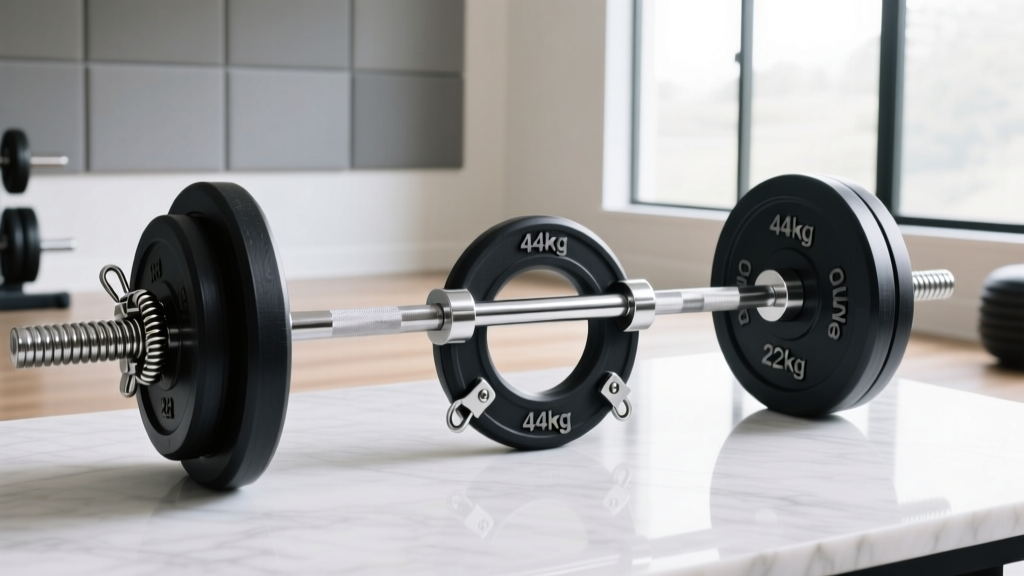
Barbell Collar Types Compared: Safety for 44kg Dumbbells & Bars
Compare spring clips, locking collars, and clamp-downs. Learn which barbell collar types secure heavy plates and loadable 44kg dumbbells safely.

The Physics of Heavy Lifting: Why Clamp Selection Matters
When you are loading up a barbell for a heavy squat or deadlift, the last thing on your mind should be your plates sliding off the sleeve. However, equipment security is not just about gravity; it is about rotational inertia and bar whip. As you transition from intermediate to elite lifting—eventually pressing massive 44kg dumbbells or squatting upwards of 200kg—the kinetic energy transferred through the barbell sleeve can easily overcome weak clamping mechanisms.
In this head-to-head product comparison, we break down the three primary barbell collar and clamp types. We will also address a critical, often-overlooked home gym scenario: securing loadable dumbbell handles to safely replicate commercial-grade 44kg dumbbells without risking catastrophic mid-rep plate shift.
Head-to-Head: The Big Three Collar Categories
Not all collars are created equal. According to BarBend's extensive barbell collar testing, the market is dominated by three distinct designs, each with specific failure points and ideal use cases.
1. Spring Clips (The Gym Standard)
Spring clips are the ubiquitous wire rings found in almost every commercial gym. They rely on the tension of the steel wire to grip the barbell sleeve.
- Clamping Force: Low (approx. 15-25 lbs of axial pressure).
- Best For: Olympic weightlifting (snatch/clean and jerk) where quick loading is paramount and the bar is dropped vertically, minimizing lateral plate shift.
- Failure Mode: Metal fatigue. Over time, the wire loses its temper and tension, resulting in a loose fit that allows plates to rattle and shift during heavy, slow grinds like squats.
- Cost: $5 - $12 per pair.
2. Clamp-Down and Jaw Collars (The Heavy Lifters)
These collars use a mechanical advantage—usually a lever or a screw—to force a hard plastic or aluminum jaw against the sleeve. The Rogue Fitness HG 2.0 Collars are a prime example of this category, utilizing a glass-reinforced nylon resin for extreme durability.
- Clamping Force: High (100+ lbs of axial pressure).
- Best For: Powerlifting, heavy squats, deadlifts, and bench presses where bar whip and rotational torque are highest.
- Failure Mode: Plastic degradation on cheaper knock-offs. High-end models like Rogue or Lock-Jawz Pro rarely fail mechanically but can scratch chrome sleeves if debris gets trapped in the jaw.
- Cost: $25 - $40 per pair.
3. Lever-Lock and Competition Collars (The Elite Choice)
Designed for sanctioned meets, these collars use a precision-machined aluminum body and a locking lever mechanism that clamps a steel inner ring against the bar. Eleiko's IWF-approved competition collars represent the gold standard here.
- Clamping Force: Maximum (Engineered to hold 25kg+ bumper plates securely during violent overhead drops).
- Best For: Competitive weightlifting, calibrated steel plate usage, and lifters who demand zero sleeve abrasion.
- Failure Mode: User error. If the lever is not fully engaged and locked, the collar can pop open under extreme vibration.
- Cost: $75 - $120+ per pair.
Comparison Matrix: Clamping Force & Application
| Collar Type | Est. Clamping Force | Weight per Collar | Avg. Price Range | Ideal Use Case |
|---|---|---|---|---|
| Spring Clip | 15 - 25 lbs | 0.2 lbs | $5 - $12 | Oly lifting, light accessories |
| Clamp-Down (e.g., HG 2.0) | 100 - 150 lbs | 0.6 lbs | $25 - $40 | Powerlifting, heavy compounds |
| Jaw-Lock (e.g., Lock-Jawz) | 80 - 120 lbs | 0.5 lbs | $30 - $45 | General heavy lifting, CrossFit |
| Competition Lever-Lock | 200+ lbs | 2.5 kg (5.5 lbs) | $85 - $150 | Sanctioned meets, calibrated plates |
The Loadable Dumbbell Dilemma: Securing 44kg Dumbbells
One of the most complex equipment challenges in modern home gyms involves heavy dumbbell training. Commercial gyms typically cap their dumbbell racks at 40kg to 50kg. However, purchasing a full set of heavy fixed dumbbells is prohibitively expensive and space-consuming. The solution? Loadable dumbbell handles (like the Rogue Loadable Dumbbell Handles or Titan T1 handles).
When you load these handles with fractional and standard plates to create 44kg dumbbells (approx. 97 lbs per hand), you run into a severe clamping problem. Loadable dumbbell sleeves are short—often only 6 to 8 inches long—and lack the deep knurling or grooves found on Olympic barbell sleeves.
⚠️ CRITICAL SAFETY WARNING: Never use standard spring clips on loadable dumbbell handles when building 44kg dumbbells. The short sleeve length and smooth steel finish provide almost zero friction. If a plate shifts outward during a heavy dumbbell bench press or row, the center of mass instantly changes, creating extreme rotational torque that can severely tear a rotator cuff or fracture a wrist.The Solution for 44kg Dumbbells: You must use low-profile clamp-down collars or specialized micro-collars. Models like the Lock-Jawz Pro Dumbbell Collars or Rogue HG 2.0 are essential here. They provide the necessary 100+ lbs of clamping force to bite into the smooth steel sleeve, ensuring the plates act as a single, solid unit even when the dumbbell is tilted at extreme angles during isolation movements.
Real-World Failure Modes: When Collars Slip
Understanding why collars fail requires looking at the intersection of metallurgy and biomechanics. Here are the primary failure modes observed in the gym:
- Rotational Inertia on Deadlifts: As the barbell leaves the floor, the plates want to stay still. If the collar lacks radial grip, the sleeve spins inside the collar, slowly inching the collar outward until the plates are loose.
- Bar Whip on Squats: A 29mm power bar or 28mm Olympic bar bends significantly under heavy loads. This bending creates a whipping effect that violently shakes the sleeves. Weak spring clips will literally vibrate off the sleeve over the course of a 5-rep max set.
- Thermal Expansion: In unheated garage gyms, steel sleeves contract in the winter. A clamp-down collar that was tight in the summer may feel slightly loose in freezing temperatures, requiring a secondary re-tightening before heavy sets.
Quick Decision Framework
Use this framework to purchase the right collar for your specific training style:
- Choose Spring Clips IF: You exclusively do Olympic weightlifting, drop your bar from overhead, and prioritize loading speed over absolute rigidity.
- Choose Clamp-Down Collars IF: You are a powerlifter, bodybuilder, or home gym owner utilizing loadable handles to build heavy 44kg dumbbells. The Rogue HG 2.0 is the undisputed value champion here.
- Choose Competition Lever-Locks IF: You are outfitting a commercial facility, hosting sanctioned meets, or using expensive calibrated steel plates that you want to protect from jaw-scraping.
Frequently Asked Questions
Do heavier collars affect the weight of my lift?
Yes, but usually negligibly. Standard clamp-down collars weigh about 0.5 to 0.6 lbs each, meaning you add roughly 1 lb to your total barbell load. However, competition lever-lock collars weigh exactly 2.5 kg (5.5 lbs) each. In sanctioned powerlifting and weightlifting, the weight of the collars is included in the official total.
Can I use barbell collars on EZ-curl bars or fixed-grip dumbbells?
Most standard 2-inch Olympic collars will not fit the tapered or uniquely shaped sleeves of EZ-curl bars. For specialized bars and loadable dumbbell handles meant to mimic 44kg dumbbells, you must look for collars with flexible inner resin bands or specifically marketed 'dumbbell collars' that can grip varying diameters.
How often should I replace my barbell collars?
Spring clips should be replaced every 6 to 12 months in a busy gym environment due to metal fatigue. High-quality clamp-down collars (like Rogue or Lock-Jawz) can easily last 5 to 10 years. Inspect the inner rubber or resin lining annually; once the lining compresses and loses its elasticity, the clamping force drops significantly.
More gear to consider
All reviews
Free Weights vs Dumbbells: Bumper Plate vs Iron Plate Guide
Dumbbell Man Maker Setup: 2026 Adjustable Dumbbell Comparison

Olympic Barbell Guide: Knurling & Lean In Dumbbell Lateral Raise
Budget Dumbbell Racks for the One Arm Row with Dumbbells (2026)

Collar Types Compared: Safe Dumbbell Skull Crushers Workout
