Barbell Collar Types Compared: Slippage & 12.5 lb Dumbbell Hacks
Compare barbell collar clamp types to stop slippage. Troubleshoot sleeve space limits and learn why the 12.5 lb dumbbell sleeve hack is a dangerous mistake.

The Hidden Physics of Barbell Sleeve Slippage
When building a home gym or upgrading commercial equipment, lifters obsess over barbell shaft steel, bushing types, and knurling aggressiveness. Yet, the most critical safety component—the barbell collar—is often an afterthought. A failing collar does not just mean a noisy plate shift; it means catastrophic weight displacement mid-lift, altered barbell kinematics, and severe injury risk. According to weight room safety guidelines outlined by the National Strength and Conditioning Association (NSCA), regular inspection and proper use of locking mechanisms are foundational to facility safety.
As we evaluate equipment in 2026, the market is flooded with cam-lever clamps, pro-lock collars, and traditional spring clips. But choosing the right collar requires understanding sleeve real estate, material deformation under load, and the physics of rotational torque. This troubleshooting guide breaks down collar types, solves common slippage issues, and exposes dangerous garage gym loading errors.
⚠️ Troubleshooting Warning: Never use makeshift implements on a barbell sleeve without a calibrated, high-friction locking mechanism. The rotational torque of offset loads can cause catastrophic collar failure, leading to severe crush injuries.Barbell Collar and Clamp Types: 2026 Comparison Matrix
Not all collars are created equal. The clamping force, material composition, and sleeve footprint vary wildly. Below is a data-driven comparison of the primary collar categories available on the market today.
| Collar Type | Model Example | Approx. Cost | Sleeve Space Used | Max Safe Drop Load |
|---|---|---|---|---|
| Spring Clip | Generic Chrome Spring | $12 / pair | 0.5 inches | 150 lbs (High Risk) |
| Cam-Lever Clamp | Lock-Jaw Pro | $35 / pair | 1.5 inches | 500+ lbs |
| Pro-Lock / HG | Rogue HG 2.0 | $42 / pair | 1.2 inches | 700+ lbs |
| Calibrated IWF | Eleiko Olympic (2.5kg) | $85 / pair | 2.5 inches | 1000+ lbs |
Troubleshooting Common Collar Mistakes
Even with premium equipment, user error leads to slippage and equipment damage. Here are the most frequent mistakes we troubleshoot in the field.
Mistake 1: The Dangerous 12.5 lb Dumbbell Sleeve Hack
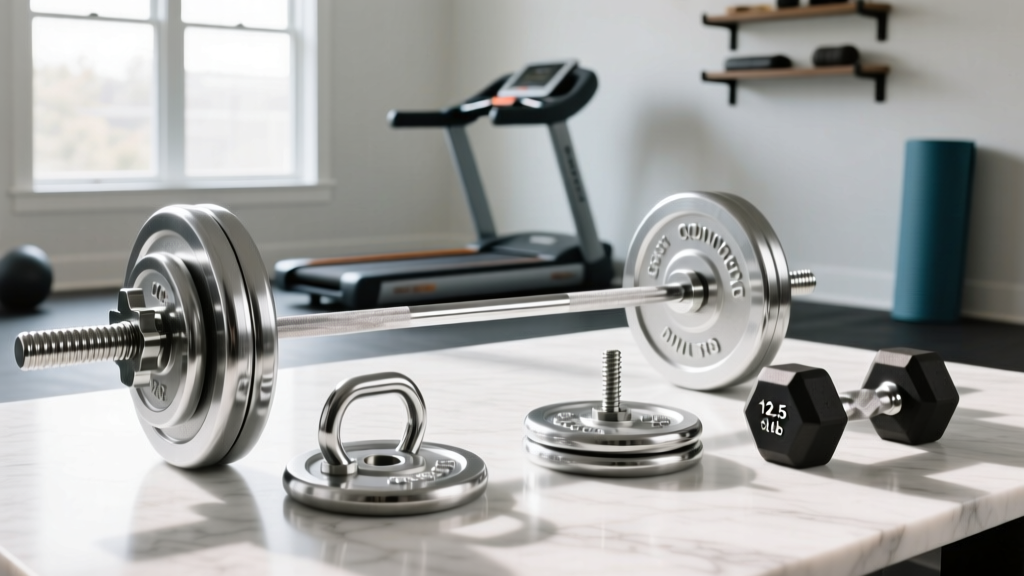
One of the most hazardous makeshift loading errors we see in garage gyms is the 'sleeve hack'—attempting to slide a cast-iron or rubber hex 12.5 lb dumbbell onto a barbell sleeve (often via a 2-inch landmine adapter) for heavy rotational work or unilateral offset loading. While a 12.5 lb dumbbell seems relatively light, its offset center of mass creates severe rotational torque on the sleeve.
The handle of a standard 12.5 lb dumbbell is smooth and lacks the raised inner lip of an Olympic bumper plate. When you apply a standard spring collar or a worn cam-lever clamp, the collar's padding grips the smooth steel, but there is no physical barrier preventing lateral movement. During a dynamic landmine twist, the twisting lever arm generated by the offset 12.5 lb dumbbell easily exceeds the static friction of the collar. The result? The collar spins open, and the dumbbell slides off the sleeve mid-rep, often crushing the lifter's foot or damaging the floor. Solution: Never load bare dumbbells onto a barbell sleeve. Use proper Olympic fractional plates or specialized odd-object sandbags with built-in 50mm sleeves.
Mistake 2: Ignoring Sleeve Real Estate Math
A standard Olympic barbell sleeve offers exactly 16.3 inches of loadable space. A standard 45 lb bumper plate is roughly 2.5 inches thick. If you load six 45 lb bumpers per side (270 lbs per side), you consume 15 inches of sleeve. This leaves only 1.3 inches of space. If you are using thick ABS plastic cam-lever clamps that require 1.5 inches of space, you literally cannot secure the barbell. Powerlifters and Strongman athletes frequently run into this edge case. Always calculate your sleeve real estate before purchasing bulky collars.
Mistake 3: Chalk Dust and the Dry Lubricant Effect
Lifters frequently complain that their premium collars are 'slipping' during heavy deadlift drops. The culprit is rarely the collar itself; it is chalk dust. Magnesium carbonate acts as a dry lubricant on smooth, zinc-plated barbell sleeves. When chalk builds up on the outer 2 inches of the sleeve, the TPU rubber lining of the collar loses its coefficient of friction. Troubleshooting Step: Wipe the sleeve with a damp microfiber cloth and a mild degreaser before every heavy session to restore the collar's bite.
Material Science: Why Cheap ABS Plastic Fails
The market is saturated with $15 cam-lever clamps made from standard ABS plastic. While these are fine for light bench pressing, they are a liability for Olympic weightlifting or high-volume CrossFit drop sets. When a barbell is dropped from overhead, the kinetic energy transfers through the plates and into the collar. Standard ABS plastic undergoes micro-fracturing and deformation under repeated impacts exceeding 400 lbs.
In contrast, premium collars like the Lock-Jaw Pro or Rogue HG 2.0 utilize glass-filled nylon resin. The addition of glass fibers dramatically increases the tensile strength and impact resistance of the polymer, allowing the collar to maintain its clamping geometry even after thousands of drops. As noted in BarBend's extensive testing on barbell collars, the material composition of the clamp body is the single highest predictor of long-term durability.
Step-by-Step: Securing Odd Loads and Micro-Plates
When working with fractional change plates (e.g., 0.5 lb or 1.25 lb plates) or odd implements, collar placement is critical. Follow this protocol to ensure maximum security:
- Seat the Plates Tightly: Tap the barbell on the ground vertically to ensure all plates, especially thin fractional plates, are flush against the inner sleeve lip.
- Clear the Chalk: Wipe the outer 2 inches of the sleeve completely clean.
- Position the Collar: Slide the collar on until the inner TPU ring makes firm contact with the outermost plate. Do not leave a gap.
- Engage the Lever at an Angle: When locking a cam-lever clamp, position the lever at a 45-degree angle pointing toward the floor before snapping it shut. This ensures gravity assists in keeping the lever closed during vertical barbell movements like snatches or cleans.
Expert Verdict & 2026 Buying Recommendations
Your barbell collar is the final fail-safe between a successful lift and a catastrophic equipment failure. For general powerlifting and home gym use, the Rogue HG 2.0 remains the gold standard in 2026, offering the perfect balance of low sleeve footprint (1.2 inches) and immense clamping force via its glass-filled nylon body. For Olympic weightlifters who require calibrated weights and absolute zero-slip security, the Eleiko Olympic Collars are a mandatory investment, despite their premium $85 price tag and bulky 2.5-inch footprint.
Avoid spring clips entirely for any dynamic movements, and never attempt to bypass proper loading mechanics with makeshift sleeve hacks. Respect the physics of the barbell, manage your sleeve space, and invest in high-friction, impact-resistant clamps to keep your training safe and effective.
More gear to consider
All reviews
What Size Dumbbells Should I Start With? Neoprene Home Pitfalls

Cast Iron vs Competition Kettlebell Care & Lat Pull Down with Dumbbells
Decathlon Dumbbells & Weights: Bumper vs Iron Plate Comparison

Power Rack vs Squat Rack for the Thomas Inch Dumbbell Weight

Maintaining Loadable Dumbbells for Your Best Chest Workout with Dumbbells