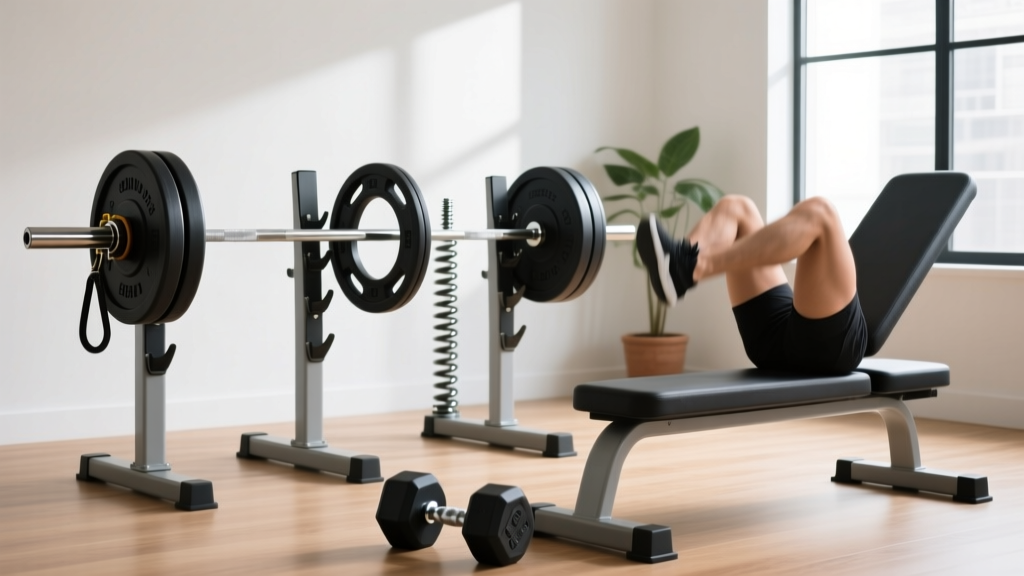
Barbell Collar Types Comparison & Dumbbell Seated Leg Extension Fixes
Troubleshoot lower-body free-weight setups with our barbell collar and clamp types comparison and common dumbbell seated leg extension mistakes.

The Hidden Dangers of Unsecured Loads and Isolation Errors
When building a comprehensive lower-body training program, lifters often hyper-focus on barbell squats and deadlifts while neglecting the nuanced safety and biomechanics of accessory movements and equipment security. Two of the most frequently mismanaged areas in the free-weight realm are barbell collar selection and the execution of isolation exercises like the dumbbell seated leg extension. Whether you are loading a barbell for heavy eccentrics or rigging a DIY quad-isolation setup, equipment failure and biomechanical compensation can lead to stalled progress or catastrophic injury.
In this 2026 troubleshooting guide, we bridge the gap between heavy load security and precise isolation mechanics. We will conduct a rigorous barbell collar and clamp types comparison to eliminate plate-shift risks, and then dissect the most common mistakes lifters make when performing the dumbbell seated leg extension, providing actionable, science-backed fixes for each.
Barbell Collar and Clamp Types Comparison: Securing the Load
The primary function of a barbell collar is not just to keep plates from falling off; it is to mitigate rotational inertia and barbell whip. During dynamic movements like the barbell hack squat or heavy Romanian deadlifts, the barbell flexes. If the collar lacks sufficient clamping force, the plates shift outward, altering the center of mass and placing asymmetric torque on your lumbar spine and knee joints.
According to safety guidelines published by the National Strength and Conditioning Association (NSCA), securing the barbell with appropriate, high-tension collars is a non-negotiable standard for all heavy free-weight lifting. Yet, many home gyms still rely on inadequate spring clips.
2026 Collar Comparison Matrix
| Collar Model | Material & Mechanism | Est. Clamping Force | Price Range (2026) | Best Use Case |
|---|---|---|---|---|
| Rogue HG 2.0 | Machined Aluminum, Stainless Steel Lever | ~350+ lbs | $42 - $48 | Heavy Olympic lifts, Drop sets, Powerlifting |
| Lock-Jaw PRO | Glass-Reinforced Nylon, Dual-Latch | ~150 lbs | $35 - $40 | General hypertrophy, Dumbbell/Barbell hybrid |
| Harbinger BioFit | Thermoplastic Elastomer, Ratchet Strap | ~90 lbs | $25 - $30 | Light isolation, Rehab, Travel |
| Standard Spring Clip | Low-Carbon Steel Wire | <20 lbs | $5 - $10 | Static holds only (Not recommended for dynamic) |
Spring clips lose their tensile strength after repeated stretching. If you are performing movements where the barbell tilts past 45 degrees (e.g., lunges, split squats), spring clips will slowly slide outward. Always upgrade to a lever or ratchet mechanism for any exercise involving a change in barbell elevation.
Common Collar Mistakes & Fixes
- Mistake: Forgetting to account for collar weight in Olympic lifting. Fix: Rogue HG 2.0 collars weigh roughly 0.5 lbs each. While negligible for a 400 lb deadlift, this matters when calculating exact kilo conversions for competitive weightlifting.
- Mistake: Placing the collar flush against the sleeve end, leaving a gap between the plate and the collar. Fix: Push all plates tightly against the inner sleeve lip, then clamp the collar flush against the outermost plate to eliminate micro-vibrations that cause loosening.
Troubleshooting the Dumbbell Seated Leg Extension
The dumbbell seated leg extension is a staple for lifters who lack access to a dedicated pin-loaded machine but need targeted rectus femoris and vastus lateralis stimulation. However, without the fixed path of a machine, the free-weight variant introduces severe stabilization demands and grip limitations.
Mistake 1: The 'Foot Pinch' Grip Failure
The most common method involves sitting on a bench and pinching a hex or rubber dumbbell between the feet. The critical failure point occurs at the top of the concentric phase (full knee extension). As the tibia becomes parallel to the floor, gravity pulls the dumbbell straight down. If the lifter's ankles are plantarflexed (toes pointed), the dumbbell slides off the metatarsals, often resulting in dropped weights on the toes or shins.
The Fix: You must maintain active ankle dorsiflexion (pulling the toes toward the shins) throughout the entire range of motion. This creates a physical 'shelf' with the top of the foot. For dumbbells exceeding 40 lbs, abandon the foot-pinch method entirely. Instead, use a neoprene ankle strap with a D-ring carabiner attached to a loading pin or a specialized adjustable ankle weight. This shifts the load from the small stabilizing muscles of the anterior tibialis directly to the knee joint's extension path.
Mistake 2: Rectus Femoris Active Insufficiency
The rectus femoris is unique among the quadriceps because it crosses both the knee and the hip joint. When you sit completely upright at a 90-degree hip angle, the rectus femoris is shortened at the hip, leading to 'active insufficiency'—it cannot generate maximal force at the knee. Lifters often mistakenly believe they are fully isolating the quads, but they are disproportionately overloading the vastus muscles while limiting overall quad development.
The Fix: To troubleshoot this biomechanical bottleneck, lean back slightly on the bench (increasing the hip angle to roughly 110-120 degrees). This stretches the rectus femoris at the hip, allowing it to contribute more effectively to the knee extension. You can achieve this by placing a few bumper plates behind your lower back or using an adjustable incline bench set to the first notch.
Mistake 3: The DIY Barbell Leg Extension Variant
Advanced lifters sometimes rig a heavier leg extension by threading an empty barbell through their feet while seated on a bench, loading the ends with plates. This is where our barbell collar and clamp types comparison becomes a matter of life and death. If you use inadequate collars on a DIY barbell leg extension, the plates can slide off the sleeves mid-rep, causing the bar to violently whip out of your feet and strike your face or torso.
The Fix: If you must use the DIY barbell method, only use high-tension lever collars (like the Rogue HG 2.0) and ensure the barbell is centered perfectly. However, the superior troubleshooting alternative is to use a landmine attachment with an ankle strap, which provides a safer, more controlled resistance curve for quad isolation.
Quick-Fix Troubleshooting Matrix
| Equipment / Exercise | Common Symptom | Root Cause | Immediate Troubleshooting Fix |
|---|---|---|---|
| Barbell Collars | Plates rattle and shift during eccentrics | Collar clamping force degraded; gap between plate and collar | Switch to glass-reinforced nylon or aluminum lever collars; eliminate sleeve gaps |
| Dumbbell Leg Extension | Dumbbell slips at peak contraction | Plantarflexion (pointed toes) removes the foot 'shelf' | Enforce active dorsiflexion; switch to ankle strap for loads >40 lbs |
| Dumbbell Leg Extension | Cramping in the hip flexors, weak knee lockout | Rectus femoris active insufficiency due to 90-degree hip angle | Lean back to 110 degrees; support lumbar spine with bumper plates |
| DIY Barbell Extension | Barbell tilts laterally mid-rep | Asymmetric plate loading or poor collar security | Use matched micro-plates for exact symmetry; mandate lever collars |
Expert Safety Standards & Final Thoughts
Whether you are analyzing the shear force of a barbell collar or the knee joint kinetics of a dumbbell seated leg extension, precision matters. The American Council on Exercise (ACE) consistently emphasizes that when free weights are used to replicate machine-based isolation movements, the lifter must account for the stabilization vectors that the machine would normally absorb.
Stop relying on fatigued spring clips for your heavy lower-body days, and stop letting ankle mobility dictate your quad isolation. Upgrade your clamping hardware, adjust your hip angles, and utilize ankle straps to ensure that the target muscle—not your grip or your equipment—is the limiting factor in your hypertrophy and strength gains.
More gear to consider
All reviews
Best Neoprene Dumbbells & Your 4-Week Dumbbell Exercise Schedule

Rubber Hex vs Urethane: 2026 Gear for Bicep and Back Dumbbell Workouts

Dumbbell Push Jerks to Barbells: Troubleshooting Weight & Knurling

EZ Curl Bar vs Straight Bar: Maintenance & Tricep Dumbbell Care
Neoprene Dumbbells for a Full Body Barbell and Dumbbell Workout Routine PDF
