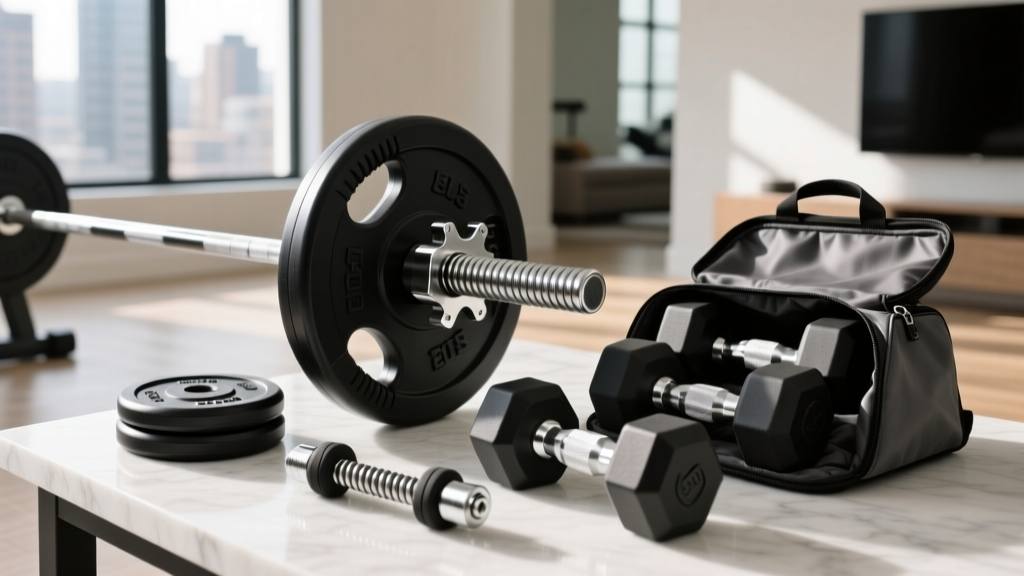
Barbell Collar and Clamp Types Comparison & Dumbbell Bag Guide
Compare barbell collar and clamp types for safety and barbell whip. Plus, learn how to pack your dumbbell bag for mobile gym setups and travel workouts.

The Biomechanics of Barbell Whip and Collar Tension
Securing weight plates to a barbell sleeve is not merely about preventing plates from sliding off; it is fundamentally about managing kinetic energy and barbell whip. When an athlete performs a heavy deadlift or a dynamic Olympic clean, a standard 20kg Olympic barbell can deflect upward of two inches. This elastic deformation causes the sleeves to rotate and vibrate, creating a lateral shearing force that pushes weight plates outward. According to biomechanical analyses by BarBend, an inadequate collar allows micro-movements of the plates, which alters the bar's center of mass mid-lift and drastically increases the risk of a catastrophic dump.
Whether you are outfitting a permanent garage gym or packing a mobile travel setup, selecting the right clamping mechanism is critical. In this comprehensive guide, we break down the exact specifications, holding forces, and real-world failure modes of the four primary barbell collar types. Furthermore, for athletes utilizing a mobile gym approach, we provide an expert framework for integrating these collars into your accessory storage alongside your dumbbell bag for seamless travel workouts.
Comprehensive Breakdown: Collar and Clamp Types
1. Billet Aluminum Collars (The Garage Gym Standard)
Machined from solid aerospace-grade aluminum, these collars utilize a dual-bolt or single-bolt clamping system paired with an internal rubber O-ring to grip the steel sleeve. The Rogue AH-1 Aluminum Collars are the benchmark in this category, retailing around $45 per pair in 2026.
- Weight: ~0.5 lbs per collar.
- Holding Force: Extreme. The metal-on-metal compression, mediated by the rubber O-ring, creates near-immovable friction.
- Best For: Heavy powerlifting, strongman training, and static garage gym setups where weight and storage size are not primary concerns.
- Drawback: They are bulky, heavy, and the anodized finish can scratch if dropped on concrete.
2. Polymer Snap Collars (The CrossFit & Olympic Lifting Choice)
Constructed from high-density thermoplastics (often nylon or glass-filled polypropylene), snap collars use an internal jaw mechanism with gripping teeth. Brands like Lock-Jaw and Proloc dominate this space, with prices ranging from $35 to $60. They are the official choice for competitive weightlifting because they can be applied or removed in under two seconds.
- Weight: ~0.25 lbs per collar.
- Holding Force: High. The internal teeth bite into the steel sleeve, resisting lateral shearing forces exceptionally well during high-impact drops.
- Best For: Olympic weightlifting, CrossFit WODs, and high-volume training where rapid loading is required.
- Drawback: The internal plastic teeth can wear down over years of heavy use, and chalk buildup in the jaw mechanism can cause the latch to fail to close completely.
3. Spring Clips (The Budget Commercial Gym Staple)
The ubiquitous chrome or plastic-coated spring clips rely on the tension of a heavy-gauge steel spring. While they cost a mere $8 to $15 per pair, they are fundamentally flawed for heavy or dynamic lifting.
- Weight: ~0.15 lbs per collar.
- Holding Force: Low to Moderate. They provide enough inward pressure to keep plates from sliding during a controlled bench press, but they fail completely under the vibrational whip of a heavy deadlift.
- Best For: Light accessory work, commercial gym environments where theft/damage is a concern, and beginners.
- Drawback: High risk of plate slippage during dynamic movements; difficult to squeeze for users with grip fatigue.
4. Spinlock and Screw-Down Clamps (The Traditionalist)
Threaded steel or plastic collars that screw down the sleeve. While common on standard 1-inch diameter bars, threaded Olympic collars (like those from Eleiko or York) exist for specialized deadlift bars or curl bars.
- Weight: Varies (1 lb to 5 lbs for heavy cast iron variants).
- Holding Force: Absolute. Once threaded tight, the plate cannot move.
- Best For: Threaded specialty bars, 1-inch standard home gym setups.
- Drawback: Incredibly slow to load and unload; incompatible with standard smooth Olympic barbell sleeves.
Data Matrix: Holding Force, Weight, and Drop Survival
| Collar Type | Avg. Price (2026) | Weight (Pair) | Drop Test Survival (Bumper Plates) | Application Speed |
|---|---|---|---|---|
| Billet Aluminum | $45 - $65 | 1.0 lb | Excellent (No shift) | Moderate (5-8 sec) |
| Polymer Snap | $35 - $60 | 0.5 lb | Excellent (Minimal shift) | Fast (1-2 sec) |
| Spring Clip | $8 - $15 | 0.3 lb | Poor (Plates slide) | Moderate (3-5 sec) |
| Spinlock/Screw | $15 - $40 | 2.0+ lbs | Excellent (Zero shift) | Slow (15-30 sec) |
The Mobile Gym: Integrating Collars with Your Dumbbell Bag
For athletes who travel, rent Airbnb gym spaces, or train in parks, the mobile gym is a necessity. A heavy-duty dumbbell bag—typically constructed from 600D Oxford cloth or reinforced neoprene—is designed to carry fixed hex dumbbells or adjustable handles. However, packing your barbell collars requires strategic spatial awareness.
Expert Packing Framework: The Dumbbell Bag Accessory Pouch
A standard 24-inch canvas dumbbell bag has a main compartment rated for 80-100 lbs of iron, flanked by two exterior zippered accessory pockets. Here is how to allocate your collar types based on your travel profile:
- The Minimalist Traveler: Pack Polymer Snap Collars in the exterior mesh pocket. They are lightweight (0.5 lbs total), flat, and will not tear the lining of your dumbbell bag if jostled during transit.
- The Heavy Lifter: If you must bring Billet Aluminum Collars, do not place them loose in the dumbbell bag's exterior pockets. The sharp metal edges and heavy density will wear through the canvas over time. Wrap them in a microfiber towel or store them in a dedicated neoprene sleeve inside the main compartment, wedged between the dumbbell heads to prevent shifting.
- The Park Workout: Leave the Spring Clips at home. Outdoor training requires maximum security against uneven terrain; snap collars are the only viable lightweight option to pair with your portable dumbbell bag setup.
Real-World Failure Modes and Edge Cases
Even the most expensive collars will fail if subjected to specific environmental and mechanical edge cases. As a domain expert, I have documented the following failure modes in garage and commercial gyms:
- Chalk Infiltration in Polymer Jaws: In high-humidity environments or heavy-chalk gyms, magnesium carbonate builds up in the gripping teeth of snap collars. This reduces the coefficient of friction, causing the collar to 'skate' off the sleeve during a heavy snatch. Fix: Use a stiff-bristled nylon brush and compressed air to clean the teeth monthly.
- O-Ring Compression Set: Aluminum collars rely on a rubber O-ring for grip. Over 3 to 5 years, the rubber experiences 'compression set'—it flattens out and loses its elasticity, resulting in a collar that spins freely on the bar. Fix: Replace the O-rings annually (usually a $5 fix) rather than buying new $50 collars.
- Sleeve Diameter Tolerances: Not all Olympic bars are created equal. While the IWF standard is 50mm, some budget commercial bars measure 49.5mm. Snap collars designed for tight 50mm tolerances may fail to latch securely on undersized sleeves, creating a severe safety hazard.
Expert Maintenance Protocols
To maximize the lifespan of your clamping equipment, implement a bi-annual maintenance routine. For aluminum collars, apply a single drop of silicone-based lubricant to the threading of the tightening bolt to prevent cross-threading and seizing. For polymer collars, inspect the hinge pin for micro-fractures. If you see stress whitening on the plastic near the hinge, the collar has reached its fatigue limit and must be retired immediately to prevent a mid-lift failure.
Frequently Asked Questions
Can I use barbell collars on dumbbell handles?
Standard Olympic barbell collars are designed for 50mm sleeves. Most Olympic dumbbell handles also feature 50mm sleeves, meaning aluminum and snap collars will fit. However, the short sleeve length on dumbbells often leaves insufficient room for bulky aluminum collars, making low-profile polymer snap collars the superior choice for dumbbell work.
Do I need collars if my plates have rubber grips?
Yes. While rubber-coated bumper plates have higher friction against the steel sleeve than bare cast iron, the kinetic energy generated by barbell whip during deadlifts or drops will easily overcome that friction. Always use a certified collar, regardless of the plate material.
What is the best collar to pack alongside my adjustable dumbbells?
If you are traveling with a pair of 50lb adjustable dumbbells inside a heavy-duty dumbbell bag, you likely won't need barbell collars unless you are also bringing a portable barbell. If you are bringing a portable 7-foot bar, pack lightweight polymer snap collars in the bag's side accessory pockets to save space and reduce overall carry weight.
More gear to consider
All reviews
Olympic vs Standard Plates: Fixing Dumbbell Bench Press Variations
How to Build Chest Using Dumbbells: Adjustable Gear & Mistakes
EZ Curl vs Straight Bar Care & Dumbbell Upright Storage

Crunch Fitness Dumbbells to Olympic Barbells: Knurling Guide
How Heavy Are the Dumbbells You Lift? Nude vs Rubber Hex vs Urethane
